Showing posts with label between the wars. Show all posts

Monday, February 9, 2015

It's time to do some serious soul searching

Go Tell it on the Mountain by James Baldwin
After reading Azar Nafisi's The Republic of Imagination, I immediately wanted to read all of James Baldwin's work.  I started with his first major work, Go Tell it on the Mountain, the book Baldwin said is "the book I had to write if I was ever going to write anything else."  The semi-autobiographical novel focuses on John, a 14-year-old boy in Harlem growing up under the watchful eyes of his father, a very stern and religious evangelical preacher.  Over the course of one day at the church, we learn about John's life to date and gain insight into the lives of his hypocritical father, Gabriel, his mother, and his aunt.

Through all their stories, there's the common thread of the Great Migration, when many Blacks moved from the racial oppression of the Deep South to the promise (often left unfulfilled) of the North.  Each of them has something deep and complex to offer the reader, not just about the pursuit of the American Dream and the likelihood of finding happiness, but also about the very painful and beautiful relationships people can have with God.  There is a lot of fire and brimstone here, with nearly ever character promised eternity in heaven or hell based on one event or act from the past.  There is rage, frustration, and desperation in much greater amounts than you are likely to find in most books written in the 20th century.  In many ways, the fears and threats that came through here made me feel almost like I was in a time warp back to the Middle Ages, but the setting really is mid-20th century America.

This book was very different than I was expecting.  I thought the story would revolve much more closely around John coming of age in a very strict household, in a very restricted and segregated space.  Instead, the book is mainly about the relationships multiple characters have with John's father, Gabriel, a man who is chased by his own demons and seems determined to ensure that no one in his life forgets for a moment that hell is just one slippery slope away.  I also wasn't expecting nearly so much religion, and I am positive that there was a TON of Biblical imagery in this book that just went completely over my head.  For example, I'm sure John's father being named Gabriel means something, and that the extremely (and I mean seriously extreme) intense vision that John had at church before finding God probably had WAY more going on than I could catch.

I think I would have found this book a bit tedious except that the language is so amazingly powerful.  Baldwin brings so much passion to his craft that I feel like when he was writing the book, his pen must have left deep scores in the paper.  He's one of those authors who pours everything he feels into his art, and the result is absolutely stunning.  I really wish I knew the Bible better because I am sure I would have been even more moved and amazed by the story if I could get all of the allusions.

Because of the deep religious tones to the novel, Go Tell it on the Mountain also made me think more about religion and spirituality.  I am not personally a very religious person, and I don't spend a lot of time actively thinking about how God would see and interpret my actions.  I have a vague belief in the "If you're a good person, then you'll be fine" train of thought, but many of the characters in this book spend years trying to atone for one thing, or spend a lot of time thinking about how to make someone else pay, and worrying about hell.  It made the quest for religious enlightenment seem much more personal (and very, very lonely) in a way that highlighted to me just how differently people can follow the same religion.

I plan to read more of Baldwin's books and essays because he is a wonderfully passionate, eloquent author who I want to know better.  However, if you aren't ready for a deep, soul-searching book that focuses a lot on religion, then this may not be the book for you right now.  I recommend you keep Baldwin on your list, though, because his way with words will probably floor you.

Thursday, January 22, 2015

If at first you don't succeed, try, try again

Life After Life
I read Kate Atkinson's Life After Life for a book club I just joined.  I read it as an audiobook, which I think was a mistake.  The book jumps around in time so often and references side characters and events quite often and I'm sure I missed quite a bit.  This is a book that requires flipping from one section back to previous ones and forward to new ones as Ursula basically lives a Choose Your Own Adventure.  But it's a long book and I knew I wouldn't get through it in time for the meeting unless I was reading it on my commute, and one of my new years resolutions for 2015 is to get out more and meet new people, so I really wanted to do well for my first book club, so audiobook it was!

The book is about Ursula Todd, a girl born in 1910 who then goes onto live several different versions of her life.  Once, she died at birth.  Another time, she died by drowning.  Another time, she fell off a roof.  Eventually, she manages to grow out of childhood, really coming into her own during WWII.  Sometimes, she lives in Germany during the war.  Sometimes, she lives in London.  In one life (not a spoiler as this is the very beginning of the book), she shoots Hitler but it's unclear what happens after this.  This annoyed me as the book is quite long and it would be nice to know how that life ended...

Monday, December 22, 2014

Review-itas: Life through the 20th century

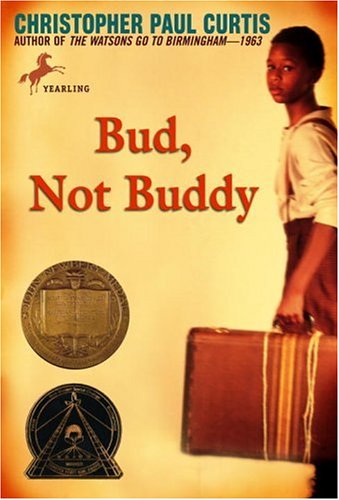
Bud, Not Buddy
Bud, Not Buddy, by Christopher Paul Curtis, is about a 10-year-old orphan boy living through the Great Depression in Michigan.  Bud's mother passed away when he was six and he never knew his father.  But in his suitcase filled with his most prized possessions, he has fliers that his mother saved over the years.  The fliers show a jazz band, and Bud's sure that his father is in that band, so he sets off to go find him.

I read Curtis' The Mighty Miss Malone earlier this year and quickly decided that I should read all of his other books, on audiobook if possible.  Bud, Not Buddy is my second Curtis book and Deza Malone even has a cameo!

I like the way Curtis writes about a black child's experience of the Great Depression.  While the Great Depression was difficult for everyone, it was particularly hard on people of color who were passed over for jobs, often couldn't own property, and were discriminated against in many ways.  I think Curtis does really well in bringing these important facts to life in ways that would make children curious to learn more and have a discussion with their parents or a teacher about how people experience the same world differently.

As with The Mighty Miss Malone, I liked how Curtis showed examples of different family structures.  Bud is an orphan but has many happy memories of growing up with a single mom.  He meets a stranger who is a proud father of a growing (and very fun) family, and a jazz band that acts as a family.  While I didn't love Bud, Not Buddy as much as I did The Mighty Miss Malone, I did enjoy learning even more about the Great Depression and am looking forward to Curtis' perspective on other important historical events in American history.


Brown Girl Dreaming
Jacqueline Woodson's memoir in free verse, Brown Girl Dreaming, is set in the 1960s and moves from Ohio to South Carolina to New York.  I did this book on audio.  I do better with poetry in audio since I don't worry so much about whether I am getting the pacing and the rhythm right.  Like pretty much everyone else, I loved it.

Woodson's stories tell of her early childhood growing up during a tumultuous time in American history, struggling with school, and falling in love with words and the art of story-telling.  I wish I had read this in physical form because the poetry is stunning.  I love the way Woodson confused facts and stories - she would hear something and then immediately incorporate that fact into a story about herself.  It wasn't lying, it was learning the art of the story, and she excelled at it.  This excerpt sums up very well the way I felt reading this book - I didn't want it to end, either:

“I am not my sister. 
Words from the books curl around each other
make little sense
until
I read them again
and again, the story
settling into memory. Too slow my teacher says.
Read Faster.
Too babyish,
 the teacher says.
Read older.
But I don't want to read faster or older or
any way else that might
make the story disappear too quickly from where
it's settling
inside my brain,
slowly becoming a part of me. 
A story I will remember 
long after I've read it for the second, third, 
tenth, hundredth time.” 


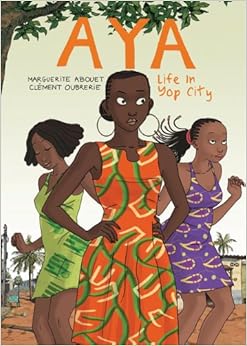
Aya:  Life in Yop City, by Marguerite Abouet and Clement Oubrerie is about 3 teenaged girls growing up in boom-time 1970s and 1980s Ivory Coast.  Aya is dedicated to going to medical school and doesn't let anything distract her from that goal.  Her friends Adjoua and Bintou, however, are more easily distracted.  The three of them deal with a lot of family drama (seriously - everything from paternity drama to secret second family drama to homosexuality and everything in between).

I am a little torn about this book.  On the surface, it's like a soap opera, with twists and turns on every level.  I don't know much at all about what life is like in a polygamous society, but it seems very complicated!  It was so interesting to learn about such a foreign culture, from the funeral parties to beauty pageant, from polygamy to witch doctors.  Everything was new to me!

On another level, though, the book touches on some really important themes.  For example, Aya wants to be a doctor, but her father just wants her to get married to some rich guy.  Aya's girlfriends seem sexually liberated and like they just want to have fun in life, but they both deal with very real consequences of their promiscuity while the men seem to get off pretty easily.  Aya's mother wrestles with the knowledge that her husband sleeps with many other women but gets very little sympathy because every man does that.  And the two gay men in the book struggle with their homosexuality and what to do, knowing that they will never be accepted.  And there are more examples of this - the beauty pageant, Aya's friend's impending marriage to a much older man, the catcalls every woman faces each time she walks down the street...


This is why I think perhaps the translation was a little lacking.  The translator did a great job of getting the humor and wit across in each panel, but it was harder for me to understand the deeper issues and social commentary that were under the current here.  Was Abouet just writing a fun drama?  Or did she have more meaningful messages that she wanted to share?  My opinion is that the latter is true (but I also probably look for feminism everywhere).  In any case, this book is worth reading just for the immersion in another culture and the fantastic, vivid art.  And, PS, it was made into an animated movie!  I'll have to try and find it (with subtitles).


Monday, September 8, 2014

Sarah Waters proves her mastery over the post-WWI creepy relationship story

It's here, it's here!  Sarah Waters' eagerly anticipated new novel, The Paying Guests, hits shelves on the 16th and is sure to skyrocket to the best-seller list pretty much immediately.  I was absolutely thrilled to get an advance copy from LibraryThing.  It took me a while to get through this book because it is pretty long and, well, summer!  But I made it through to the end and I'm confident that if you enjoyed Waters' other novels, you will really enjoy this one.

The Paying Guests is set in post-WWI London.  The economy is not doing well, the class system is starting to break down, and there are many women living without the support of men.  Frances and her mother are two of those women - Frances' two brothers died in the war and her father passed away, too, leaving an old house and a lot of debts behind him.  To make ends meet, Frances and her mother decide to take in lodgers.  Enter Mr. and Mrs. Barber, a working-class couple who seem to embrace a more carefree, Bohemian lifestyle.  But sometimes, their marriage seems just a little bit less happy than they project to the world.  And as Frances spends more time with the couple and gets to know them better, she becomes intimately involved in their lives and can't quite get away.

I really like the cover shown on this one - not only is it in line with the rest of Waters' books, but I love the sinister look of it.  The woman standing in the light, and then a man to the side, watching her in the dark.  It really does evoke the feel of this book, the unease with which the characters approach each other.

If I could liken this book to another, I think the one that comes to mind is Donna Tartt's The Secret History.  I did not really enjoy The Secret History, and I admit that there were several times during The Paying Guests when I got a little tired as well.  It just started to feel so repetitive!  And I applaud Waters for being able to keep upping the ante and the tension for a good 300 pages or so, but GOSH, I got tired of it!  I would say more, except I am pretty sure that I would be accused of putting in spoilers.  But anyway - a lot of this book is about how relationships can evolve and change and backtrack and go in circles, particularly at times of stress.  It felt quite realistic to me, but also quite painful to read.  By the end, I wasn't really a big fan of any of the characters, though I started the book really liking all of them.

What is awesome about this book, though, is Waters' amazing turn of phrase.  Here are some of my favorites:

"Their friendship sometimes struck Frances as being like a piece of soap - like a piece of ancient kitchen soap that had got worn to the shape of her hand, but which had been dropped to the floor so many times it was never quite free of its bits of cinder."

"How well she filled her own skin! She might have been poured generously into it, like treacle."

"You don't think about all the colors when everything's going all right; you'd go mad if you did. But those colors are there, all the same. All the quarrels, and the bits of unkindness. And every so often something happens to put a chip right through; and then you can't NOT think of them."

"It was like a cure, being with Lilian. It made one feel like a piece of wax being cradled in a soft, warm palm."

Note:  I received an advance copy of this book in exchange for a review.  This review is based on an advance reader's copy.

Monday, August 25, 2014

Beautiful girls in the city by the bay

Shanghai Girls by Lisa See
I think Lisa See is one of those authors that I like in theory more than I do in actuality.  The plot summaries of her books sound so fascinating!  They take place at such pivotal moments in history, in such vivid settings!  But somehow, the characters never seem to come alive for me, and I'm left vaguely disappointed.

This is pretty much what my experience was reading Shanghai Girls.  Two sisters living it up in Shanghai in the 1930s!  Then they move to the US and struggle to make ends meet through the 1940s.  And deal with the racism of the Communist scare in the 50s.  It all sounds so fascinating.  But it just didn't work for me.

The book did have its good points.  I really enjoyed learning about the high-flying lifestyle of the Chinese middle class between the wars.  I had never heard of the "beautiful girls" who posed for commercial artists in China in the 1930s, whose likenesses ended up anywhere from ads for matchsticks to (later on) propaganda for communism.  I also didn't know much about the conditions for immigration into the US in the 30s, and just how blatantly racist the system was.  It never fails to amaze me just how horribly western governments treated non-whites for so long.  And seeing just how deeply the Red Scare infiltrated people's everyday lives (especially those with a direct link to a Communist country) was eye-opening.  Really important, fascinating stuff.

But gosh, the characters did not do it for me.  The two sisters, Pearl and May, were hard to know and not very likable.  The story is told from Pearl's point of view, but she is not a very dynamic character, and it was a little boring to spend so much time inside her head.  She was scared of everything.  (Granted, much of it with good reason.)  And her sister, May, was so self-absorbed and spoiled that I didn't want to spend much time with her, either.  The other characters were fine, I guess, but didn't stand out as having distinct personalities.  Really, the book seemed to be more about all the suffering and hardship the characters went through rather than their development into strong and individual people.  This is how I felt when reading Snow Flower and the Secret Fan, too - I just felt like all the characters kept me at arm's length, and as a result, I just never felt emotionally connected to this one.

Thursday, April 24, 2014

A frothy, fun romance for the landed gentry

I read my first book by Angela Thirkell, High Rising, about four years ago and thoroughly enjoyed it.  I had a lot of trouble finding any other books by her, though, so didn't get to any further in her series.  Luckily, though, I am now part of a large library system and I was able to find the second book in the series, Wild Strawberries.

As far as I know, Wild Strawberries does not have any of the same characters as High Rising, but it has been four years since I read the previous book, so it's possible that I just don't know.  This story is set in a Barsetshire country house, where the Leslies make their home.  The eldest son in the family was killed in World War I, and Lady Emily and her husband have not quite recovered.  But it's the Roaring 20s and the younger set is happy, optimistic and bright, as many wealthy young people often are.  Mary Preston comes to stay as a companion for Lady Emily, and we hear most of the story from her point of view.

Much like High Rising, this book was high on wit and humor, and pretty light on character development and plot.  Mary was naive and silly, though her elaborate imaginings about saving her love from a fire or nobly stepping aside so that another woman could be happy were fun to read.  We didn't get to know the hero very well at all, though we were assured throughout the novel that he was a very kind, intelligent, and thoughtful man.  I think I was turned against John fairly early, though, because he said a horribly racist thing in a quite off-hand manner.  And YES, I get the whole "Oh, Aarti, everyone was racist in the 20s!  Don't hold it against them!" thing (a comment that I find extremely offensive, so please don't say it to me).  But it's hard to give your heart and soul to a character in a book when he makes it so plain that he considers you beneath him.

What Thirkell excels at is in pointing out the foibles and inconsistencies of the British upper class with gentle irony.  One of the characters decides that he is a French royalist, but we find out a bit later that in previous years, he thought himself a Bolshevik, a Communist and all sorts of other things, so we know not to take him too seriously.  Another character, David, kind of wants a job, but he just can't take himself seriously enough to find one.  And then there are the women, all so vague and unaware of their surroundings that you can't help but think they must be addicted to laudanum or something.

This was a fun and light read (except for the racist bit), and while I don't think the characters were as realistic as I'd like, and the plot was pretty shaky, it was a good way to unwind after a tough day at work.  Recommended for fans of Wodehouse.

Monday, September 16, 2013

The deepest thoughts of upper-crust Brits

Mrs Dalloway
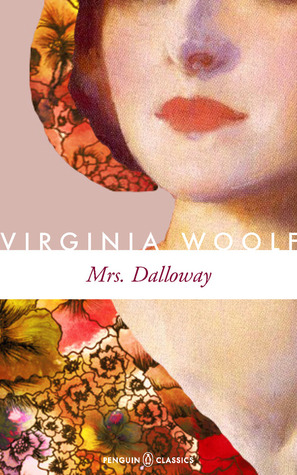
There is a lot of love for Virginia Woolf on blogosphere, but she has always been one of those authors who, for whatever reason, really intimidates me.  I decided to tackle her via audiobook first and I chose a stream-of-consciousness novel.  I am not sure if the audiobook was a good idea.  Woolf, I think, is an author who chooses each word very carefully, and reading the book while commuting was perhaps not the best way to appreciate the lovely language being employed.  Also, stream of consciousness is alright when it is one character, but when you are following a lot of characters around, it can become quite hard to follow on audio.  Alas.  These things happen.

Mrs. Dalloway is the book to which I refer.  The GoodReads summary is quite good, so I am going to steal it here:
Heralded as Virginia Woolf's greatest novel, this is a vivid portrait of a single day in a woman's life. When we meet her, Mrs. Clarissa Dalloway is preoccupied with the last-minute details of party preparation while in her mind she is something much more than a perfect society hostess. As she readies her house, she is flooded with remembrances of faraway times. And, met with the realities of the present, Clarissa reexamines the choices that brought her there, hesitantly looking ahead to the unfamiliar work of growing old.
This is mostly true as a summary, except that we are not only in Mrs. Dalloway's head, we are also in the heads of other people around her:  her husband, Richard Dalloway, who loves his wife completely but cannot tell her so; her former flame, Peter Walsh, who hasn't quite gotten over Clarissa's rejection of him years ago; Septimus Smith, suffering from PTSD and desperate to escape from his doctor.  There are so many loosely (and tightly) connected people populating this book.  I really love that premise, the idea that one person can have a huge impact on someone else without really knowing.  I also really enjoy knowing what is going on inside someone's head in addition to what they say out loud, because the two things so often are not the same.

So, really, when I think about this book in theory, I really liked it.  I like everything Virginia Woolf was trying to do here.  I enjoy leaping from one character's mind to another, from one subject to another, and from present to past.  I also really enjoyed Woolf's writing.  So much so that I don't think I will do her books as audio any more, but in print, so that I can sit and savor the words she has chosen to describe her story.

I did not love this book, though, and I am unsure of why, exactly.  Perhaps it was the audiobook.  I have found that when you are following along with stream-of-consciousness in a book, it is easy for your mind to lapse into its own stream of consciousness, and then you find that you have missed out somewhere.  Also, when you switch from one character's mind to another while with the same narrator, it can be hard to follow and know exactly who is thinking what.

That said, I feel like this is the sort of book I WOULD like, if I were in the right mood and had it in print form.  For example, it is a cold and rainy day outside today and I feel like getting cozy on my sofa with some red wine and Mrs. Dalloway would be an excellent way to spend the afternoon, if I had not just finished the book in a different format.

I don't think this review is very helpful.  I apologize for that - I have given you really no information at all about plot and characters and pacing.  But there isn't really much plot.  It's a lot of thinking by different characters, and I did really enjoy that.  I do feel my fear of Woolf was fair, though - this book wasn't exactly intimidating to read, but Woolf is clearly very intelligent and an amazing writer and I think her books deserve and warrant a lot of attention because of all the nuance, so if you plan to read her - be ready!

Monday, July 15, 2013

The naive, lonely girl gets her man

The Young Clementina
D.E. Stevenson is an author I've wanted to read for a while now.  She was a Scottish woman who wrote in the first half of the 20th century, and I had a vague sense that she would be something like Barbara Pym, an author that I've really enjoyed.

So I was quite excited to accept The Young Clementina to review, though it did take me a while to actually get around to reading it.  But that's what vacation is for!

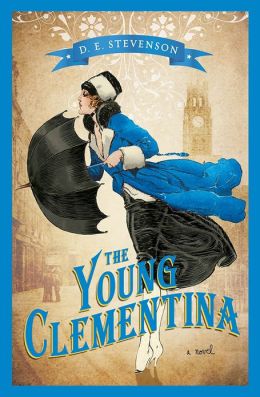
The Young Clementina is about Charlotte Dean, a lonely, poor librarian living in London after WWI.  Charlotte tells us her story - of an idyllic childhood in the country, falling in love with a handsome gentleman, Garth, and then finding that gentleman much changed after he returned from the war.  And then struggling through life when her true love married her younger, prettier sister instead of her.  But life doesn't end just because it doesn't work out the way you want it to, so Charlotte goes on with her life and then gets a jolt back to the past when Garth asks her to raise his daughter while he goes abroad.

Monday, March 18, 2013

Sam Spade's Hard-Knock Life

The Maltese Falcon
Dashiell Hammett's The Maltese Falcon is a very famous mystery written in the noir style.  It stars the cynical private detective Sam Spade, inspiration for so many hard-working, lonely detectives in novels today.  Spade and his partner are asked to help a woman find her sister, but things go wrong very quickly and Spade learns that no one is being very honest with him.  Everyone wants the Maltese Falcon, a beautiful stone bird of high value.  But no one knows where it is.  Except, perhaps, Sam Spade.

Obviously, this book has been on my radar for a long time, as it's a title that everyone knows.  I'm not sure exactly what motivated me to buy it - I think I was in a detective story phase and figured that I should read the mystery that everyone seems to know.  So I bought it and let it sit on my shelf for a couple of years and then managed to remove it from my TBR pile by renting it on audiobook from the library.

The audiobook I ended up renting was a production with a full cast and sound effects and everything!  It definitely helped me fit into the atmosphere of the book.  I felt as though I were back in the 1920s, in the golden age of radio, listening to my favorite serial on my way home from work.

There were some really great things.  For example, the book is very quotable, and the jokes are delivered in a very dry, sarcastic tone.  Also, the book just is noir.  The actor playing Spade had a very gruff voice.  He called women "sweetheart," and they responded.  He walked along the foggy streets of San Francisco.  The characters were hard to like, hard to trust, and willing to do almost anything to get what they wanted.  I can see how this story inspired so many others about cynical detectives that work for their own sense of justice, even if they're not always on the right side of the law.

While I can see why this book is so popular, I didn't love it.  To me, there were too many people for such a short book, and not one was developed fully.  We know nothing of their thoughts or motivations - only what they say and do to Spade.  It's hard for me to love a story when I don't feel any pull towards the characters.

Also, while I enjoyed the audiobook production a lot, it was a little confusing.  There were a lot of different actors, and at times it was difficult to differentiate between people's voices, particularly when there were a lot of people in the same scene.  Perhaps if it had been a longer book, I'd have had more time to learn each character's voice, but there were many characters, several had accents, and the whole book was only about 3 hours long, so there just wasn't enough opportunity.

While this isn't one for my keeper pile, I'm really glad I read it, if only to understand the mystery genre better. I hope to watch the movie adaptation, too, with Humphrey Bogart as Sam Spade!

Tuesday, September 4, 2012

Musings: Queen Lucia

Queen Lucia
Queen Lucia is E.F. Benson's first book in the Lucia and Mapp series that chronicles the lives of the upper crust in rural England.  I really loved Benson's Mrs. Ames, so I was excited to start his most famous series.  I listened to this on audiobook from the library, but it's also available for free download in the public domain from Librivox, so I'm reviewing this over at the Project Gutenberg blog.  I hope you jump over and visit as this was a great satire that really poked fun at the trials and tribulations of the rich in England.

Thursday, June 21, 2012

Musings: Al Capone Does My Shirts

Al Capone Does My Shirts
I am not sure when I first heard about Gennifer Choldenko's middle grade book Al Capone Does My Shirts.  I don't read much middle grade fiction, but the premise of this book really caught my attention.  Moose Flanagan is a 12-year-old boy growing up in the midst of the Great Depression.  His family has just moved to Alcatraz for his father's new job as electrician and prison guard.  They hope that the new job will give the family enough money to afford a new school for Moose's older sister, Natalie, who suffers from severe autism.  Maybe if Natalie gets into that school, Moose's mom will return to normal, too.

Al Capone Does My Shirts is a slim volume that deals with a lot of heavy issues.  I feel like when I was in middle school, books for young readers were written on one topic.  For instance, there would be a book about Moose's family moving to Alcatraz.  Or a different book about Moose's families money issues.  Or another about Moose dealing with his mom's depression.  And another about his sister.  But they wouldn't all be in a book together.  It's as though until recently, no one thought that kids could handle more than one difficult situation at once.  But now we all understand that kids' lives are complex, and books have evolved to acknowledge that complexity.  This is an excellent example of that evolution.

Monday, May 21, 2012

Musings: The Log-Cabin Lady

"It will probably surprise you to learn that when I was fourteen years old I had never seen a table napkin. My family were pioneers in the Northwest and were struggling for mere existence. There was no time for the niceties of life. And yet, people like my family and myself are worth serving and saving. I have known what it means to lie awake all night, suffering with shame because of some stupid social blunder which had made me appear ridiculous before my husband's family or his friends."

The Log Cabin Lady is an anonymously told American Cinderella story.  A country bumpkin goes to New York and meets a handsome blue blood.  The two fall in love and marry.  But, for Cinderella, that marks the beginning of a very difficult transition from country girl to society girl, one that caused her no end of panic and grief.

To see my thoughts on this book, head to the Project Gutenberg Project blog- hope to see you there!

Saturday, April 21, 2012

Musings: A Blunt Instrument

It is not often that I say this for a Georgette Heyer book, but A Blunt Instrument struck me (excuse the pun) as incredibly "meh."  I think it's highly unfortunate for me that one of the first Heyer mysteries I read was Footsteps in the Dark, which is one of the most hilarious novels I've ever read, and so every time I pick up another one of her books, I hope against hope that it turns into Footsteps in the Dark.  And sadly, it never does.  A Blunt Instrument, for some, may get close.  There is a very bizarre police officer who quotes cryptic, doomsday proverbs from the Bible at every turn.  There's an heir to a vast fortune who claims not to care about anything or anyone, but just wants to live his life in the generally selfish manner he chooses.  There's a mystery authoress who, for reasons I couldn't quite discern, chooses to wear a monocle.  There's a Misunderstanding Between a Couple that is in the Midst of a Great Divide.  But it just didn't work for me.

This novel centers around the murder (by a blunt instrument no one can find at the scene of the crime) of a prominent and wealthy womanizer in his own study.  It turns out the gentleman was not quite so savory, had many affairs, acted unethically in the stock market, and held other people's debts over their heads.  So really, any number of people may have wanted to kill him, though at first it seems like no one ever would.

Thursday, March 8, 2012

Musings: Diary of a Provincial Lady

Diary of a Provincial Lady
One of my favorite things about reading Diary of a Provincial Lady by E.M. Delafield was the number of references to other books that showed up in the story.  From what I can tell, the following books (many of which are now on my wish list) were referenced:

American Tragedy
High Wind in Jamaica
The Exciting Family
The Edwardians
Bulldog Drummond
Little Dorritt
The Daisy Chain
Jane Eyre
A Brass Hat in No Man's Land
Life of Sir Edward Marshall-Hall
Life of Disraeli
The Good Companions 
Elizabeth and Her German Garden

Some of those books are hard to find, particularly as authors are not always listed with the titles, but definitely on my to-read list now are High Wind in Jamaica, Bulldog Drummond and The Edwardians.

But what were my thoughts on Provincial Lady?  I don't really know.  So many people have read this book over the past couple of years in blogosphere.  The first reviewers raved about so, so then many more people had high expectations regarding it, and then they read it, too, but didn't enjoy it quite so much as the earlier reviewers.  I am in the second camp, not only because I was in the second wave of people reading this book, but also because I didn't love it the way so many before me did.

Tuesday, November 8, 2011

Musings: Why Shoot a Butler?

Why shoot a butler? cover
Georgette Heyer's Why Shoot a Butler? is different from most of the other Heyer mysteries I've read because it does not feature either Inspector Hemingway or Inspector Hannasyde.  This is not a huge loss because Heyer is one of those mystery authors for whom the detective is not the most interesting or important character.  Both inspectors are pretty forgettable and indistinguishable (strange for someone who is so sharp on characterization), and she focuses much more on the murder victim's family and friends and their dynamics.

In this outing, Mr. Frank Amberley, one of those fashionably bored and witty society types that Heyer writes so well, comes across a beautiful woman on the side of a road one night.  She's standing next to a car with a dead man in it (the butler from the title) and she's holding a gun, but she insists she did not commit the murder.  Amberley believes her, and when he tells the police about the murder, he does not mention seeing her.  He has very little faith in the police solving the murder correctly, and he comes to realize that the murder is just one part of a much larger puzzle.  As he delves deeper into the mystery, his lovely and mysterious friend seems more and more unwilling to trust him.  But as more people turn up dead, Amberley realizes it's essential to solve this mystery as quickly as possible.

Tuesday, September 27, 2011

Joint Musings: A Band of Noble Women

A Band of Noble Women
I heard about the book A Band of Noble Women:  Racial Politics in the Women's Peace Movement from Eva and was instantly interested in reading it.  We both got to read the book through NetGalley and decided to discuss our thoughts and share them with all of you in a joint review format.


A Band of Noble Women is a non-fiction book about key players in the Women's Peace Movement after WWI- a group of women internationally who wanted to ensure that war would never happen again.  As the group was comprised of women all over the world, there were many politics involved, but the US contingent in particular had to deal with the racial politics of the day and African-American women serving as delegates faced significant setbacks.  The result?  They started fighting for rights at home.  This book highlights some truly wonderful, fascinating women who did so much to fight discrimination in the world, specifically in the United States.  While the book had some severe flaws, I am grateful to have read it solely to have learned more about these strong and passionate women.

Below is Eva's half of our review of this book.  I responded to the same questions, and these are posted over on Eva's blog.  Check it out, if we've piqued your interest at all!

Friday, June 10, 2011

Joint Musings: The Blind Assassin

The Blind Assassin
In her intricately woven novel, The Blind Assassin, Margaret Atwood gives us the life story of Laura and Iris Chase, two sisters whose fates are intertwined from their first recollections to their last.  Daughters of a dissolute and extremely wealthy factory owner, both Laura and Iris are raised in the lap of luxury by their parochial mother, but when she dies, it is up to their housekeeper Reenie and Iris herself to do the job of raising the sisters, a job that their father cannot do.  While Iris is mostly a solitary young girl and woman, Laura is more flighty and taken by strange notions and beliefs that shape her consciousness and the way that she views the world, a fact that will change both her destiny and her sister’s.
Meanwhile, running concurrently with the story of Laura’s and Iris’ lives, a third story, housed within a second, is taking place simultaneously. A young woman is having an affair with a man who is on the run, and the two are forced to meet in various abodes that he has been able to negotiate. The young man begins to create a fantastic tale for the woman’s entertainment, of an alternate universe where aliens make hostile overtures, bands of a renegade tribes are on the loose, and where human sacrifice is the order of the day. The hero of this universe is the titular blind assassin, who will go to great lengths to live up to his calling. As the story of young lovers and their fantastical story moves forward, it is sandwiched between the continuing life saga of both Iris and Laura, one of whom will end up dead under mysterious circumstances, leaving the other to carry her memory.  Both fantastically imagined, and beautifully crafted, The Blind Assassin is a triumph of literary achievement from one of the world’s most beloved authors.

I read this book with Heather from Raging Bibliomania as one of our sporadic buddy reads.  We have the good fortune of picking really great, meaty books to discuss with each other, and this one was no exception!  What follows is the first half of an (heavily truncated, for the sake of spoiler-protection) email chain between the two of us, chatting about the book.  Check out the second half at Heather's blog today here.

Friday, March 25, 2011

Musings: The Door in the Forest

The Door in the Forest, by Roderick Townley, is a young adult fantasy that takes place somewhere in Europe shortly after the first world war.  Daniel is a tall, lanky boy in his early teens who physically cannot tell a lie.  He lives with his younger brother and his parents in a very small, rural town.  But strangers from town are coming through, including a fascinating girl named Emily who barely speaks.  She moves in with her grandmother, Bridey Byrdsong, a local witch.  And then the soldiers come, creating havoc and stealing a map (is it a map?) from Emily.  The villagers start getting angry, but one soldier in particular is greatly interested by the island in the forest by the village.  How do you get to it?  And what happens to you when you get there?

I've heard a lot about Roderick Townley's book The Great Good Thing, about a character in a fairy tale who decides to take her story into her own hands.  I've been wanting to read the author for a long time because he is well-regarded for his young adult fantasy.  But this book wasn't quite what I expected.

Friday, February 25, 2011

Musings: Miss Pettigrew Lives for a Day

Persephone Reading Weekend

I am so excited to participate in my first Persephone Reading Weekend (hosted by Claire and Verity)!  I have read so many reviews of Persephone books over the last few years and drooled at the sight of all those beautiful gray covers with those fun cloth designs, but alas, I have always stayed on the sidelines.  But now I am a participant!  And while it's very difficult to find Persephone editions of books here in the States, I'll keep my eye on their catalog and be sure to scan shelves for those distinctive covers, too!

My first foray into the world of Persephone was the Cinderella-esque book Miss Pettigrew Lives for a Day.  It was a fun, quick and light read through 1930s England and exactly the sort of story I wanted to read in the midst of all the stress and turmoil of final exams and my continuing search for a summer internship.

Sunday, February 20, 2011

[TSS] Musings: Clouds of Witness

Clouds
On I continue in my quest to read books that have long been on my shelves but never seem to come down.  This time around, I picked up Dorothy Sayers' Clouds of Witness, book two in the Lord Peter Wimsey series. 

It didn't take me long to remember why these books have lapsed for so long on my shelf.  I understand that it may be unpopular of me to say and I also understand that I have yet to be introduced to THE Harriet Vane and I also understand that supposedly, the first few books in this series are not all that great.

That said, I have very little desire to progress further in this series, which is unfortunate as I own I think the first five books in it.  I just don't like Lord Peter, quite frankly.

But let me start with the plot.  Lord Peter returns to England after a nice trip abroad to find news reports of his sister's fiancee murdered and his elder brother, the Duke of Denver, in jail as the accused.  He is obviously more than a little perturbed by this situation and sets off to help prove his brother innocent.  What follows is a whole lot of red herrings and then a literal play-by-play of the entire court proceedings that goes on for about 30 pages.