Showing posts with label historical fantasy. Show all posts

Friday, January 6, 2017

Intisar Khanani's Memories of Ash

I was lucky enough to get an early copy of Intisar Khanani's Memories of Ash back in May when it was first released.  I really love Khanani's work, and I fully intended to sit down and read the book as soon as I received it.  But things do not often work out as well as you wish, and I never got around to reading this book until over the Christmas long weekend.  This ended up working out for the best, though, as I had precious hours in a row to devote to reading and became fully enmeshed in the story.

Memories of Ash picks up about a year after Sunbolt ends.  It's been well over two years since I read Sunbolt and I admit that I was foggy on some of the details (and, er, major plot points).  I highly recommend that you read Sunbolt before you read Memories of Ash, and if you are the type to re-read when a new book in a series comes out, I recommend you do that, too.  I rarely do that and rely solely on memory and chutzpah to get me through, and usually it works fairly well.

Anyway, Memories of Ash begins with Hitomi living a quiet, peaceful life in the country with an older mage, Brigit Stormwind, who is teaching her how to hone her magical skills.  But soon people come for Stormwind, accusing her of treason and other trumped-up charges.  Stormwind is taken away; Hitomi leaves soon after to go and save her.  The rest of the book follows Hitomi as she sets out to accomplish this very difficult task.

One of the greatest things about Khanani as an author, at least to me, is that she rewards her characters for being good people.  So often in fiction, people are shown to be unkind or vindictive or two-faced or untrustworthy.  In Khanani's books, people are shown to be kind and supportive.  They may have different priorities or goals, but they listen to each other and attempt to understand motives.  At a time when it feels like people just talk past each other and don't really listen and are not willing to hear anything they don't want to hear, I cannot express how much I treasure this aspect of Khanani's work.

We learn more about Hitomi's past in this book, and while that knowledge adds intriguing depth and great promise to this series, Hitomi herself remains loyal, steadfast and honorable in light of everything she finds out.  She's a pretty great lead character, so it's no surprise that she makes some really wonderful friends.

In reading this book, I also understood why Khanani spent so much time writing and editing it.  Not only has she constructed a beautifully intricate world and peopled it with a diverse and fascinating cast, but she's also given all of them rich cultural backgrounds and hinted at more to come.  There are a lot of politics at play here and Hitomi has to navigate all of that in addition to trying to meet her own goals.  She has so much empathy for people, and because of that, she really tries to understand what motivates them and what would make them believe her and help her.  If this sounds like manipulation, then I am not describing it well.  Hitomi does not pray on people's fears or weaknesses, she looks for common ground.

And this is one of the reasons I love some types of fantasy and really hate others.  I prefer the premise that people are good and can see some of themselves in others, that power is a privilege that should be wielded fairly and with integrity.  I don't like fantasy that implies that as soon as someone gets power, that person becomes corrupt and savors violence or cruelty (especially towards women).  I appreciate that Khanani seems to have that same vision; most of her characters are kind and strong and stand up for what's right, even the ones with smaller roles.  And that means a lot.  So even if it takes another two years for the next installment in this series to come out, I'll count it worth the wait if it continues this excellent trend.

Thursday, April 14, 2016

The Forest and the Tower

Naomi NovikI started Naomi Novik's Temeraire series with a bang but then lost steam somewhere around the third book and never got back into it.  So I admit I was not all that excited about about her new stand-alone novel, Uprooted.  But the book got rave reviews from people I trust, so I thought I should give it a go.

Of course, the large hardcover edition came into the library just before I was off on a trip to the other side of the world.  It also came in at the exact same time as another large hardcover fantasy novel I wanted to read.  After some serious agonizing, I chose to take Uprooted with me on my trip and leave the other book behind.  And, pretty much as soon as I read the first page, I was sure I had made the right decision.

To digress for a moment, one of the reasons I get a little bit annoyed by all the love and adulation that Game of Thrones has inspired from the HBO series is that I think of Game of Thrones as a fantasy throwback.  Maybe it was of the moment when the series first started being written about 20 years ago, but now, it just feels a bit dated and outmoded to me.  The fantasy genre has evolved past the massive doorstoppers, series of 10 books each, swords and sorcery and all the rest.  I'm sure those types of books are still being written and enjoyed, but I love that the genre has expanded to include so much else, too.  And so while I really enjoyed Game of Thrones when I first started the series, I have no real desire to continue with it.  I prefer the way fantasy is now.

And that's why I think Uprooted really works for me.  While Uprooted is very firmly rooted in traditional fantasy and folk tales, it is also very much a modern novel.  The book stands on its own without two more books to follow, features a gloriously strong heroine, focuses on friendship and caring for others, and there is no objectification of women (or men).  Hooray!

My favorite thing about Uprooted is one of its key themes, the push and pull between caring for individuals and caring for populations.  How important is it to save one person when an entire group of people is at risk?  Alternatively, how easy is it to lose empathy for others if you never consider them as individuals?  I loved the way Novik explored this with Agnieska and the wizards.  Agnieska is deeply rooted to her home, her family, and the people she grew up with.  She loves them all and knows them.  In contrast, the wizards, all of whom have lived far longer than her and seen everyone they care about come and go, seem to care very little for individuals.  They care more for symbols and countries and larger beliefs.  Both beliefs make sense, and I really appreciated the way both sides played out throughout the novel.

My other favorite thing about this book was the friendship between Agnieska and her friend, Kasia.  Some readers are apparently disappointed that Agnieska and Kasia's relationship did not become a romance.  I was not disappointed by that at all; I love when authors give equal footing to friendship as they do to romance.  Friendship can be so hard to write well because it develops deeply over time.  Novik took a friendship that had existed for both girls' entire lives, and she brought so much honesty and trust and forgiveness to it.  I loved everything about how this friendship was brought to life.  It was wonderful.

There is a romance in this book, but it does not take center stage.  While I found it believable in some ways, I also don't think the male character was developed well enough for it to capture my heart or imagination.  That said, I loved the way Agnieska acted in the romance.  She never considered herself unworthy, she never considered them unequal, and even when it seemed like maybe things wouldn't work out, she went on with her life doing good things for many people.  It was excellent.

This book got me through several nights of jet lag (or perhaps exacerbated the jet lag since I was totally open to reading it at all hours of night).  I think it was a little long at the end, but other than that, it was lovely.  Exactly the sort of fantasy novel that I love; I can't wait to purchase a copy of the book for myself.  And while I know I said I'm so thrilled that this is a stand-alone novel, I also would love to jump back into this world and spend more time there.

Monday, March 7, 2016

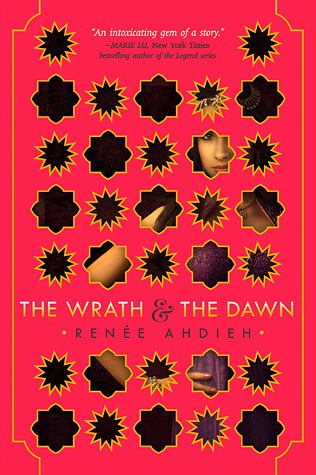
The Wrath and the Yawn

Renee Ahdieh
I was very excited to read Renee Ahdieh's The Wrath and the Dawn, pretty much entirely because I love anything based on the Arabian Nights.  Ahdieh's book got rave reviews on GoodReads, which was another good sign.  But really, it was all about the 1,001 Nights and those interlaced stories.

Which is why I was pretty disappointed when I realized that this book did not in any way center on the stories that Shahrzad tells her husband each night in an effort to extend her life.  From what I recall, we hear two stories that Shahrzad tells the caliph, which is significantly less than 1,001, I think you'll agree.  It is probably unfair of me to hold this against the book, but I definitely do.  I just really wanted all those layered stories, and I got zero layered stories.

Mostly, this book is about the dramatic love story between Shahrzad and her husband, Khalid, the caliph.  And all the heartache the two must endure.  In mostly agonizing silence.

It was difficult for me to be fair to the book after finding out that there are hardly any tales shared, especially when I also discovered that this book is, to quote Care, "more YA than the YA I usually read."  I nearly laughed aloud when, early in the novel, there was Jill's telltale sign of a YA novel, the hero tucking the heroine's hair behind her ear.  (I knew it was coming because her hair whipping around her face had been mentioned at least twice by that time.)

But there wasn't a lot of laughing in this book.  It's a lot of drama and tension around Shahrzad's Stockholm Syndrome of falling for her husband (after approximately 36 hours of marriage, from what I could tell).  She is filled with angst for loving someone who has killed so many women already, including her best friend.  At least, that's what we're told.  But as Shahrzad spends hardly any time in the book thinking about her friends or family that she left behind when she got married, it's hard for readers to feel much empathy for her situation. Once Shahrzad got married and moved to the palace, it was as though she lost interest completely in the people she left behind.   I wanted to know the people she left behind so that I could understand her guilt (which didn't last long).

It's not that Shahrzad is a weak character.  She's not.  She's fierce and stubborn and beautiful, and I can see why so many teenagers would fall completely in love with her.  But she didn't really develop as a character, we were just supposed to like her because she was independent and good at everything and didn't feel bound by the rules that usually governed women.  All of that just got tiring for me.  Shahrzad just blew either fully hot or fully cold.  Promptly after falling in love with her husband, Shahrzad switches from guilt about betraying her friends to anger with her husband for not divulging all his secrets to her.

There are other characters in this book.  Khalid, Shahrzad's husband, is also tortured and dramatic and beautiful.  His cousin and Shahrzad's handmaiden.  Shahrzad's first love, Tarak, with his piercing eyes.  (Shahrzad, in contrast, has "tiger eyes.")  Bedouins and magicians and armed guards.  I think they all could be pretty interesting people except that there is so much angst around Shahrzad and Khalid that they are not given the opportunity to develop very much.  And everyone and every moment is described in such flowery language.  It's hard to imagine 16-year-olds and 18-year-olds speaking in such a manner.  It was just a lot, and in many ways, a bit too much for me.

The Wrath and the Dawn is the first book in a duology.  I am not entirely sure if I will read the next book.  Though the story had some solid points and there is a fairly intriguing curse/mystery/magic situation brewing, I don't know if these characters are for me.  Too much hot and cold, too much too quickly, and not really enough focus on developing deeper characters and deeper emotions.

Monday, December 21, 2015

Stories within stories within stories

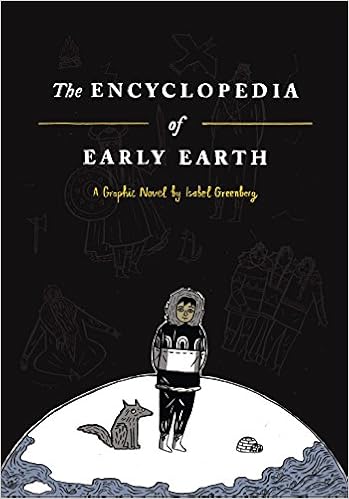
I first heard about The Encyclopedia of Early Earth from Ana.  It grabbed my attention because it's one of those layered stories, in which people tell each other stories upon stories, and they all eventually ladder back up to the main one in a gloriously onion-like manner.  (Or rose-like manner, depending on your choice of simile.)  It focuses on a boy from the far north who leaves his home in search of himself and comes across many different people.  There are gods and queens and warriors and dogs, and several wonderful stories.

The Encyclopedia of Early Earth is one of those books that truly showcases the power of story-telling.  It uses deceptively simple words to convey beauty and love and heartache.

Also, it's a comic book!  With beautiful illustrations.

I sometimes complain about books I read that just seem to tell the same story that has been told over and over again.  I particularly tire of this in the fantasy genre (seriously, how many prophecies about a Chosen One can there be?), though it's true across all genres.  But a couple of recent reads have made me realize that, actually, I have nothing against authors telling the same stories over and over again, if they tell them well.  Isabel Greenberg tells her story so well that I'm pretty convinced she could tell me her coffee was cold and I'd be utterly enthralled by the second word.

Possibly I'm still raw from reading The Shepherd's Crown and reflecting on all the horrible things that have happened in the world this year, but one of my favorite things about this book was that it was ultimately about using stories to connect, to understand that we all have much in common.  Greenberg does this with such a light touch of humor and such evocative illustrations.  I cannot recommend this book highly enough to anyone who needs a bit of comfort when life is rough.


Thursday, August 20, 2015

Gloriously diverse Regency era fantasy

Sorcerer to the Crown, by Zen Cho
If you remember my post about Zen Cho's short story collection Spirits Abroad, you'll know that I was super-stoked about Cho's full-length novel coming out, Sorcerer to the Crown.  I got an advance copy of this book through the help of fate and magic and pure luck, and so now I can tell you ALL OF MY FEELS about the novel!

I am probably the prime target for this book because:
1.  It is set in late 18th/early 19th century England.
2.  It is a fantasy novel.
3.  The main female character is half Indian, and that half is from southern India.
4.  The main male character is a former slave.
5.  The other kind-of main character is an old Malaysian woman.

Actually, now that I review the list, I feel like those are five things that would probably make ANYONE want to read this book, though I understand some people don't love fantasy and some people don't love historical fiction, and even though that is my ideal combination of all sorts of books, I know that is not the case for all of you.  In general, I feel sorry for all the amazing stories you are missing, but I get it!  I am probably missing BOATLOADS of awesome stories because I veer away from "literary fiction" and women's fiction.

Anyway, back to Sorcerer to the Crown.

The story centers on Zacharias Wythe, a freed slave with super-impressive magical abilities who, much to everyone else's chagrin, becomes Sorcerer Royal of England.  But magic seems to be leaving England, and Zacharias faces opposition and threats from everywhere, not least from some tiny island nation in the Pacific where vengeful female ghosts are attacking the populace.  Luckily, he meets a beautiful and amazingly talented woman, Prunella, who technically shouldn't practice magic but is really good at it, and the two set off to make everything better.

I admit that if I had a slight problem with this book, it was in the character development.  There are just a lot of people in this book.  And while I enjoyed spending time with both Zacharias and Prunella, and I think they were both awesome, I wouldn't say that they were fully fleshed out, complex people.  I would have liked to dig a little deeper with them.  But maybe Cho just had so much going on in terms of setting the scene and introducing the magical elements and explaining the class/gender/race relations between everyone that there just wasn't enough time to also develop the characters that well.  What I knew of Zacharias and Prunella I liked, but I hope that in future books, they are more full-fledged oil paintings than pencil sketches.

But seriously, I liked so many other things about the story!

One of my favorite things about Spirits Abroad was the way Cho infused all her stories with Malaysian culture, from using dialect to describing food to incorporating folklore and so much else.  She does the same thing here, even though the book is set in London and the main characters are not Malaysian, and I love that.  THIS IS WHY DIVERSITY IN PUBLISHING IS SO IMPORTANT.  How many people would think to combine Indian history with Malaysian folklore, add a healthy dollop of English Faerie, and then make light but awesome references to equal rights for women and people of color?  Not many.

And the feminism, it is awesome.  There so many different women, most of whom wield different sorts of power that complement and contrast with one another.  And Cho doesn't just hit you over the head with the feminism, she really just kind of pokes fun at history and pokes holes in its rules, and it's a lot of fun.  And then she also shows how women in different cultures (English, Malaysian, Indian and, er, faerie) push against their boundaries even while working within their cultures.

And then there's the race stuff, too!  I think Cho maybe could have gone further on the race component than she did, but this is a pretty light book, so I can understand why she didn't.  Suffice it to say that Zacharias (and, to a lesser extent, Prunella) never forgets that he is different, and so much of his personality and actions are informed by that fact.  He's always a complete gentleman, and utterly polite to everyone, so that no one knows just how frustrated and angry he is.  All because he doesn't want to give them any reason to remember how different he is.  It's subtly done but so powerful when you catch on.

All in all, this book is great!  I think you should read it.  And then tell your friends to read it!  Perhaps for A More Diverse Universe :-)

Note:  This review is based on an advance reader's copy.  I received an e-galley of the book in exchange for an honest review.

Monday, July 20, 2015

Steampunk computer scientists!

by Sydney Padua
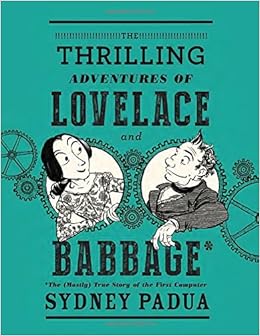
Pretty much as soon as I heard about Sydney Padua's graphic novel The Thrilling Adventures of Lovelace and Babbage, I wanted to read it.  A graphic novel set in some sort of alternate universe in which Ada Lovelace grows old and uses computers to solve crimes with her genius-but-awkward partner, Charles Babbage?  Yes, please!

I was a little overwhelmed by this book at the beginning.  There are a LOT of footnotes, basically at the rate of one per sentence.  Most of them are related to mathematical theories, historical writing, obscure (to me) Victorians, etc.  I admit I didn't read all of the footnotes (mostly because, in addition to footnotes, there are also extensive endnotes), so it's possible I missed some key action points in the book.

But honestly, I didn't really care.  This book was fun, regardless.  I love the idea of just turning Victorian society on its head and showing us that maybe some of them had well-developed senses of humor and mischievous smiles and poorly-timed snorts of derision.  I always imagine Victorians as either completely buttoned up or letting loose in bizarre ways, and I liked how Padua made the Victorians much more vivid and real and relatable.


And at the center, of course, are Ada Lovelace and Charles Babbage.  (And, to a lesser extent, Queen Victoria.)  Partly because of the sense of motion and vigor in the artwork, partly because of Padua's great sense of fun, and partly because Ada Lovelace and Charles Babbage were just amazingly larger-than-life characters, they really made the stories come alive.

But it's not all fun and games.  Well, it is.  But it's also science and math and economics and probability and so much more.  Basically, these stories are based on the premise that Lovelace and Babbage design and refine a very complex machine (the Difference Engine) that Queen Victoria would like to use to solve ALL THE PROBLEMS.


And they make many reasonable (and unreasonable) attempts to do so, or solve more mundane matters, even including a fantastic cameo by George Eliot.  But generally, they don't really make great progress.  But again, who cares?  It's so fun.

I really enjoyed everything about this book, and I learned a lot of fun history and science along the way.  It is so entertaining and just so fun to read; I highly recommend it to anyone with even a modicum of interest in Ada Lovelace, computers, technology, Victorian England, pocket universes, or anything else.

Thursday, July 16, 2015

Review-itas: Books I didn't love

Finnikin of the Rock, by Melina Marchetta, is one of those books that so many people recommended to me.  Or, I should say, Melina Marchetta is an author that many people love, and I have never read her.  But I've had Finnikin of the Rock on my Kindle forever, and I finally read it!

Or, tried to.

The book reminded me of Guy Gavriel Kay's Tigana.  It's a fantasy novel about displaced people trying to find their way home.  I really liked that part of the story - all these people, separated for years, finding each other and joining in The Quest, and trying to get home.

Unfortunately, there was also a massively inconsistent romance in the book that really annoyed me.  Sometimes Finnikin and this at-first-mute but then really talkative religious-novice (supposedly) Evanjalin are BFF, and sometimes they hate each other, and sometimes they love each other, and sometimes they want other people, and it was all just TOO MUCH for me.  Also, I thought Evanjalin was all over the place, character-wise.  So I didn't finish this one.

I did finish Karen Thompson Walker's The Age of Miracles, but that's really only because I was reading it on audiobook and I figured, since the book is about the apocalypse, that I should get to the end and see what happened to the world.

In this dystopian young adult novel, the earth's rotation is slowing.  The days are growing longer, the crops aren't growing at all, and Julia is growing up.  She's 11 years old, her best friend is moving away, and she has a big crush on a sk8r boi.

It's hard to be an adolescent at the best of times, and it's probably even harder to be one when the world is ending.  Julia goes through quite a bit of heavy stuff, but she also goes through life as a pre-teen.  She loses her best friend, she faces her parents' crumbling marriage, she tries to just be normal.  I liked the way Walker mixed the extraordinary with the ordinary to show what life could really be like in such a situation - people just keep trucking on.

That said, the book didn't really succeed for me.  Julia sometimes was far too deep for an 11-year-old.  And this was a very quiet book in many ways, which isn't exactly what I was expecting from a novel about the end of the world.  I appreciate that Walker didn't fill it with massive wars or thieving hordes, but I also wish she had done just a little bit more.

Monday, May 4, 2015

Meet Balsa, your new hero

Moribito:  Guardian of the Spirit, by Nahoko Uehashi
Moribito:  Guardian of the Spirit, by Nahoko Uehashi, is the first book in a ten-book series of which I was completely unaware.  It's set in a fantasy version of medieval Japan and centers on this amazing woman, Balsa, who is the greatest martial artist ever and who works as a bodyguard.  Her new charge is Prince Chagum, who has been possessed by a spirit.  He is being pursued by people who want to kill him and by some sort of animal who wants to eat the spirit inside him.

I am not sure how I first heard about this book, but I assume it was on a blog somewhere.  I thought it was a graphic novel, but it's not, though there is gorgeous artwork on not just the cover but throughout the story.  I also don't think I realized it was just the first in a long series, of which only the first two books have been translated into English.  Hopefully the rest are translated soon!

There were a lot of things I really enjoyed about this story.  First, it's a fantasy adventure series that features a woman as the hero, which is awesome.  Balsa is an amazing fighter who possibly enjoys fighting a little bit too much.  She has a slight romantic interest, and that man is a healer who waits patiently for her to return to him, another great example of role reversal.  A third very powerful character is an old woman.  Again - how awesome is this cast of characters?  I love the way Uehashi took what is a fairly common plot - a strong, weary person promised to help a smaller, weaker, but important person to safety - and twisted all of it around to give women and men roles they normally wouldn't get in a fantasy novel.

I also LOVED the setting.  Loved, loved, loved.  Everything felt so real, from the heavy snow in the mountains to the simple recipes.  And the way the characters interacted with each other based on class and role was so different than anything I had come across before.  It was excellent.  Uehashi wrote a novel for children and young adults but within these pages lies a lot of commentary - how facts can be embellished or erased; the power of folklore and stories; and the importance of understanding the truth, and not just listening to what people tell you.

That said, the book was not without its flaws.  The story did not flow very smoothly.  There were multiple worlds existing in the same space, which is a complicated idea to describe, and I don't know if the translator did Uehashi justice.  The description of the spirit (actually an egg) that lived inside Chagum and the animal that wanted to eat the egg were also very odd.  There were several disparate parts that were all supposed to come cleanly together at the end, but instead, it felt like cutting and pasting and the result was a little haphazard.  Hopefully the second book is better translated and easier to follow.

BUT, seriously, this book is less than 250 pages with big font and I read it on a rainy afternoon and evening.  The negatives above are, in my opinion, outweighed by the characters and the unique setting.  Check it out!

Monday, April 27, 2015

Gray London, Red London, White London, Black London

Victoria E. Schwab
I have been in a serious reading slump since February and couldn't really find any book to keep my attention.  Last week, I got a notice from the library that it was finally my turn to read V.E. Schwab's A Darker Shade of Magic.  I was in the midst of reading Shadow Scale, the second book in Rachel Hartman's Seraphina series, but the book wasn't really holding my attention, so I switched to Schwab's.  And, poof!  The slump was over!  I was immediately pulled into the universe Schwab created.

It's not that Schwab's universe is particularly ground-breaking or original, or that the story is one that hasn't been told before in different guises.  But, like the best storytellers, Schwab takes an old and used skeleton and gives it new life.  Here, she gives us four worlds, all of which center on grand cities named London.  There's Gray London, with no magic; Red London, rich with the balance between people and magic; White London, where people and magic are at odds; and Black London, which no one talks about any more.

Kell is one of only two people across the entire universe who can travel between the worlds.  He works for the royal court of Red London, sharing messages back and forth with Gray and White London.  He also has a little side business through which he illegally transports goods between the worlds.  One night, though, he is given something truly dangerous and forbidden to transport, and it sets all the worlds on edge.  And the only person who seems able to help him is Lila, an orphan in Gray London who wants nothing more than to escape her life.

In reading over the plot summary, I can't quite pinpoint why I loved this book so much.  As Care stated so well in her review of The Love Song of Miss Queenie Hennessey, sometimes you just love a book, and who cares if no one else does?  I was completely entranced by the idea of four Londons with varying amounts of magic.  I am very intrigued by the way the Londons interact with each other and how those interactions may grow in the future.  I want to understand the political structures of each place.  I loved Kell and his 25-sided coat, I am looking forward to gaining a better understanding of his background and the pact that he made to his prince, and I think Lila will grow up to be pretty badass herself.

I also appreciated that, even though this is the first book in a trilogy, the book actually had an ending.  Not a cliffhanger, but a satisfying ending.  So while I am so looking forward to the next book in the series, I am happy with where this one left things.

But really, I think this was just the right book at the right time.  So often, fantasy novels are the ones that bring me up and out of my reading ruts, and that is exactly what happened for me here.  I became so immersed in the world, so attached to the characters, and so addicted to the action that I read the book in just two nights.  That hasn't happened in I don't even know how long.  And I just LOVE that feeling.  So thanks for that, Victoria Schwab!

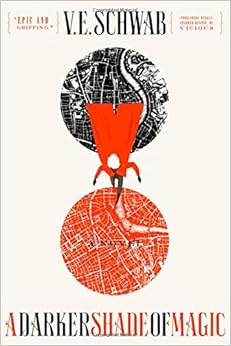
PS - The cover art for this book is SPOT ON.  I love when that happens!  I definitely think this one will be a contender for best cover art of the year.

Friday, November 21, 2014

In which I face a moral dilemma

Rat Queens
While searching for images of the comic Rat Queens online, I came across the terrible news that one of the co-creators, Roc Upchurch, was arrested for domestic violence at the end of October.  In his response to the allegations, he said that his attack was justified because she hit him first.

This is unsettling and upsetting for pretty much all the normal reasons.  But it's also hard to stomach because in Rat Queens, Roc Upchurch and Kurtis J. Wiebe created a cast of strong, no bulls*it women who approach life with a take no prisoners attitude.  So how can a man who seems to enjoy writing and drawing such amazing women also be one who seems to like to put them in their place?  It's very difficult to reconcile.

I read Rat Queens because Sharon and Andi both loved it.  And it IS a lot of fun.  It's full of swashbuckling heroines, swords for hire, lots of bar fights, and a very random cast of characters.  It's also the first comic I think I've read that probably fits most people's perception of comics (except that it features women in the main roles, so maybe not).  I admit that at first I was a little overwhelmed by all the bad language and the rest.  (To be clear, this didn't upset me because it was women swearing and doing all the rest - just because I don't usually read books that have so much of that going on.)  But the characters are so fun and the jokes so good, I got over that fast.

These four ladies are mercenaries, though.  Swords for hire.  And while fighting, they dress like this:

Rat Queens

I mean, come on.  The only one who looks remotely ready for a fight is Violet, second from the left.  And she is probably wearing knee-high stiletto boots.

Honestly, I don't know what else to say about this series.  I think it's fun to read, but I also feel like it's a lie, and that it was maybe just created because girl power is "on-trend" and that at least one of the creators doesn't really believe the message he's sending.  But maybe the other people involved really do care and want to bring great stories to life.  Should I continue reading a series written by someone who can do such horrible things and then justify them with a "she deserved it" bravado?  I don't know!  What do you do in situations like this?

Update:  Writer Kurtis Wiebe made a statement on the news and said that the series will continue on, without Roc Upchurch as illustrator.  He specifically said, "I want to write stories about women that I see in my everyday life, about friendship and to make comics that include and embrace diversity."  Sounds like a plan.  I'm on-board.

Tuesday, October 14, 2014

A lovely collection of stories set in Faerie England

The Ladies of Grace Adieu
I really loved Susanna Clarke's Jonathan Strange & Mr. Norrell when I read it years ago in college.  But probably one of the first words used to describe that novel is "uber-long."  It's a very hefty tome.  So when I heard that Susanna Clarke also wrote short stories, I admit I was a little skeptical.  Can an author who imbues her stories with so much rich detail, who develops characters and plots over hundreds of pages, also excel at the short story format?

Apparently, yes.

As the weather gets colder and the days get shorter, I always find myself drawn to fantasy novels.  Something about magic and mischief and mayhem works so well for me as I am snuggled on the sofa with a big fleece blanket to cover me.

To be fair, I read The Ladies of Grace Adieu on audiobook in my car, so there were no fleece blankets.  But the magic still worked on me!

One of my favorite things about Clarke's writing is how she is so well able to bring in the witty, elegant style that many of us associate with Jane Austen.  This style is just as present in these eight short stories as it was in Jonathan Strange & Mr. Norrell.  

The stories traipse all over England and over several centuries of history, featuring a wide and varied cast from Mary, Queen of Scots to the Duke of Wellington to a poor charcoal burner to Jonathan Strange himself.  And there are faeries!  And many well-known folktales like Tamsin and fairy tales like Rumpelstilskin.

I highly recommend this book if you enjoyed Clarke's earlier novel - the style is the same and the witty language against the sometimes dark and creepy setting is absolutely delicious to read.  And if you think you would like Clarke but are intimidated by Jonathan Strange & Mr. Norrell (and all its footnotes!), then I think this is a great way to dip your toes in and see if you are ready to tackle that book.  An excellent book for the RIP challenge and as we get into the Halloween season!

Thursday, June 26, 2014

Rapunzel, MD

Sold for Endless Rue, by Madeleine E Robins
Sold for Endless Rue, by Madeleine E. Robins, is an adaptation loosely based on Rapunzel, though I didn't even realize that until near the very end when the Rapunzel character chopped off her hair.  It is set in Medieval Italy and focuses on a female line of healers and physicians.  The second in that line, Laura, is an orphan adopted by a kind and confident healer.  Laura is very intelligent and goes on to become a physician in the city.  Her adopted daughter Bieta also wants to be a physician but struggles a lot with her studies and falls in love with a fisherman.  This angers her mother, who wants her to study only.  The fisherman is not acceptable.  Thus, Bieta's life becomes more and more limited, and then there is mention of her long hair, and that is when I realized that Bieta was actually Rapunzel and Laura was the villain.

I really love Robins' Sarah Tolerance series, set in an alternate history Regency England with an awesome fallen woman private investigator.  However, I have not enjoyed any of her other books nearly as much.  Sold for Endless Rue was fairly disappointing as well.

What I did like was the detail about medicine in 13th century Europe, and Robins making clear that women, whether as midwives, rural healers, or highly respected physicians, had a very strong and respected role in healing.  I also enjoyed reading more about the rigorous training required to be a physician in the 13th century, though there is of course the irony that the physicians spent a lot of time learning things that, I assume, did not make them much better at all than their rural healer counterparts who did not need to understand algebra and astrology to help their patients.  I do think that Robins is quite skilled at showing how women in history expanded their worlds, proving that our narrow way of assuming that all women ran homes and nothing else is false.  And even if it's mostly true, women did do a lot that we don't give them credit for.

Thursday, June 19, 2014

A Goblin in the Emperor's Court

The Goblin Emperor
Katherine Addison's The Goblin Emperor has been making waves in the fantasy world.  This is probably partly because it's written by Sarah Monette, a very popular fantasy author.  But mostly it's because people really love the story.  And yay!  A stand-alone fantasy novel!  I loved it for that reason alone.

Maia is the youngest son of the Elvish emperor, though he has never been at court.  His mother was a goblin and the emperor never liked her.  But the emperor and his three other sons all died in an airship accident, and now Maia is emperor.  This makes many people unhappy and throws all sorts of things into upheaval.  Maia navigates the complicated court, full of intrigue, alliances, and frenemies, and when he finds out that his father and brothers were victims of murder, he must also be careful of his own life.

This probably sounds like a fairly typical plot for fantasy novels.  And I guess it is, but the reason the plotline is so typical is because there is so much room to develop characters and settings and backgrounds and all the rest.  So I am not tired of it yet!

I loved that Maia was a mixed-race character taking charge of an Elvish world.  In many ways, this reminded me of Seraphina, except that in this book, everyone knew that Maia was half-goblin due to his appearance.  I think Maia's background, especially his clear love for his mother and the goblin traditions she taught him, was such a strong part of the story.  I also loved Maia's growth as a character.  He had a very painful, lonely childhood, and when he gets to court, there is just so much hostility and he's utterly bewildered.  His efforts to connect with the people around him (while dealing with the double whammy of being half-goblin and the emperor) were so well-written, and his pain when he was rebuffed or manipulated was very real.

I also really enjoyed reading about the political and social spheres in which this book is set.  There is a lot about the class structure and how it can disenfranchise the poor, homosexuality and the various ways people react to it, the role of women and how the women respond to that role, and much about tradition vs innovation in the form of a campaign to build a bridge across a very large river.  There is so much depth to the story that you could easily see Addison writing more books set in this world (prequels or sequels, really), and centering on characters in different areas and on different rungs of the economic ladder.  I think that would be such a rich and unique way of telling the over-arcing story.

I did struggle a bit with the language and the names in this book.  There is an index in the back with people's names, but they are only listed by last name and sometimes that is not the name used in the text, and so it could become very difficult to find them.  I got confused between a lot of the characters.  There are many, and their names all were very foreign to me, and so I would often have no idea who was in the conversation until I either grasped the context of the situation or found the character's name in the index.  I am not sure if this was just an issue for me, but it was a pretty big stumbling block for me, so just be ready!  It's worth the effort to struggle through, though, for sure.

I also feel like the women in this book were not given much dimension.  Granted, Maia is a man and the emperor and the world he lives in does seem to be one that separates genders quite a bit (why must this happen so often in fantasy fiction?).  But I felt like many of the men developed distinct personalities and we learned much more about their personal histories.  We never really got much of that with the female characters.

But maybe if there is another book set in this world, there will be loads of women and they will get their share of the spotlight.  I sure hope so, because this is a world that I would like to know better.  And if you are a fan of fantasy novels, then I think it's pretty likely you will enjoy this book.  So go to it!

Also, I clearly need to read some of the Monette books I already have on my shelves!

Thursday, March 20, 2014

The perils of studying dragons while wearing a skirt

A Natural History of Dragons
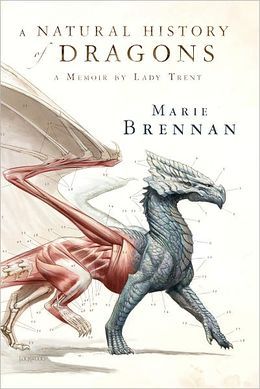
A Natural History of Dragons:  A Memoir by Lady Trent is a fictionalized account of a Victorian(-esque) woman's efforts to become a scientist of note.  The book's author is Marie Brennan.

The book is the first in a series that relates Lady Trent's life.  This book tackles the early part of her life, from her childhood spent catching sparklers and dissecting birds to her coming out and marriage, and then onto her first scientific trip to the far reaches of the world (basically an alternate Russia).  Through it, her love of dragons runs deep, though I don't quite know why she loves dragons so much.  I think because they are large and can fly.  In this world, though, dragons are just another animal - they cannot speak (at least, not to humans).  If you ever watched Discover Channel's Dragons:  A Fantasy Made Real (and if you didn't, why not?!), this is more in that tone.

This is one of those books I liked on so many levels, except perhaps the deep emotional one (which is an important level).  I love the premise, I love the setting, I love the feminism, I enjoy the narrative voice, and gosh, I like dragons.  But while I think Lady Trent is someone that I would like to know and admire greatly, she probably isn't someone that I would make an effort to see regularly.  There was just a bit of distance between us.  She is not cold, I just that I did not feel a great deal of warmth for her.  And none of the other characters were given much meat, either.  Everyone just felt quite shallow to me, and I wanted a chance to get to know them better.

That said, on an intellectual level, this book was very engaging!  There is a mystery at the center of this book - why have dragons started to attack humans in a particular region when they never did before?  And what helps to solve this mystery?  SCIENCE.  And Lady Trent is one of the people involved in figuring it out!  I can only imagine how wonderful that must have felt for her, and that came through loud and clear - when you help advance knowledge about your lifelong passion, the feelings, they are good.

I also appreciated Lady Trent's narrative voice.  She writes these memoirs when she is much older and wiser.  It's nice to see that somewhere along the way, she grew confident in her own scientific abilities and stopped apologizing for being a woman.  You can see glimpses of her just OWNING IT in the future, and I am excited to read the books about how she got there.  Even today, it's difficult to be a woman in science, and I think this would be a fantastic book for younger readers to see what a worthwhile struggle it can be.

On a side note, I am LOVING all these books about women science geniuses.  Flavia is still my absolute favorite, but I appreciate Lady Trent, too!  Anyone have any other recommendations?

Monday, March 17, 2014

Money can't buy you happiness, though it can buy you a beautiful wife

I reacted to The Brides of Rollrock Island, by Margo Lanagan, in much the same way that I reacted to the only other novel by her I have read, Tender Morsels.  It was a painful and difficult read because of the way it draws attention to gender roles and the dynamics of power.  But it was ultimately very satisfying.

The Brides of Rollrock Island is set on a very small island where everyone makes their living on the sea, and everyone knows each other.  They are not a beautiful race, but they are hardy and loyal and stick to what they know.  But one day, the short and fat and ugly witch Misskaella changes all that by bringing a beautiful woman out of a seal.  The seal woman catches sight of one of the island men and the two are locked together, the woman utterly devoted to the man, and the man truly in love with the seal-life who will never speak a word against him.  Soon, all the men want seal-wives, and the women of Rollrock leave the island to seek happiness elsewhere.  But how happy are the men with their new, obedient wives?  And how happy can a woman be, no matter how in love she might be, when she is always longing to be somewhere else?

It probably took me a week to get past the first 70 pages or so of this book.  I honestly considered just returning it to the library unfinished because it was not working for me.  But many people I trust told me that the book is so good, so I persevered.  And I'm so glad I did because this was such a rewarding read on many levels.

I think Ana does a fantastic job of explaining what it is that makes this book so good, so I will refer you to her.  There's little that I can add to her post that is more than a "Me, too!" but I will spend some time describing something that I think is an important aspect of the book and I haven't seen touched on very much before now.

Part of what makes The Brides of Rollrock Island so powerful is how quickly things become "normal."  When the seal women first make their appearance, everyone judges the men who succumb to their lust and desire, no matter how beautiful the seal woman is.  The men love the idea of a woman who will never question or nag the way that their hardy Rollrock wives do.  And so the women of Rollrock leave, to be replaced very quickly by seal-wives.  And soon enough, no one even really remembers what it was like to have other women on the island.  In fact, soon enough, people forget what it's like to have women on the island, period, who were not seals first.  And one of the most chilling aspects of this novel is how immune you become to the horror of events that you find normal (like, you know, slavery, rape, racism, violence ...).  None of the boys on the island spends a lot of time thinking about girls because there aren't any around.  The men on the island don't think anything is wrong with taking a seal from her life in the ocean and forcing her to live with him for the rest of her days, just because that is what he wants.  And there's nothing wrong, either, with selling half your fortune and most of your soul to a witch so that you can have a wife as beautiful as everyone else's, even if you never thought you wanted one in the first place.  Lanagan makes it so painfully clear that we are all creatures of habit, and how difficult it can be for one person to wake up and realize that something is not quite right.  And she does not place blame anywhere, exactly, but shows what an uphill battle we are all fighting.

I'll leave you with one quote (and I apologize, because it is a long one) that really stood out to me and made this clear:
I remembered Aran standing shocked at the cupboard door, the padlock in his hand, and all of us staring at it.  But it was not the padlock keeping the skins in the cupboard, it was what had hooked and locked it there in the first place:  the whole island's agreement.  Let us take these coats, by force or by trickery, from their rightful owners, Rollrock men had decided, and forever keep them apart.  They may have thought that this would gain them their own happiness, but they might as well have vowed, Let us all stay miserable together - dads, mams and lads alike - to the end of our days! 
And all the men had agreed this - even a man as kind as my own dad.  Against so many grown men and what they wanted, what hope did one boy have of bringing relief - of bringing maybe happiness, even! - to our poor mams, to our poor dads?

Monday, January 20, 2014

A girl's death-defying feats of courage

Keturah and Lord Death
I put Keturah and Lord Death on my Amazon wish list in 2007.  Every once in a while, I'd go through and clean up my wish list, but I never removed this book from it.  Maybe because of the beautiful title?  The very eye-catching cover?  The inference that the story just could not end well but would be a truly heart-rending, wonderful story nonetheless?  I'm not sure.

But today, I came across it on the library bookshelf.  And I read it in approximately two hours, straight through.  It took over six years for me to finally get around to it, but I'm glad I did.  While the book had some flaws in continuity and character development, those are petty standard for fairy tales and I enjoyed the lovely language Martine Leavitt used to share her story.

The story is a medieval Europe combination of folk tale and Arabian Nights.  Keturah is a beautiful teenager who gets lost in the woods one night.  Death come for her, but she pleads with him for one more day so that she can find her true love and warn her village of imminent danger.  She tells him a story, leaving him with a cliffhanger ending, promising to finish the story the next day.  He agrees.  She leaves and sets to her tasks.  The next night, he finds her and she again asks for another day as she has not yet found her love and the village is still in danger.  She continues the story, and leaves him with another cliffhanger.  He agrees to extend her life by one more day.  And so she goes home again, frantically looking for the love of her life and hoping to make life better for her friends.

Monday, December 23, 2013

End of Year Review-itas

I've gotten through more books than expected over the past couple of weeks.  One of them, A Tale for the Time Being, is worthy of its own post, but for those below - I just don't have a ton to say, so I shall combine my comments into one post for them.

The Republic of Thieves by Scott Lynch
The Republic of Thieves, by Scott Lynch:  I was excited to hear that Scott Lynch's latest installment in the Gentlemen Bastards series was finally out. I enjoyed The Lies of Locke Lamora, though I didn't love Red Seas Under Red Skies. The Republic of Thieves got off to a promising start, with all the quick wit and fantastic one-liners that really set the series apart from a lot of fantasy novels.

But it often felt as though Lynch put a lot more effort into crafting a carefully worded insult or bizarre analogy than into fleshing out the characters themselves. I got tired of all the clever banter and just wanted a plot that interested me. And honestly, there was SO MUCH DRAMA between Locke and his lady love Sabetha that I spent half the book rolling my eyes.  The two of them were so annoying, and I don't think they had much chemistry at all, though clearly Locke thinks they do.  Sabetha - who knows?  I stopped  caring after the first scene they were in together.  So rather than being excited to FINALLY meet Sabetha (for whom there was so much foreshadowing in the first two books of the series), I just dreaded any scene of the two of them together - every one would inevitably end with Sabetha taking offense and Locke groveling for her forgiveness. Ugh. No thank you.

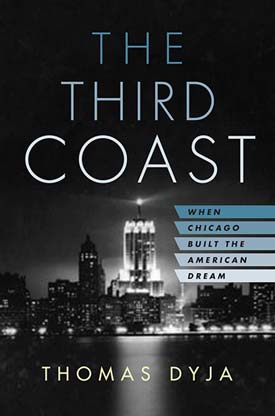
The Third Coast:  When Chicago Built the American Dream
The Third Coast:  When Chicago Built the American Dream, by Thomas Dyja, was a pretty depressing read.  It sounds very positive - America!  Dreams!  Chicago!  But it really isn't very happy at all.  As a Chicagoan, this disappointed me, but I also appreciated Dyja's very honest portrayal of my home city.  Chicago has always been known for having a very corrupt local government, and it also gained a lot of notoriety for race riots during the mid-20th century.  But it also has one of the world's most beautiful skylines, miles and miles of public lakefront property, amazing city parks and a very impressive cultural scene for a smaller city.

But, apparently, all of this was gained through an appalling system of racism, displacement, and terrifyingly horrible mismanagement.  Also, because of Mayor Richard Daley.

A lot is covered in this book, from Mies Van der Rohe's architectural aesthetic and how the Illinois Institute of Technology steamrolled entire neighborhoods to grow under Van der Rohe's guidance to Nelson Algren's sordid affair with Simone de Beauvoir and his one-hit wonder, The Man with the Golden Arm.  From the short, golden age of Chicago film and TV to the brutal murder of Emmitt Till.  There is so much here, and the overwhelming message is - Chicago is a great city, but it could have been so much greater.  And that's hard to swallow as a lifelong Chicagoan.  But it's also so important to understand your home's history and culture and how it came to be what it is now.  And just how much work there is to be done to make it better.

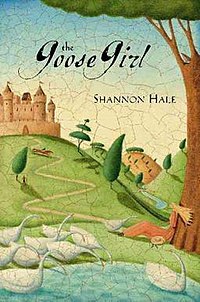
The Goose Girl by Shannon Hale
I read Shannon Hale's The Goose Girl on audiobook.  It was my first childen's audiobook and it was interesting to hear all of the music, the full cast of characters, and the very different intonations that the cast used vs what they would have for an adult reading of the book. 

I became interested in The Goose Girl after I read Thorn, a different retelling of the fairy tale.  At first, I was a little concerned with the similarities between Khanani's story and Hale's.  In both, the princess is lonely, doesn't really get along with her siblings, and is basically ignored by her mother.  She also becomes an advocate for the common people when she moves to a new kingdom.  But luckily, the books were different enough that I was able to enjoy the story once more.

I really enjoy Shannon Hale's writing, and this book was no exception.  Ani is a very nice person and the book is about her coming into her own and making friends.  It's not about her romance with the prince.  I really enjoyed that.  However, the book did feel young to me, particularly when compared with Khanani's novel, which was rich with complexity, gray areas, and many wonderful characters.

I think in future, I'll be reading many more fairy tale retellings!  I do love them, and just how rich a story a gifted author can create out of just a few pages of inspiration.

 Sandra Gulland's Mistress of the Sun has been on my shelf since it was first published.  I LOVED Gulland's Josephine Bonaparte trilogy and was so excited to get my hands on this one, too.  But not excited enough to actually read it until very recently.

Mistress of the Sun is about Louise de Valliere, a young woman sent to the court of Louis XIV (the Sun King) and becomes his mistress.  I was really hoping for a deeply personal account that also highlighted all of the goings-on at the court itself (such as the Affair of the Poisons!).  But instead, I spent a lot of time reading about Louise's relationship with horses (which I did not really care about at all) and about how guilty she felt about sleeping with the King (but it felt oh so good, too!).  I didn't think she was a strong enough character to carry the whole novel, and I didn't really like any of the other characters, either.  No one seemed to really like each other, and so the reader was always at a distance from everyone in the whole novel.  There were no real friendships at all.

I did appreciate the insight Gulland gave us into court life - it seemed rather tedious when it wasn't teeming with intrigue.  And all of the superstitions and home remedies they had for things were quite fun to read about, when not terrifying.

The book did remind me that I have Anne Somerset's The Affair of the Poisons on my bookshelf to read, so maybe some time in 2014, I will read that one :-)

I'll be off now until the new year, which I'll kick off with a 2013 Year in Review post.  Best wishes for a happy holiday week and a fantastic start to 2014!

Monday, March 25, 2013

Schoolgirls Form Clique, Discover Other Realms

A Great and Terrible Beauty
I continue my quest to make a dent in my TBR pile, often with the assistance of the Chicago Public Library's extensive collection of e-books.  I've had A Great and Terrible Beauty on my shelf since 2006.  As often happens when it takes you more than six years to read a book, I don't think this is one that I would pick up nowadays.

It's a young adult book about four teenagers in a Victorian era finishing school who find that they can do magic.  The main character is Gemma, who I guess is fine, though "not handsome enough to tempt me" into wanting to read two more books about her life.  In fact, I decided to read this book mostly so that I could get it off my shelf as I had a feeling I wouldn't be continuing with the series.  This has been confirmed.

Gemma, then.  She feels a lot of guilt over the death of her mother, has a priggish older brother, and feels very awkward and out of place in boarding school because she grew up in India (a country she despised while she was there).  But then she finds other girls who also have Heavy Weights to bear (even though they aren't very nice) and they discover magic together and things seem to improve.

So, I admit that this book set up my back from the very first because of just how ridiculous the portrayal of India and Indians was.  The very first page starts like this:
"Please tell me that's not going to be part of my birthday dinner this evening."
I am staring into the hissing face of a cobra.  A surprisingly pink tongue slithers in and out of a cruel mouth while an Indian man whose eyes are the blue of blindness inclines his head toward my mother and explains in Hindi that cobras make very good eating.
SERIOUSLY?!  Yes, because Indians eat cobras all the time and obviously, when you encounter a man with a snake on the street, you assume that he is offering to sell it to you for a meal.  I am surprised she didn't first describe him as charming it with a flute.  I am not even five sentences into the book and already I am thoroughly offended.

 And quite honestly, Libba Bray could have been outstanding from that point onward and I would probably still not forgive her.  But I don't think this book was for me.  The characters seemed very one-dimensional.  Gemma's brother is a supremely stereotypical Victorian male who thinks women shouldn't do anything but be ornaments.  Her roommate is a poor orphan who also happens to be ugly and have a stutter.  There's the cruel, beautiful girl that, for some reason, everyone wants to be friends with, and that Gemma stands up to when no one else will.  And all the girls spend a lot of time bemoaning their futures as Victorian women.  Which I get, as they always revolved around marriage and not making a fool of yourself and making sure your corset was tied tightly.  But also, I don't think that many teenagers would spend so much time thinking about how unfair it was.  I don't remember spending much time thinking about feminism when I was in high school, but perhaps I am an anomaly.

I think what originally appealed to me most about this book was that it was fantasy set in the Victorian era.  While this genre has recently exploded and we're filled to the gills with steampunk and other novels of the sort, I do think Libba Bray was one of the earlier authors to write in this vein.  So thanks to her for that!  But I just couldn't get over those first scenes in India, and the rest of the book didn't draw me in enough to make me want to continue with the series.  Perhaps if I had read this book right when I got it, I would have been swept away and pulled into the magic of it, but six years later, it wasn't for me.

Thursday, January 24, 2013

Murder, Zombies, and Courtesans in Ancient China

The Story of the Stone
The Story of the Stone is the second book in Barry Hughart's The Chronicles of Master Li and Number Ten Ox trilogy.  I read and loved the first book, Bridge of Birds (thanks again to Heather for pushing me to finally read this one a couple of years ago!), but had a lot of trouble finding the next two books in the series.  Luckily, the whole trilogy is available for $9.99 on Kindle, so I was able to get The Story of the Stone and Eight Skilled Gentlemen on e-book for my trip to India.  Hughart originally intended to write a series of seven books, but he only ever published three of them, citing differences with his publisher.  It's unfortunate for readers, as these books really are gems, but at least there are three out there for us to read!

The Story of the Stone picks up some time after Bridge of Birds ends, in "an ancient China that never was."  Master Li, a brilliant and ancient sage with "a slight flaw in his character," and Number Ten Ox, his extraordinarily strong peasant assistant are called to investigate the murder of a monk in the Valley of Sorrows, where a psychotic ruler from centuries before, the Laughing Prince, is believed to have come back from the dead to cause destruction once more.  Master Li and Ox set off to solve the mystery, picking up along the way a beautiful courtesan with no memory of most of her life and a glorious sound master who causes mayhem wherever he goes and who has quite an effect on every male he ever encounters.

Wednesday, September 26, 2012

Musings: Bayou, Volumes 1 & 2

Bayou vol 1
I have been interested by Jeremy Love's Bayou webcomic series since I first heard about it (which, admittedly, wasn't too long ago).  I decided it would be a great fit for me to read during A More Diverse Universe because it is just the sort of fantasy I want to read.  Not only is it a beautifully illustrated graphic novel, but it has a really brave young girl at its heart and addresses the very important issue of racism, particularly the myriad ways in which it can effect a society, in a highly original and truly terrifying way.

Lee lives on the Mississippi bayou with her father in the early 1930s.  Her best friend is Lily, a white girl who can sometimes be nice and can sometimes be horrible.  One day, Lee sees Lily eaten by a monster from the swamp.  When she gets home, she realizes that her beloved father has been accused of kidnapping her best friend.  After a brutal beating, he's hauled off to prison, though everyone thinks he's likely to be lynched before he even stands trial.  Lee decides that she must save her father, and sets off to the land of the monster to do so, embarking on an Alice in Wonderland type adventure steeped in Southern folklore and tradition, accompanied by a kind and haunted giant name Bayou who dreams of losing his children to shackles that rise up from the ground.

It is difficult to review these two volumes because the story is unfinished, frustratingly so.  I remember feeling similarly when I got to the end of Castle Waiting and realized that there were many loose ends that I'll likely never see wrap up.  But Castle Waiting is a light and fun read, whereas Bayou does a LOT of heavy lifting.  I ended Volume 2 still not knowing if Lee will save her father from lynching, and there were so many other questions left unanswered, too.

But if you go into this series with a willingness to embrace that ambiguity, then you'll be highly rewarded.  Bayou is one of those books that convinces readers that the comic format is a powerful force in literature that should be taken seriously by all readers.  It explodes with meaning on every page.

It's a coming-of-age story for a young girl.  It's a tale of loyalty and friendship that transcends the traditional boundaries - of a black girl trying to save her white friend, and of a strong man beaten into submission learning about courage from a tiny girl.  It's about broken families and how poverty can impact social structure.  It's about how slavery's legacy carries on for generations so that poor, uneducated little men can feel big and powerful by using cruelty against others.  It's about the power of music, the ill effects of alcohol, friends betraying friends for money, and so much more.  (There is even a very disturbing bit on natural African hair being "nappy" and the straightened, chemically treated hair being much better.)  And it's all told in such lush, beautiful pictures.


I admit that there were parts of this story I didn't get, connections I couldn't draw.  Many characters have ties that began before the story does and lives that extend from our world to the fantasy world and back again.  There are crows - called Jim Crows - that can tear a man apart.  There are bloodhounds that keep everyone submissive.  There are rabbits - and I admit I don't know the significance of these characters being rabbits, but I'm positive there's a reason.

There's really so much here and so much more to come.  The story is on so many levels that I'm positive I'm missing a few of them.  And the drawings are so evocative.  This is one of the best graphic novels I've ever come across - there is so much depth in the story, so much heart in its characters, so much horror in the situations they face, and so much that is true about their relationships.  There's nothing obvious in the story - the characters have feet of clay, and as a reader, I was so worried about little Lee and the people in whom she was forced to put her trust.  But Lee has seen and dealt with more in her ten years than I am likely to see in my lifetime, and if there's anyone who can tackle the problems that arise, it's her.


This review is posted as part of the A More Diverse Universe Reading Tour.