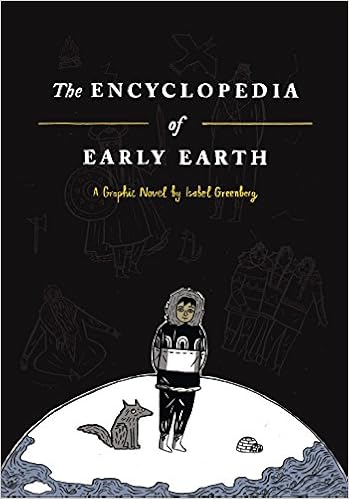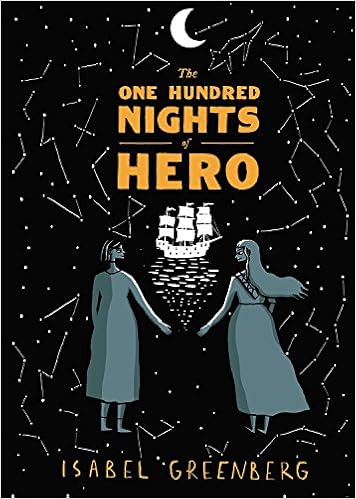
I adored Isabel Greenberg's The Encyclopedia of Early Earth, so as soon as I heard about her new book The One Hundred Nights of Hero, I put it on hold at the library. And this book was just what I needed. It's all about women being amazing, about the power of stories, about the importance of resisting, even in the face of inevitable failure, and so much more.
I debated whether I should review this book or not because it's one of those books that I just really loved because it was kind and beautiful. However, The One Hundred Nights of Hero tackles some really big topics in a gloriously feminist way. While The Encyclopedia of Early Earth was complex in its layering of stories within stories, the stories themselves were not super complicated (that I remember) and the story was centered on a man seeking love. The One Hundred Nights of Hero is centered on two women in love. Cherry is married to an imbecile who challenges his friend to seduce her in 100 nights. His friend agrees, and is pretty clear that if seduction doesn't work, force will. Cherry and her love, Hero, come up with a plan to distract the nefarious villain with stories each night. But not just any stories, stories about women and the power of knowledge and the importance of choice.
In none of these stories is there a happy ending of "Girl meets boy, girl marries boy, they live happily ever after." There are stories of love and how beautiful a thing it can be, but Greenberg always stresses that the ability of a woman to choose her fate is equally, if not more, important. Some of the stories end happily because women find ways to live independently. Many of them end sadly because the women featured in them do not fit neatly into the strict definitions that patriarchal societies have set for them.
That makes it sound as though this is a melancholy and depressing book, but it is not that at all. It's absolutely amazing. There is so much humor, so much kindness and friendship and loyalty, and glorious sisterhood. Also, the illustrations are beautiful. And then, of course, there are the stories.
It's an excellent, gorgeous book, and I intend to splurge and buy some Isabel Greenberg for myself for my birthday this year - she's absolutely worth having on your keeper shelf.
Showing posts with label folktales. Show all posts
Wednesday, February 8, 2017
Monday, December 21, 2015
Stories within stories within stories
I first heard about The Encyclopedia of Early Earth from Ana. It grabbed my attention because it's one of those layered stories, in which people tell each other stories upon stories, and they all eventually ladder back up to the main one in a gloriously onion-like manner. (Or rose-like manner, depending on your choice of simile.) It focuses on a boy from the far north who leaves his home in search of himself and comes across many different people. There are gods and queens and warriors and dogs, and several wonderful stories.
The Encyclopedia of Early Earth is one of those books that truly showcases the power of story-telling. It uses deceptively simple words to convey beauty and love and heartache.
Also, it's a comic book! With beautiful illustrations.
I sometimes complain about books I read that just seem to tell the same story that has been told over and over again. I particularly tire of this in the fantasy genre (seriously, how many prophecies about a Chosen One can there be?), though it's true across all genres. But a couple of recent reads have made me realize that, actually, I have nothing against authors telling the same stories over and over again, if they tell them well. Isabel Greenberg tells her story so well that I'm pretty convinced she could tell me her coffee was cold and I'd be utterly enthralled by the second word.
Possibly I'm still raw from reading The Shepherd's Crown and reflecting on all the horrible things that have happened in the world this year, but one of my favorite things about this book was that it was ultimately about using stories to connect, to understand that we all have much in common. Greenberg does this with such a light touch of humor and such evocative illustrations. I cannot recommend this book highly enough to anyone who needs a bit of comfort when life is rough.
Monday, December 15, 2014
Only thing soft about Tan-Tan is she big molasses-brown eyes...
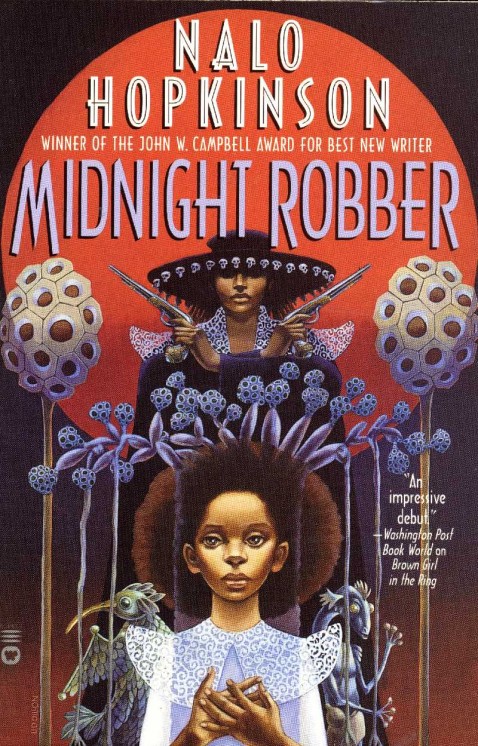
Midnight Robber is the first novel by Nalo Hopkinson I've ever read, but it won't be the last. I have had the book for a few years now but have always shied away from reading it. It's science fiction, a genre I don't read very often (but am getting more into!), it's written in dialect (patois), and, more to the point, the main character is a victim of incestuous rape.
But I finally opened up the book and read the first few pages. I was so drawn into the story that ally my qualms just disappeared. Midnight Rider is the story of Tan-Tan. After Tan-Tan's father commits an unforgivable sin during Carnival, he escapes (with 6-year-old Tan-Tan) to New Half-Way Tree. Tan-Tan must learn to adapt to survive, and so she takes on the persona of the Midnight Robber, a Robin Hood-esque, smooth-talking, vengeance-seeking rhyme master who helps people in need and punishes people who cheat.
At first, I really struggled with the dialect in this book, especially because I would read a few pages here and there during Thanksgiving week, quite distractedly. I never got into a rhythm. Finally, over this past week, I was able to read at least 50 pages at a time, and that really helped me. While I still stumbled sometimes and had to reread sentences, it was much easier, and I became much more immersed in the world Hopkinson created through the language she used.
Hopkinson's universe is based on an Caribbean culture, dominated by the African folktales and sprinkled with Indian influences. Just as I loved Aliette de Bodard's Eastern influence in her science fiction, I really, really appreciated this in Hopkinson's. Here's a universe where Carnival is the biggest holiday of the year, everyone has a helpful eshu (the trickster teacher of African tales) in her ear, and children go to bed hearing stories of Anansi and the Midnight Robber. I especially appreciated the way Hopkinson weaved her main story with folktales about Tan-Tan as the Midnight Robber. I love folktales and just ate those sections up.
I also liked the way Hopkinson progressed her story. I don't want to give too much away, but as I said at the start, Tan-Tan goes through some truly horrible stuff in her early life. Hopkinson shows how this abuse affects Tan-Tan's ability to trust other people, to form friendships, and to meet new people. For example, Tan-Tan flirts with every man she comes across because she cherishes the feeling of her being in the position of power, when she's been powerless for so long. And Hopkinson also evolves that feeling into the Midnight Robber, Tan-Tan's alter ego who is confident and witty and strong and doesn't pull any punches.
There's also a lot of symbolism in this story. There's another intelligent species on New Half-Way Tree, and the way people treat that species is much as you would expect. There's Tan-Tan's desperate need to escape from a past that keeps coming to find her. The gender bender of Tan-Tan becoming the Midnight Robber while a man waits patiently at home for her to return. The lawlessness of convict towns slowly becoming more civilized and the impact something like that has on the environment and ecosystem around those towns.
I admit that the characters in this story didn't draw me in nearly as much. Tan-Tan is the central character, and while I liked her, she kept me at a distance. Other characters come in and out of the story without any real personality or development, even when they are quite integral to Tan-Tan's life - her mother, the town doctor, her best friend Abitefa. I wish we had seen more of these characters and how they saw and interacted with Tan-Tan. But maybe Hopkinson didn't want to take away from her main character and put all the focus there. I do hope that in other books, there is more a cast of characters than just the one.
That said, the positives outweighed the negatives here. There's so much, more than enough to sink your teeth into and ponder over several nights. I'm absolutely going to read many more books by Nalo Hopkinson, and I recommend you to do the same. Especially because
Monday, October 27, 2014
Subversive Superhero
The Shadow Hero, by Gene Luen Yang & Sonny Liew, is so much fun to read. The backstory is fantastic, the Asian-American hero is wonderful, the family dynamics are great, and it seems like Yang and Liew had a blast working on it together.
The book description from School Library Journal is pretty spot on, so here it is:
Award-winning author Yang and artist Liew tackle a lesser-known aspect of history, breathing new life into the Green Turtle, a 1940s comic book hero. According to lore, the Green Turtle was originally drawn to be Chinese, but publishers quashed artist Chu Hing's plans, and Hing rebelled by drawing his hero so that his face was never visible.
The Green Turtle is cast as an unlikely 19-year-old young man, Hank, the son of Chinese immigrants who own a grocery store in 1940s America. When his mother is rescued by a superhero, the loving but overbearing woman decides that it's Hank's fate to become a hero himself, and she does everything in her power to push her son in that direction. Though Hank initially shies away from assuming the role of caped crusader, when tragedy strikes, he's eventually inspired to call himself the Green Turtle, and fight back against gangsters who have been intimidating his family and many others in Chinatown.
Liew's scratchy, action-packed illustrations have a nostalgia-tinged vibe ideal for the gritty/hard-boiled setting, and Yang plays expertly with clichés and stereotypes about Chinese culture without ever becoming heavy-handed or obvious. A detail about the four spirits of China, one of whom allies himself with Hank's father and then Hank, injects an element of magic and of Chinese history and mythology that made Yang's American Born Chinese (First Second, 2001) such a layered and complex work. - Mahnaz Dar
How brilliant does that sound? REALLY brilliant, and it delivers.
I have not been reading much lately. I am not sure what happened, but after #Diversiverse, I just couldn't find any books that kept my interest and I kept flitting from one to another. When this happens, I usually go back to the genres that I grew up on - epic fantasy and Georgette Heyer (fine, she's not a genre all her own, but she is for me). Neither of those appealed to me this time, either, so I turned to graphic novels, and hooray! Not only did it (mostly) work, but it also gave me the opportunity to read a book that everyone in blogosphere has loved.
I really enjoyed The Shadow Hero, not just because the premise is so fantastically subversive, though that's a lot of the reason. I LOVE the idea that someone stuck it to the man right in front of the man's face. But the book also has so many wonderfully realistic, self-deprecating, humorous moments.
I could talk, too, about how well-integrated Chinese culture is in the story. But honestly, it was the fun plot and the great artwork that worked for me in this story. I love books in which diverse characters shine and defy stereotypes and do awesome things. But I love them even more when they are fun and hilarious and well-illustrated. The Shadow Hero is all of those things, and I can't wait to read more.
Tuesday, October 14, 2014
A lovely collection of stories set in Faerie England
I really loved Susanna Clarke's Jonathan Strange & Mr. Norrell when I read it years ago in college. But probably one of the first words used to describe that novel is "uber-long." It's a very hefty tome. So when I heard that Susanna Clarke also wrote short stories, I admit I was a little skeptical. Can an author who imbues her stories with so much rich detail, who develops characters and plots over hundreds of pages, also excel at the short story format?
Apparently, yes.
As the weather gets colder and the days get shorter, I always find myself drawn to fantasy novels. Something about magic and mischief and mayhem works so well for me as I am snuggled on the sofa with a big fleece blanket to cover me.
To be fair, I read The Ladies of Grace Adieu on audiobook in my car, so there were no fleece blankets. But the magic still worked on me!
One of my favorite things about Clarke's writing is how she is so well able to bring in the witty, elegant style that many of us associate with Jane Austen. This style is just as present in these eight short stories as it was in Jonathan Strange & Mr. Norrell.
The stories traipse all over England and over several centuries of history, featuring a wide and varied cast from Mary, Queen of Scots to the Duke of Wellington to a poor charcoal burner to Jonathan Strange himself. And there are faeries! And many well-known folktales like Tamsin and fairy tales like Rumpelstilskin.
I highly recommend this book if you enjoyed Clarke's earlier novel - the style is the same and the witty language against the sometimes dark and creepy setting is absolutely delicious to read. And if you think you would like Clarke but are intimidated by Jonathan Strange & Mr. Norrell (and all its footnotes!), then I think this is a great way to dip your toes in and see if you are ready to tackle that book. An excellent book for the RIP challenge and as we get into the Halloween season!
Thursday, September 4, 2014
In search of the b'gwus, stability, and other hard-to-attain things
"As I drove away, I felt deeply comforted knowing that magical things were still living in the world."
Eden Robinson's Monkey Beach has been on my radar for quite a while, I think since Eva reviewed it in 2012. I finally read it, and it's wonderful. I hope you all put it on your radar but don't take more than two years to read it like I did.
Monkey Beach is set on the coast of British Columbia, in what I imagine is a majestic setting of mountains and forests and small islands. Lisamarie Hill wakes up one morning to the news that her younger brother Jimmy is missing. He was on a boat that sank and there is no word of him. Her parents leave to find him, and Lisa decides to go look for her brother, too, separately. She takes off in a small boat to Monkey Beach, where she and Jimmy grew up looking for the b'gwus (yeti) years ago. On her way there, readers are treated to flashbacks of her life. Lisa grew up under the loving care of not only her parents, but her uncle Mick, an Indian civil rights activist, and her grandmother, Ma-ma-oo, who cherishes the old ways but does not know as many of them as she wishes. She is also visited by spirits who bring her news of what is yet to come.
Oftentimes, we are told that children who grow up in happy homes become happy, well-adjusted adults. Father figures are integral to this, as well as strong mothers. Lisa grew up with very loving parents and a brother who adored her. She was close to her uncle and to her grandmother. But, as Robinson points out with great subtlety, this is not always enough. Lisa's town doesn't have much going for it - fishing is an industry, but it seems to be drying up. There's also a cannery, but work conditions there are tough. No one that Lisa knows has plans to go to college, so she sees no point in going, either. She is surrounded by alcoholism, abuse, and people who have reached dead ends. Her brother is a superstar swimmer, and everyone latches onto that as one of the few ways for Jimmy to get up and out into the larger world. Where, hopefully, he'll be treated fairly. But if patterns continue, everyone from Lisa's town will face racism and discrimination for the rest of their lives.
Lisa is very different from her brother. She believes in magical beings. She knows how to build a fire, live off the land, and tell stories. These traits are not highly valued in modern life, though, and she struggles in school. She makes friends but keeps them at arms' length. She cares deeply and completely for those she loves but does not show it. As she gets older, she isolates herself more and more from the people she needs most.
Lisa's story is a difficult one. She goes through a lot of tough times, but she's a resilient and strong character. I fell completely in love with her, though it was tough to stay with her through her internal struggles. It may be very optimistic of me, but I think if there were an epilogue to this story, it would involve her struggling (but succeeding) to get through school, tentatively starting to date a guy she should have dated long ago, and finding a way to keep the spirits at bay.
Truly, this book was beautifully written. I think some people will probably struggle with Robinson's style of writing. She goes back and forth a lot, includes some non sequitors about b'gwus and the heart, and shows us a lot more than she tells us (particularly in the last several pages). But I loved being a part of the deep and strong bonds that Lisa formed with her uncle and her grandmother, the fierce determination she had to help her brother, and her struggles to take control of her life. Highly recommended.
Monday, March 17, 2014
Money can't buy you happiness, though it can buy you a beautiful wife
I reacted to The Brides of Rollrock Island, by Margo Lanagan, in much the same way that I reacted to the only other novel by her I have read, Tender Morsels. It was a painful and difficult read because of the way it draws attention to gender roles and the dynamics of power. But it was ultimately very satisfying.
The Brides of Rollrock Island is set on a very small island where everyone makes their living on the sea, and everyone knows each other. They are not a beautiful race, but they are hardy and loyal and stick to what they know. But one day, the short and fat and ugly witch Misskaella changes all that by bringing a beautiful woman out of a seal. The seal woman catches sight of one of the island men and the two are locked together, the woman utterly devoted to the man, and the man truly in love with the seal-life who will never speak a word against him. Soon, all the men want seal-wives, and the women of Rollrock leave the island to seek happiness elsewhere. But how happy are the men with their new, obedient wives? And how happy can a woman be, no matter how in love she might be, when she is always longing to be somewhere else?
It probably took me a week to get past the first 70 pages or so of this book. I honestly considered just returning it to the library unfinished because it was not working for me. But many people I trust told me that the book is so good, so I persevered. And I'm so glad I did because this was such a rewarding read on many levels.
I think Ana does a fantastic job of explaining what it is that makes this book so good, so I will refer you to her. There's little that I can add to her post that is more than a "Me, too!" but I will spend some time describing something that I think is an important aspect of the book and I haven't seen touched on very much before now.
Part of what makes The Brides of Rollrock Island so powerful is how quickly things become "normal." When the seal women first make their appearance, everyone judges the men who succumb to their lust and desire, no matter how beautiful the seal woman is. The men love the idea of a woman who will never question or nag the way that their hardy Rollrock wives do. And so the women of Rollrock leave, to be replaced very quickly by seal-wives. And soon enough, no one even really remembers what it was like to have other women on the island. In fact, soon enough, people forget what it's like to have women on the island, period, who were not seals first. And one of the most chilling aspects of this novel is how immune you become to the horror of events that you find normal (like, you know, slavery, rape, racism, violence ...). None of the boys on the island spends a lot of time thinking about girls because there aren't any around. The men on the island don't think anything is wrong with taking a seal from her life in the ocean and forcing her to live with him for the rest of her days, just because that is what he wants. And there's nothing wrong, either, with selling half your fortune and most of your soul to a witch so that you can have a wife as beautiful as everyone else's, even if you never thought you wanted one in the first place. Lanagan makes it so painfully clear that we are all creatures of habit, and how difficult it can be for one person to wake up and realize that something is not quite right. And she does not place blame anywhere, exactly, but shows what an uphill battle we are all fighting.
I'll leave you with one quote (and I apologize, because it is a long one) that really stood out to me and made this clear:
I remembered Aran standing shocked at the cupboard door, the padlock in his hand, and all of us staring at it. But it was not the padlock keeping the skins in the cupboard, it was what had hooked and locked it there in the first place: the whole island's agreement. Let us take these coats, by force or by trickery, from their rightful owners, Rollrock men had decided, and forever keep them apart. They may have thought that this would gain them their own happiness, but they might as well have vowed, Let us all stay miserable together - dads, mams and lads alike - to the end of our days!
And all the men had agreed this - even a man as kind as my own dad. Against so many grown men and what they wanted, what hope did one boy have of bringing relief - of bringing maybe happiness, even! - to our poor mams, to our poor dads?
Monday, January 20, 2014
A girl's death-defying feats of courage
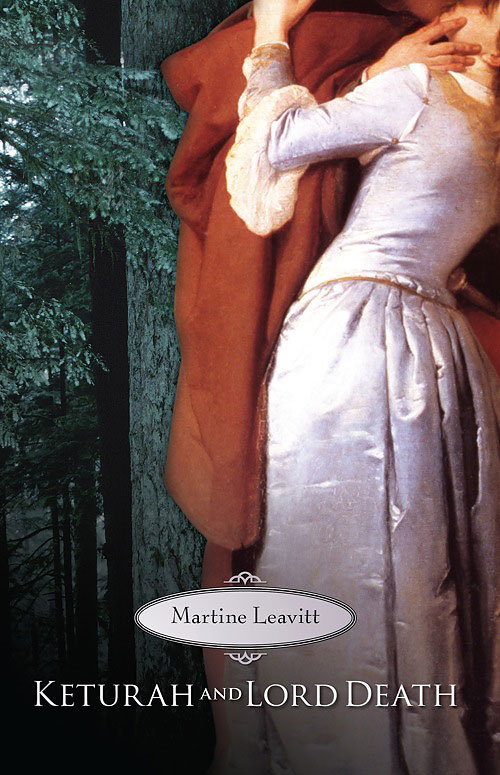
I put Keturah and Lord Death on my Amazon wish list in 2007. Every once in a while, I'd go through and clean up my wish list, but I never removed this book from it. Maybe because of the beautiful title? The very eye-catching cover? The inference that the story just could not end well but would be a truly heart-rending, wonderful story nonetheless? I'm not sure.
But today, I came across it on the library bookshelf. And I read it in approximately two hours, straight through. It took over six years for me to finally get around to it, but I'm glad I did. While the book had some flaws in continuity and character development, those are petty standard for fairy tales and I enjoyed the lovely language Martine Leavitt used to share her story.
The story is a medieval Europe combination of folk tale and Arabian Nights. Keturah is a beautiful teenager who gets lost in the woods one night. Death come for her, but she pleads with him for one more day so that she can find her true love and warn her village of imminent danger. She tells him a story, leaving him with a cliffhanger ending, promising to finish the story the next day. He agrees. She leaves and sets to her tasks. The next night, he finds her and she again asks for another day as she has not yet found her love and the village is still in danger. She continues the story, and leaves him with another cliffhanger. He agrees to extend her life by one more day. And so she goes home again, frantically looking for the love of her life and hoping to make life better for her friends.
Monday, November 25, 2013
What if religion is really just a computer program?
Alif the Unseen, by G. Willow Wilson, has a really great cover design. I love the Arabic window shape and the lettering. And the circuits! It fits so perfectly with the story, I just love it.
Let me tell you about the story so that you can see just how perfect the cover is. The back cover summary is good at sharing the plot without giving away key details, and it certainly inspired me to pick the book up, so here it is for you:
One of the key insights of Alif the Unseen is that religious texts such as the Qu'ran adapt and change with the times even without editing one word. They are a bit like computer programs, and if you can code the books into an advanced computer, then you can know everything about everyone in the world. This was very difficult for me to wrap my head around, and all the metaphors that Wilson used to try to help me understand were lost on me. I still enjoyed reading the book even without this knowledge, but I feel like I missed something important.
There were a few things about this book that I truly loved. The first was how Wilson portrayed Dina, a very religious Muslim woman. When we first meet Dina, we get the impression that she is dowdy and conservative and not a very fun or interesting or confident person. Many of us would read through the lines and assume that the lack of fun and interest and confidence was due to her beng such a religious person. But as the story goes on, Dina is just magnificent. She's strong and loyal and kind and practical, and she is all of those things without ever losing her faith and belief in her God. So often, Muslim women in books are portrayed as oppressed, as victims who allow other people to tell their stories for them. I love how Dina had her own voice and how amazing that voice was.
I also really enjoyed the challenge that Wilson brought to her readers about what we believe and don't believe. Many people believe in their religions passionately and whole-heartedly. But while they believe some things, there are others that they ignore or believe to be metaphorical. Such as burning bushes, fornicating gods, and jinns. Why is this? How can we believe that some miracles are possible but not others? Why do we accept some things on faith but require so much proof for others? We are willing to give so much of ourselves to our technology but we do not give that same trust to what we deem the guiding force in our lives.
I did not love this book completely. Alif really bothered me, and parts of the story felt clunky and too long. But I am so glad that I got to know Dina, who was such a wonderful character, and that I had the opportunity to reflect on how I read stories and internalize them and incorporate them into my life.
Let me tell you about the story so that you can see just how perfect the cover is. The back cover summary is good at sharing the plot without giving away key details, and it certainly inspired me to pick the book up, so here it is for you:
In an unnamed Middle Eastern security state, a young Arab-Indian hacker shields his clients—dissidents, outlaws, Islamists, and other watched groups—from surveillance and tries to stay out of trouble. He goes by Alif—the first letter of the Arabic alphabet, and a convenient handle to hide behind. The aristocratic woman Alif loves has jilted him for a prince chosen by her parents, and his computer has just been breached by the State’s electronic security force, putting his clients and his own neck on the line. Then it turns out his lover’s new fiancé is the head of State security, and his henchmen come after Alif, driving him underground. When Alif discovers The Thousand and One Days, the secret book of the jinn, which both he and the Hand suspect may unleash a new level of information technology, the stakes are raised and Alif must struggle for life or death, aided by forces seen and unseen.There was a lot going on in this book. Arab Spring, computer hackers, a Big Brother-type government that spies on its citizens (ahem), the idea of books as programs, religion, stories and so much more. It was a bit overwhelming, but certainly ensured that I kept reading! In many ways, Alif the Unseen reminded me of Ready Player One, though that could just be because they both involve tech nerds saving the world from large, scary conglomerates, and both of them have a lot of technical and background story that bogs them down.
One of the key insights of Alif the Unseen is that religious texts such as the Qu'ran adapt and change with the times even without editing one word. They are a bit like computer programs, and if you can code the books into an advanced computer, then you can know everything about everyone in the world. This was very difficult for me to wrap my head around, and all the metaphors that Wilson used to try to help me understand were lost on me. I still enjoyed reading the book even without this knowledge, but I feel like I missed something important.
There were a few things about this book that I truly loved. The first was how Wilson portrayed Dina, a very religious Muslim woman. When we first meet Dina, we get the impression that she is dowdy and conservative and not a very fun or interesting or confident person. Many of us would read through the lines and assume that the lack of fun and interest and confidence was due to her beng such a religious person. But as the story goes on, Dina is just magnificent. She's strong and loyal and kind and practical, and she is all of those things without ever losing her faith and belief in her God. So often, Muslim women in books are portrayed as oppressed, as victims who allow other people to tell their stories for them. I love how Dina had her own voice and how amazing that voice was.
I also really enjoyed the challenge that Wilson brought to her readers about what we believe and don't believe. Many people believe in their religions passionately and whole-heartedly. But while they believe some things, there are others that they ignore or believe to be metaphorical. Such as burning bushes, fornicating gods, and jinns. Why is this? How can we believe that some miracles are possible but not others? Why do we accept some things on faith but require so much proof for others? We are willing to give so much of ourselves to our technology but we do not give that same trust to what we deem the guiding force in our lives.
I did not love this book completely. Alif really bothered me, and parts of the story felt clunky and too long. But I am so glad that I got to know Dina, who was such a wonderful character, and that I had the opportunity to reflect on how I read stories and internalize them and incorporate them into my life.
Thursday, April 18, 2013
I can tell you're Hazara just by looking at you
Guys, I was so excited to read this book. I read the following description and pretty much requested it IMMEDIATELY:
This extraordinary book, derived from the long oral tradition of storytelling in Afghanistan, presents a mesmerizing portrait of a people who triumph with intelligence and humor over the oppressions of political dictators and an unforgiving landscape.
A musician conjures stones to rise in the air and teaches his art to a mute child. Master Poisoner, Ghoroob of Mashad, has so perfected his craft that it is considered an honor to die from his meals. These are stories of magic and wonder in which ordinary people endure astonishing extremes in a world of bloodshed and brotherhood, miracles and catastrophes.
With lyrical wit and profound simplicity, The Honey Thief reveals an Afghanistan of greater richness and humanity than is conveyed in newspaper headlines; an Afghanistan not of failure and despair, but of resilience and fulfillment.
Doesn't that sound brilliant? I was imagining Arabian Nights and The Kite Runner and all sorts of admittedly stereotypical things when I started this book. I didn't quite get what I was hoping for.
Sunday, December 23, 2012
[TSS] End of Year Review-itas
I have become quite lazy about reviewing the most recent books I've read. In an effort to get them all out there, here are some quick recaps on what I thought. Hopefully, they're refreshing - I know that usually, my reviews go on and on and on :-)
On the Map: A Mind-Expanding Exploration of the Way the World Looks, by Simon Garfield: A history of maps and how they got that way. I liked this book in theory but was very turned off by how Euro-centric it was. Garfield makes glancing references to maps from Asia, but he spends the majority of his time talking about maps by Europeans and sometimes Americans, and it started to frustrate me. And he jumped around so much from a map's creation to current debate around its accuracy to contemporary beliefs about the world. It just wasn't what I wanted to read. I didn't finish it, and am not sure if I will pick it up again.
Note: I received a complimentary galley of this book to review.
Two Old Women, by Velma Wallis: An Alaskan folk tale about two women in their 70s who are abandoned by their tribe and have to survive on their own. It's a short book and not exactly ground-breaking - the expected lessons about self-sufficiency, working even when it hurts, etc. come through here. But there's often a theme in books written before, say, 1950 or so (just to wildly throw out a date with zero reason for doing so) about people feeling so much better about themselves when they can be useful, and that comes through well here. Also a great, light introduction to Alaskan culture.
One Upon a Time Machine, by Andrew Carl and Chris Stevens: Jill was kind enough to send this book to me after she finished it because she knows how much I enjoy graphic novels and fairy tales. Once Upon a Time Machine is a collection of fairy tale and folk tale retellings set in outer space. It's a compilation of stories by many authors and illustrators, so it is inevitably hit and miss. In a Chronicles of Harris Burdick way, some of the re-imaginings were just one-page illustrations. I thoroughly enjoyed the story of Pinocchio and a few others. A good one if you like fairy tales and science fiction and graphic novels!
Bel Canto, by Ann Patchett: I must admit I don't know what all the fuss is about on this one. I did it in an audiobook format, and maybe that was the problem. But I just feel like nothing happened and then suddenly a bunch of stuff happened and then the book was over and I was just left reeling trying to figure out the consequences. Whoa, Stockholm Syndrome, you mess with people in a big way. Not sure that you will believe me when I say that this novel about a terrorist organization harboring 50+ fugitives from all over the world was very slow-moving. If you want to know more about hostage situations, I recommend watching the movie Argo instead.
Between Man and Beast: A Tale of Exploration and Evolution, by Monte Reel: A biography about Paul DuChaillu, a Victorian era explorer who brought knowledge of gorillas to the Western world. There were a lot of interesting facts presented in this book - for example, there is speculation that Victorian explorers were so high on quinine, laudanum, and other drugs all the time that their descriptions of the areas they traveled are probably hallucinatory and not completely accurate. Monte Reel parallels DuChaillu's path with the evolutionary debate in an Erik Larsen manner.
He makes some effort to bring an air of tension and mystery to the book by hinting at DuChaillu's past, but not telling us anything about it until late in the book, but this effect is spoiled somewhat by Reel not giving this late reveal much space at all, so we find out this great dark secret but know nothing about its impact on DuChaillu's life. The book does provide an eye-opening (and very disturbing) look at the way Victorians tried to use the theory of evolution to explain racial superiority. Also upsetting in the number of animals killed just for rich Europeans and Americans to see.
Note: I received a complimentary galley of this book to review. It will be released in March 2013.
Monday, November 19, 2012
Musings: Kwaidan - Stories and Studies of Strange Things
I'm over at the Project Gutenberg Project blog again today, reviewing a collection of Japanese folk tales that I really enjoyed! Come visit and see my thoughts - and of course, if you're reading books that are in the public domain, please know that we are always looking for guest posters!Wednesday, September 26, 2012
Musings: Bayou, Volumes 1 & 2
I have been interested by Jeremy Love's Bayou webcomic series since I first heard about it (which, admittedly, wasn't too long ago). I decided it would be a great fit for me to read during A More Diverse Universe because it is just the sort of fantasy I want to read. Not only is it a beautifully illustrated graphic novel, but it has a really brave young girl at its heart and addresses the very important issue of racism, particularly the myriad ways in which it can effect a society, in a highly original and truly terrifying way.
Lee lives on the Mississippi bayou with her father in the early 1930s. Her best friend is Lily, a white girl who can sometimes be nice and can sometimes be horrible. One day, Lee sees Lily eaten by a monster from the swamp. When she gets home, she realizes that her beloved father has been accused of kidnapping her best friend. After a brutal beating, he's hauled off to prison, though everyone thinks he's likely to be lynched before he even stands trial. Lee decides that she must save her father, and sets off to the land of the monster to do so, embarking on an Alice in Wonderland type adventure steeped in Southern folklore and tradition, accompanied by a kind and haunted giant name Bayou who dreams of losing his children to shackles that rise up from the ground.
It is difficult to review these two volumes because the story is unfinished, frustratingly so. I remember feeling similarly when I got to the end of Castle Waiting and realized that there were many loose ends that I'll likely never see wrap up. But Castle Waiting is a light and fun read, whereas Bayou does a LOT of heavy lifting. I ended Volume 2 still not knowing if Lee will save her father from lynching, and there were so many other questions left unanswered, too.
But if you go into this series with a willingness to embrace that ambiguity, then you'll be highly rewarded. Bayou is one of those books that convinces readers that the comic format is a powerful force in literature that should be taken seriously by all readers. It explodes with meaning on every page.
It's a coming-of-age story for a young girl. It's a tale of loyalty and friendship that transcends the traditional boundaries - of a black girl trying to save her white friend, and of a strong man beaten into submission learning about courage from a tiny girl. It's about broken families and how poverty can impact social structure. It's about how slavery's legacy carries on for generations so that poor, uneducated little men can feel big and powerful by using cruelty against others. It's about the power of music, the ill effects of alcohol, friends betraying friends for money, and so much more. (There is even a very disturbing bit on natural African hair being "nappy" and the straightened, chemically treated hair being much better.) And it's all told in such lush, beautiful pictures.
I admit that there were parts of this story I didn't get, connections I couldn't draw. Many characters have ties that began before the story does and lives that extend from our world to the fantasy world and back again. There are crows - called Jim Crows - that can tear a man apart. There are bloodhounds that keep everyone submissive. There are rabbits - and I admit I don't know the significance of these characters being rabbits, but I'm positive there's a reason.
There's really so much here and so much more to come. The story is on so many levels that I'm positive I'm missing a few of them. And the drawings are so evocative. This is one of the best graphic novels I've ever come across - there is so much depth in the story, so much heart in its characters, so much horror in the situations they face, and so much that is true about their relationships. There's nothing obvious in the story - the characters have feet of clay, and as a reader, I was so worried about little Lee and the people in whom she was forced to put her trust. But Lee has seen and dealt with more in her ten years than I am likely to see in my lifetime, and if there's anyone who can tackle the problems that arise, it's her.
This review is posted as part of the A More Diverse Universe Reading Tour.
Thursday, August 2, 2012
Musings: Green Grass, Running Water
I first heard about Thomas King's Green Grass, Running Water on Eva's blog. I put it on my wish list and looked for it every time I went to a bookstore or a library, but never found it. And then I went to the BIG library and lo and behold it was there! And so I have finally read it, and I'm so, so glad I did because this book is really, really good.
How can I describe it to you? There are four old men: The Lone Ranger, Robinson Crusoe, Hawkeye, and Ishmael. There is also Coyote. They have all escaped from a mental institution together. For the 37th time. One at a time, they tell Coyote a creation story. Coyote interrupts, and as each man tells his story, we cut across to other people's lives in the modern day- "strong, sassy women and hard-luck, heardheaded men, all searching for the middle ground between Native American tradition and the modern world." As the story progresses, all the characters move closer and closer towards the Sun Dance at their childhood home of Blossom, which is where (drum roll, please) the climax happens.
I really didn't do the book any justice above, and so you will just have to trust me on its worthiness and add it to your wish list or TBR or Purchase Immediately pile based on your innate trust of my taste in books.
Thursday, July 19, 2012
Musings: Where the Mountain Meets the Moon
I'm on a quest to read more fantasy novels written by people of color. I love the genre but dislike the stereotyping that is so prevalent within it. As usual, I am not entirely sure how I first heard about Grace Lin's Where the Mountain Meets the Moon, but it went straight onto my wish list. And I was so excited to learn that the Chicago Public Library offers it as a digital download audiobook.
In retrospect, I wish I had read this book with my eyes, not my ears, because I've since realized that the accompanying illustrations are stunning. But the story stands very well on its own, too. Minli is a young girl growing up in a poor village that sits in the valley of Fruitless Mountain. Every day, she and her parents and neighbors work very hard to plant their rice and till their fields, but their struggles never seem to end. (In a wonderful instance of book serendipity, I am concurrently reading Charles C. Mann's 1493, and he spends quite a bit of time describing the droughts that plagued China for years and could very well be the time period for this book.)
Anyway, the bright spot in Minli's day is storytime with her father. Each evening, she escapes to a wonderful history of dragons and gods, greedy magistrates and kind villagers. But at the same time, she hears her mother's constant worries about money. Inspired by the stories and by a chance encounter with a fish seller, Minli sets off on a quest to change her family's fortune. Along the way, she makes new friends, learns important lessons, and hears important stories, all of which are a treasure for readers.
Monday, April 2, 2012
Musings: The Virago Book of Fairy Tales
I first heard about the Virago Book of Fairy Tales (my copy was called The Old Wives' Fairy Tale Book) from Ana in a comment on my review of Trickster. In that review, I said that I enjoyed Trickster, but was unhappy that so many of the stories related did not portray women in a very positive light. Ana pointed me towards Angela Carter's more women-centric book of folk tales and fairy tales, and I quickly got the book from the library to read.
And, as Ana promised, the book is much more interesting and nuanced in its portrayal of women because, well, that was a significant motivating factor in compiling the book. The stories also come from peoples and cultures all over the world, from Native Americans to West Africans to Eskimos to Europeans, so it was really fascinating to see the different cadences and rhythms and themes that emerged from them.
Sunday, February 12, 2012
Musings: Trickster - Native American Tales
I finally used the University of Michigan library system! The undergraduate library is a really swanky library and has a browsing collection and just happens to be on my walk to the business school. I stopped in today and snatched up three books, all of which I've wanted to read for some time, so it was a very successful trip.
One of the books I got and immediately delved into was Trickster: Native American Tales - A Graphic Collection. I've wanted to read this book for quite a while, and was so thrilled to find it waiting for me at the library. (Isn't it awesome how libraries manage that?) Trickster is a compilation of many Native American folk tales, shared by storytellers of several different tribes and then put into the graphic novel format by artists the storytellers chose themselves. Some of the stories have morals, some explain natural occurrences, some teach lessons and some are just entertaining.
Saturday, April 30, 2011
Musings: Outlaw
Angus Donald's Outlaw is his first novel in a new series about Robin Hood. I realized when reading this book that I don't actually know much about Robin Hood at all. I remember some characters' names from the BBC series, but that's pretty much it. I also had this vague and completely baseless notion that Robin Hood and his Merry Men were similar to King Arthur and his Knights of the Round Table, but that is (unsurprisingly) quite false. But both Robin Hood and King Arthur are men steeped in legend- all sorts of stories abound about them and their deeds even as people have trouble proving that either of them actually existed.
In Angus Donald's mind, Robin Hood is the head of what seems to be a medieval Mafia. He offers villagers protection from the sheriff and dangerous criminals. In return for a fee. That's how Alan Dale ended up with Robin's men. He stole from a pie vendor and his mother asked Robin Hood to protect her son. Robin agreed and Alan never looked back. The story is told in a pretty typical flashback- the now old and lonely Alan Dale is relating his younger exploits on paper for the world to see.
Friday, April 22, 2011
Musings: Red Branch
There are some books that stand out to you on the shelf one day, and you have no idea why. What is it about a book that can make it sit patiently on your shelf for years before finally your eyes glance at it and decide it's the one you want to read next? Often, I don't know. In this case, though, I know exactly why I picked this book up!
While reading Hawk of May, I noticed many allusions to a mythological Irish hero, Cuchulain and the Red Branch warriors. I remembered that I had a book called Red Branch by Morgan Llywelyn (who is nothing if not Irish) and started browsing my shelves. Sure enough, there it was on my shelf! Where it has been waiting for me, according to LibraryThing, since at least 2006. (I only opened my LibraryThing account in 2006, though, so maybe it has been on the shelf even longer...) So I finally picked it up to learn more about a group of warriors who were mythical even in King Arthur's time.
Sunday, February 6, 2011
Musings: Silverlock
Silverlock is the story of A. Clarence Shandon, a good-looking, cynical man from Chicago in the 1940s. On a sea voyage, his ship is wrecked and he is saved only through the help of a man named Golias, who helps him onto a raft and takes him, with a few stops on the way to the Commonwealth of Letters. There, Shandon goes on a wide variety of adventures, meeting beautiful women, laughing giants, brooding princes and all sorts of others. His journey takes him to the depths of Hell and back out again, and along the way, he becomes a brighter, better person who calls himself Silverlock.
I am not sure where I first heard about this story. It gets great praise on the cover, with people calling it "the stuff of wonder" and "bigger than life." And, of course, "a masterpiece." It's on quite a few lists of best fantasy stories. But what really drew me to the book is its premise. One of the beautiful women Shandon meets is Circe. The laughing giant is the Green Knight who confronts Sir Gawain. The brooding prince in Hamlet. There is also Robin Hood, Don Quixote and Dante. References to Paul Bunyan and the Alamo. Beowulf makes an appearance, as does Oedipus.
Subscribe to:
Posts (Atom)