Showing posts with label dark fantasy. Show all posts

Monday, November 28, 2016

"There's more hunger in the world than love." - Monstress, Volume 1

In case you thought I only reviewed books about gloom and doom in America, DON'T WORRY.  I also review books about gloom and doom in fantasy worlds!  And Monstress, by Marjorie Liu and Sana Takeda, is a SUUUUUUUUPER good fantasy comic about gloom and doom.

I had never heard of Monstress before.  I went to an indie bookstore for Small Business Saturday, and after we finished at the bookstore, my brother-in-law asked if we could go to a local comic bookstore, too.  I said yes.  I admit that I usually find comic bookstores quite intimidating, but the people at the one I went to were so nice!  And they had this wall of best-selling comics, and it thrilled me to see how many of those best-sellers were ones that featured women.  So of course, I felt the need to support both the indie store and female empowerment, and I purchased this book.

I don't know if I would have picked up Monstress if I had known how violent it is.  Or how many dark subjects it tackles.  But I'm so glad I didn't know those things and picked it up because it was SO GOOD!

(I hope that you are not the same as I am and that knowing the book is violent and dark will not drive you away from it, because that would be a mistake.)

Monstress is about many things, and I admit that I am vague on a lot of the details because it was also a bit confusing.  But it doesn't really matter because it is amazing.  The artwork is absolutely stunning, and brings to life a world that is complicated and can be difficult to grasp.  Takeda puts a huge amount of detail into each panel.  The dark color scheme she uses perfectly captures a world in the midst of an endless war.  The rich detail in the panels shows the level of sophistication that the civilizations have reached, and the trade-offs between culture and war (and how one can often drive the other).  The characters are all beautifully drawn, including a SERIOUSLY ADORABLE little fox named Kippa.  Honestly, I feel like a lot of people will judge me for this, but I generally don't find animals that fascinating.  Like, I know that puppies and kittens are sweet and cute, and I like looking at them sometimes, too, but I don't get squealy and excited or feel the need to pet them.  But Kippa just stole my heart, mostly because of how vulnerable and sweet she was, and how she would hold her tail for security like a blanket.  It's a little strange at first to see these doll-like faces (Kippa is not the only one with the perfect, adorable face) on such fierce characters, but hey, heroines come in all forms.


The artwork is great, but when you combine it with the story and the characters, the whole effect is quite pleasing.

I cannot believe I have gotten this far in my review without mentioning that this comic series is all about women.  There was probably one main male character in this story (and possibly a male cat, but I'm not sure of the cat's gender).  All the "good guys," all the "bad guys" - none of them are guys at all!  And it's not a story that's obviously about women the way Lumberjanes is.  (Though being obviously about women is totally fine, too!  I was just making a comparison in that Lumberjanes is more vocally about women and the role of women vs Monstress is about the story and features women and the fact that it features women is the statement.)

I used to read a lot of epic fantasy, the multi-volume, 500+-page per volume variety that focused a lot on building a world and a lot on sharing that world's history and a lot on character development.  I would say that Liu is a pretty amazing epic fantasy storyteller.  She populates her world with a complex group of characters, none of whom have clear motivations or loyalties or goals (except the adorable Kippa!  She's perfect in every way!).  The main character is Maika, who is clearly very, very powerful but who also has a monster living inside her.  Maika is trying to learn more about her past and who she is, but she has blackout moments when she must feed this monster inside of her.  (With, er, people.)  She tries to fight it, but, well, it's a monster (artistically rendered as a lot of tentacles and eyes), and that's hard work.


The monster at first seems like a straightforward villain, but as you get deeper into the story, you realize the monster also is confused and unsure of what to do.  Maika works hard to make the right decisions for herself, and the monster works hard to make the right decisions for itself, but the two have to work together to do what is best for both of them.  Hopefully, anyway, as no one really knows what is the best course of action.  Even at the end of this book, it's unclear whether Maika is being hunted so that people can harness her power or so that she can be killed.

I mentioned a long, on-going war.  There is one, and it's about one race exploiting another race for power.  This seems pretty standard for a lot of fantasy and science fiction novels, but it's still a very important storyline to drill into people's heads, and I liked Liu's take on it.  She has a lot here to develop and nurture over the course of the next several volumes, and I can see this becoming a very rich and rewarding series.

Thursday, February 5, 2015

Secrets of a xenophobic house in Dover

White is for Witching by Helen Oyeyemi
I think maybe I am not quite smart enough for Helen Oyeyemi.  I am always so enthralled with her, and so proud of myself for (I think) understanding some of the symbolism, drawing the links and conclusions I should be drawing, understanding some of the story line that she hints at but doesn't quite tell us.

And then I get to the last 10-20 pages of the book and am just completely lost.

This happened to me with Boy, Snow, Bird, and it has happened again with White is for Witching.  Luckily, based on a quick Google/blog search, it looks like many other people were also confused by White is for Witching, so at least I am in good company.

I found this book utterly absorbing, even as I had a feeling I was reading on a different plane than the one on which Oyeyemi was writing.  This is a rich and beautifully written story about grief and loss, about the walls we build to make us feel safe and how those walls can turn on us.  There are four narrators of this story, one of whom is a deliciously creepy and unreliable house.  Honestly, I love any book with an unreliable narrator.  I also like books with multiple narrators.  So Oyeyemi had me hooked pretty quickly.

I would try to tell you what this book is about, but I'm not sure I know.  These are the facts:

  • Lily Silver died in Haiti, leaving her husband, Luc, and teenaged twins Eliot and Miri behind.
  • Luc runs a B&B in Dover.  It's hard to keep help because people are very frightened of Miri and (mostly) of the house itself.
  • Miri doesn't eat real food, she just chews on chalk and plastic, and she just got out of the hospital.  She looks very thin and nothing at all like herself.
  • Miri gets into Cambridge and she meets this amazing girl, Ore, there.  Eliot (supposedly) goes to South Africa.
That's pretty much all I can say with certainty about this book, though it is rich with so much more.  I really love Oyeyemi's way of weaving commentary about current events and perceptions into her books.  For example, in White is for Witching, the creepy, evil house is highly xenophobic and very racist, working desperately hard to kick out anyone who isn't white from the house, including the help, the houseguests, and Miri's friend Ore.  This is paralleled by the Kosovan refugees in Dover and Ore's experiences feeling like a complete outsider at Cambridge.

The story also details the deep grief that Luc, Eliot and Miri feel at the loss of Lily (who probably was trying to escape the house, too.  The house likes to kick out certain people but also works really hard to keep others in).  Luc buries himself in his work and makes elaborate, beautiful meals that he hopes and prays that Miri will eat and enjoy (she does not).  Eliot tries to distance himself from his twin sister but finds that he misses her deeply.  And Miri, poor Miri, feels like she is turning into her mother (or her grandmother, or her great-grandmother), losing her own memories.

And then the end of the book comes and I have no idea what happened.  What did Ore do with the salt and the skin?  Did it work?  And why did Sade leave?  Did she do anything to help?  And is Miri now part of the house, or did the house reject her, or what?  WHAT HAPPENED?

So, basically, I have no idea.  But I still thought this book was really well-written and maybe I am just not meant to understand the endings of any Oyeyemi book.  Definitely read this if you like Shirley Jackson!  Or if you like unreliable narrators!  Or if you want to a book to force you to think and wonder but not quite know.

And, er, maybe don't read it right before going to bed like I did.

Thursday, December 4, 2014

Lord of the Flies, in pretty, minuscule watercollor

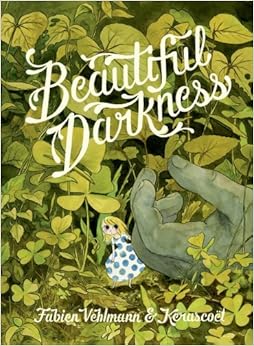
Beautiful Darkness
Like pretty much everyone else who saw Elizabeth's review of Beautiful Darkness, by Fabien Vehlmann and illustrated by Kerascoet, I immediately had the book on my radar.  Luckily, the library has the book and I just got to read it.  And, as Elizabeth says, it is SO CREEPY.

This book is what I remember of Lord of the Flies, all the way down to the dead person offering no help, decaying as the civilization around her decays.  A population of small people is somehow whisked away from their fairy tale-esque life of balls and hot chocolate and happiness and dropped into a wild, foreign place with no one to help them.  At first, they all try to help each other under the leadership of Princess Aurora, who works hard to make sure everyone has what she needs.  But not everyone wants to work, and not everyone is created equal.  People commit horrible acts and then go on with their days as though nothing has changed.  And through it all, Princess Aurora works to make things better.

As Elizabeth stated in her review, this is a book that stays with you long after you finish reading it.  not only due to the scary things that happen in its pages but also because of the juxtaposition of those horrible things and the beautiful, almost idyllyic scenery in which they happen.  Like in Joseph Conrad's Heart of Darkness, everyone here reverts to their baser selves, focused on primacy and power.  This is humanity with a veneer of civilization but with gloves off and claws out.

I had a lot of trouble finding a page of panels to share in this review because I don't want to give too much away.  I already feel like maybe I did, with my references to Lord of the Rings and Heart of Darkness.  If you are anything like me, those two comparisons may be enough to send you running in the other direction.  I didn't much care for those books when I read them - they were too raw and visceral and overt.  But now that I've read Beautiful Darkness, I think that the overtness was fine.  In this book, the in-your-face selfishness of humanity seems so at odds with the waif-like, adorable characters that it really gets in your head!

And that's all I'll say.  If you happen to be somewhere in the world where there is lush greenness around you, I highly recommend you to read this book outside - I bet you won't look at birds and bees in quite the same way for at least a few days afterward.  If you're in the midst of winter like I am, then read it in front of a warm and cozy fire with a cup of hot cocoa - you'll need it.

Monday, November 25, 2013

What if religion is really just a computer program?

Alif the Unseen
Alif the Unseen, by G. Willow Wilson, has a really great cover design.  I love the Arabic window shape and the lettering.  And the circuits!  It fits so perfectly with the story, I just love it.

Let me tell you about the story so that you can see just how perfect the cover is.  The back cover summary is good at sharing the plot without giving away key details, and it certainly inspired me to pick the book up, so here it is for you:
In an unnamed Middle Eastern security state, a young Arab-Indian hacker shields his clients—dissidents, outlaws, Islamists, and other watched groups—from surveillance and tries to stay out of trouble. He goes by Alif—the first letter of the Arabic alphabet, and a convenient handle to hide behind. The aristocratic woman Alif loves has jilted him for a prince chosen by her parents, and his computer has just been breached by the State’s electronic security force, putting his clients and his own neck on the line. Then it turns out his lover’s new fiancĂ© is the head of State security, and his henchmen come after Alif, driving him underground. When Alif discovers The Thousand and One Days, the secret book of the jinn, which both he and the Hand suspect may unleash a new level of information technology, the stakes are raised and Alif must struggle for life or death, aided by forces seen and unseen.
There was a lot going on in this book.  Arab Spring, computer hackers, a Big Brother-type government that spies on its citizens (ahem), the idea of books as programs, religion, stories and so much more.  It was a bit overwhelming, but certainly ensured that I kept reading!  In many ways, Alif the Unseen reminded me of Ready Player One, though that could just be because they both involve tech nerds saving the world from large, scary conglomerates, and both of them have a lot of technical and background story that bogs them down.

One of the key insights of Alif the Unseen is that religious texts such as the Qu'ran adapt and change with the times even without editing one word.  They are a bit like computer programs, and if you can code the books into an advanced computer, then you can know everything about everyone in the world.  This was very difficult for me to wrap my head around, and all the metaphors that Wilson used to try to help me understand were lost on me.  I still enjoyed reading the book even without this knowledge, but I feel like I missed something important.

There were a few things about this book that I truly loved.  The first was how Wilson portrayed Dina, a very religious Muslim woman.  When we first meet Dina, we get the impression that she is dowdy and conservative and not a very fun or interesting or confident person.  Many of us would read through the lines and assume that the lack of fun and interest and confidence was due to her beng such a religious person.  But as the story goes on, Dina is just magnificent.  She's strong and loyal and kind and practical, and she is all of those things without ever losing her faith and belief in her God.  So often, Muslim women in books are portrayed as oppressed, as victims who allow other people to tell their stories for them.  I love how Dina had her own voice and how amazing that voice was.

I also really enjoyed the challenge that Wilson brought to her readers about what we believe and don't believe.  Many people believe in their religions passionately and whole-heartedly.  But while they believe some things, there are others that they ignore or believe to be metaphorical.  Such as burning bushes, fornicating gods, and jinns.  Why is this?  How can we believe that some miracles are possible but not others?  Why do we accept some things on faith but require so much proof for others?  We are willing to give so much of ourselves to our technology but we do not give that same trust to what we deem the guiding force in our lives.

I did not love this book completely.  Alif really bothered me, and parts of the story felt clunky and too long.  But I am so glad that I got to know Dina, who was such a wonderful character, and that I had the opportunity to reflect on how I read stories and internalize them and incorporate them into my life.

Monday, May 9, 2011

Musings: Best Served Cold

Best Served Cold
Joe Abercrombie's Best Served Cold is a (very long) novel about, unsurprisingly, revenge.  It is a stand-alone book set in the same world as his First Law Trilogy that I read about a year ago.  One of my best friends gave me the book to borrow an unconscionably long time ago, and I never had the nerve to pick it up.  I wasn't ready for 600+ pages of massive hardcover in Joe Abercrombie's signature style, which is comprised of brutality, cynicism and a lot of regret.

I finally picked the book up and read through it almost without pause.  If you want to read this book, I would avoid this method because it is depressing.

Like pretty much every story about revenge, it starts with the Perceived Wrong.  Monza and her brother, Benna, are the generals of the largest mercenary force in the known world.  They're also very popular with the people- too popular for the grand duke's liking.  So one day, the king and six other people kill Monza's brother and attempt to kill Monza.  But she survives, with some severe physical scars (and a whole lotta Emotional Baggage), and vows revenge on all of them for doing such a dastardly, undeserved deed.

To accomplish this, she assembles a motley crew:  Shivers, a Northman who wants to turn over a new leaf and be a good man; Friendly, an obsessive-compulsive, highly efficient killer; Morveer and his assistant Day, two highly-skilled poisoners; and a few others, my favorite being the charismatic Nicomo Cosca, Monza's old boss.  Lured by promises of large payments, these people all agree to join Monza on her quest for vengeance.  And, as in most stories about revenge, things don't end quite as well as Monza hoped.

Saturday, July 24, 2010

Review: Sunshine

Sunshine Robin McKinley

Note to self:  You do not like books with a lot of internal monologue.  Nope.  Not at all.  You also don't like vampire books, remember?

Robin McKinley's Sunshine is set in a world similar to ours, but that is inhabited by demons, were-creatures and vampires as well as humans.  Some time has passed since the Voodoo Wars between humans and vampires.  Humans won, but barely.  Enter Sunshine, a baker in New Arcadia who (surprise!) really loves the sun.  She also has a wee bit of magic in her, which comes in handy when she is kidnapped by vampires and locked in a room with... another vampire, Constantine.  Sunshine and Constantine manage to escape their kidnappers, but by doing so they forge a bond between themselves that is, to say the least, frowned upon by both the human and vampire sides.  And their kidnapper is still out there...

Wednesday, September 16, 2009

Review: Neverwhere

Title: Neverwhere

Author: Neil Gaiman

Publisher: Headline Books (Author's Preferred Text)

# of Pages: 372

Rating: 10/10

Favorite Quote: He had gone beyond the world of metaphor and simile, into the place that things are, and it was changing him.

Amazon.com Review
Neverwhere's protagonist, Richard Mayhew, learns the hard way that no good deed goes unpunished. He ceases to exist in the ordinary world of London Above, and joins a quest through the dark and dangerous London Below, a shadow city of lost and forgotten people, places, and times. His companions are Door, who is trying to find out who hired the assassins who murdered her family and why; the Marquis of Carabas, a trickster who trades services for very big favors; and Hunter, a mysterious lady who guards bodies and hunts only the biggest game. London Below is a wonderfully realized shadow world, and the story plunges through it like an express passing local stations, with plenty of action and a satisfying conclusion. The story is reminiscent of Douglas Adams's The Hitchhiker's Guide to the Galaxy, but Neil Gaiman's humor is much darker and his images sometimes truly horrific. Puns and allusions to everything from Paradise Lost to The Wonderful Wizard of Oz abound, but you can enjoy the book without getting all of them.

Well, I admit I didn't get very many allusions to Paradise Lost. But I did love this book! I always think that I don't enjoy fantasy set in the modern-day, that it just doesn't do anything for me the way that historical fantasy does. And then I read a Neil Gaiman book and start drooling. Honestly, the man has got skill. What a marvelous writer. I didn't know that Neverwhere was a tv series in the UK as well. I am not sure if I should watch the miniseries now, after having read the book. The book was so great that I feel certain the tv version would be a letdown. But maybe not.

Seriously, though, I need to get my hands on more Neil Gaiman. I don't know if I can really say why I liked this book so much. Sometimes, it's really just a matter of the right book at the right time. Maybe this was one of those instances. But for some reason, the characters really resonated with me, and the writing seemed so lyrical as to almost be set to music at times. I could have chosen from so many very descriptive quotes to showcase above- I just chose one.

I loved the way Gaiman wrote this book with a nod to London's history, showing how so many places and things that are now just names- they all resonate with a past that deserves acknowledgement and respect. Where do those Underground stops get their names? Gaiman knows, and tells us. It's remarkable how many important historic events and ideas and places get distilled down through the ages until all the deep meaning is almost completely forgotten. And it's amazing that Gaiman considered that angle to be novel-worthy, and wrote such an incredible novel as this one about just such a situation.

Ok, ok, and I admit to being more than a little in love with the Marquis de Carabas. As Richard Mayhew aptly describes, "the Marquis managed to make being pushed around in a wheelchair look a romantic and swashbuckling thing to do." Sigh. What a man ;-) I'll let you discover him for yourself.

This book cries out for a sequel. And a prequel, really. I don't know if either of the two will ever exist, but here's hoping that there's a possibility. Until then, I'll just rest happily having this one read under my belt, and looking forward to discussion about it with all of you!

Saturday, June 6, 2009

Review: Darkwood

Title: Darkwood

Author: M.E. Breen

Publisher: Bloomsbury

# of Pages: 273

Rating: 5/10

This review is based on an advance readers' copy.

Product Description
Darkness falls so quickly in Howland that the people there have no word for evening. One minute the sky is light, the next minute it is black. But darkness comes in other forms, too, and for thirteen-year-old Annie, the misery she endures in her Uncle’s household makes the black of night seem almost soothing. When Annie escapes, her route takes her first to a dangerous mine where a precious stone is being stolen by an enemy of the king, and later to the king’s own halls, where a figure from Annie’s past makes a startling appearance. All the while, reported sightings of kinderstalk— mysterious, wolf-like creatures that prowl Howland’s dark forests—grow more frequent. Eloquent, suspenseful, and imbued with fairy-tale motifs found in The Brothers Grimm, this is a riveting coming-of-age story of a girl who must learn to trust her instincts if she’s to lead the people she is destined to rule.

This book seemed right up my alley when I requested it through Amazon Vine- it is fantasy for young adults (and really- who would disagree that children's & young adult fantasy is not where it's at, these days?), involves a girl overcoming obstacles and has been compared to fairy tales by the Brothers Grimm. It also has very nice cover art. However, as sometimes happens in life, all these separate, excellent elements did not come together to make a great story.

Darkwood is the first in a series. It does not say this anywhere on the cover or in the book, so I went into the book thinking it was a stand-alone. You can imagine my annoyance when I got to the end- a cliffhanger, of course- and none of the storylines had really been resolved. I think the author tried to put far too many elements of the story into too small a book. It weighs in at less than 300, large-texted pages, and yet involves countless characters, seemingly random (and pointless?) plot twists and all sorts of other confusing things. The shifts in scenes were often jarring and had no sort of transition. All in all, I found it very muddled.

That said, I feel like some of my annoyances could be ironed out in future novels. This is Breen's first novel, and it's the first in a series, so it's possible that my utter bewilderment with some plot elements is temporary and all will become clear in future books. There are some characters- the king and his fiancee, and the loveable sisters Beatrice and Serena, in particular- that I would love to see develop and come into their own.

I don't know, though, that I feel vested enough in the series to continue. This isn't an author I am going to watch, and it isn't a series for which I will eagerly anticipate the next book. Personally, I think that if you are a fan of young adult dark fantasy (and it's pretty dark for its age group), then there are many other series out there that you could read instead for better enjoyment.

Monday, December 17, 2007

Review: Twilight

Title: Twilight

Author: Stephenie Meyer

# of Pages: 498

Publisher: Little, Brown Young Publishers

Rating: 5/10

Favorite Quote: When life offers you a dream so far beyond any of your expectations, it's not reasonable to grieve when it comes to an end.

From School Library Journal
Starred Review. Grade 9 Up–Headstrong, sun-loving, 17-year-old Bella declines her mom's invitation to move to Florida, and instead reluctantly opts to move to her dad's cabin in the dreary, rainy town of Forks, WA. She becomes intrigued with Edward Cullen, a distant, stylish, and disarmingly handsome senior, who is also a vampire. When he reveals that his specific clan hunts wildlife instead of humans, Bella deduces that she is safe from his blood-sucking instincts and therefore free to fall hopelessly in love with him. The feeling is mutual, and the resulting volatile romance smolders as they attempt to hide Edward's identity from her family and the rest of the school. Meyer adds an eerie new twist to the mismatched, star-crossed lovers theme: predator falls for prey, human falls for vampire. This tension strips away any pretense readers may have about the everyday teen romance novel, and kissing, touching, and talking take on an entirely new meaning when one small mistake could be life-threatening. Bella and Edward's struggle to make their relationship work becomes a struggle for survival, especially when vampires from an outside clan infiltrate the Cullen territory and head straight for her. As a result, the novel's danger-factor skyrockets as the excitement of secret love and hushed affection morphs into a terrifying race to stay alive. Realistic, subtle, succinct, and easy to follow, Twilight will have readers dying to sink their teeth into it.–Hillias J. Martin, New York Public Library

So, really, I should have known before even starting this book that it wasn't for me. I'm not the sort of girl who enjoys teenage romance, especially the type with a supernatural bent to it. But SO MANY PEOPLE rave about this book (and the two that follow it. I believe a fourth one is due soon, as well.), and I felt like I should give it a chance.

But in my opinion, it was a pretty painful read at times. And also cause for a great deal of eye-rolling.

I don't think I'm really that cynical a person- I enjoy a good romantic comedy (The Cutting Edge, anyone?), and don't dislike romance in books, for the most part.

What I dislike is drama. Unnecessary, overwrought and ridiculous drama. And, when you have a book about a high school girl who falls in love with a vampire, the drama is just in overabundance.

17-year-old Bella is from Phoenix- apparently, she was socially awkward there (one doesn't know why, except that perhaps she was too clumsy) and didn't have many friends. However, she moves to Forks and everyone thinks she's gorgeous, including a very sexy and good-at-everything vampire named Edward. Clearly, she was not nearly as socially awkward or average-looking as she believed. Instead, she was gorgeous and it just took moving to Washington state to realize it.

This premise in general annoys me- the one of a girl who believes herself to be average-looking, only to be told (over and over and over again, in this particular book!) by a very attractive man that she is undeniably beautiful and perfect.

I dislike it even more, though, when the awkward-but-gorgeous girl then hooks up with the very attractive man (in this case, a vampire) and they declare their undying love for each other about ten minutes after their first conversation, and then the rest of the book is just drama about them being together and escaping from a different vampire who wants to suck her blood.

I am in the vast minority of people who didn't fall immediately in love with this book. On Amazon, 957 of 1,151 gave it 5/5 stars. I am giving it 5/10. I recognize that my rating is not in line with most people's. But... I just can't see what all the fuss is about, personally. There was just far too much teenage angst for me, coupled with the inevitable drama that surrounds the fantasy genre. Putting the two together took me over my limit.

The book was entertaining, certainly- as my friend who suggested the read told me, it's hard to put down. You always want to read the next chapter. But after a while, you realize that the next chapter is pretty much exactly the same as the one before it! Edward the vampire comes within three feet of Bella, and she starts hyperventilating. He kisses her, and the girl faints. He touches her and she tingles. And she just can't get over how gorgeous he is. And that he wants her.

Good grief.

Optimistically, my friend gave me book two (New Moon) of the series tonight at dinner, though she said she can see why I might not read it. I don't know yet. She assures me it is better than the first one in some ways because Bella and Edward are not together, for the most part, and so Bella can't faint away or have a heart attack every third line. This seems more promising. But I am not sure if that is reason enough to continue with the series when I could settle in for some time with the practical and beloved Helena in the Falco series. We'll have to see :-) Bella Swan, though, is certainly not making it to the list on the right side of this page!

Wednesday, December 12, 2007

Review: The Book of Lost Things


Title: The Book of Lost Things

Author: John Connolly

Publisher: Washington Square Press

# of Pages: 480

Rating: 9/10

Favorite Quote:
He had quite liked the dwarfs. He often had no idea what they were talking about, but for a group of homicidal, class-obsessed small people, they were really rather good fun.

From Publishers Weekly
Thriller writer Connolly (Every Dead Thing) turns from criminal fears to primal fears in this enchanting novel about a 12-year-old English boy, David, who is thrust into a realm where eternal stories and fairy tales assume an often gruesome reality. Books are the magic that speak to David, whose mother has died at the start of WWII after a long debilitating illness. His father remarries, and soon his stepmother is pregnant with yet another interloper who will threaten David's place in his father's life. When a portal to another world opens in time-honored fashion, David enters a land of beasts and monsters where he must undertake a quest if he is to earn his way back out. Connolly echoes many great fairy tales and legends (Little Red Riding Hood, Roland, Hansel and Gretel), but cleverly twists them to his own purposes. Despite horrific elements, this tale is never truly frightening, but is consistently entertaining as David learns lessons of bravery, loyalty and honor that all of us should learn.

I loved this book. I loved it from the first line- "Once upon a time- for that is how all stories should begin- there was a boy who lost his mother." Wonderful. I had no trouble delving deeply into it from there, and this book is the one that REALLY made me feel like my reading habit is back. Granted, in my last entry I stated that I didn't think my reading habit would ever be back to full force the way it was last year- and that will probably hold true. But, reading is fun again, and there isn't any guilt involved, and I still love that exquisite feeling of finishing a book with a sigh of contentment and then going to my bookshelves to choose the next one to read- no matter how long that book might take to read.

This book did not take long to read. It only took a few days. On all of those days, I started reading in the night, and then read way past my bedtime- which, by the way, is never a good idea when you are reading a book which centers around rather twisted fairy tales.

This book is very much in the tradition of the "quest" fantasy novel- a boy enters a foreign realm and spends the vast majority of the book trying to get somewhere, to talk to someone, so that he can go home again.

I love how some authors can vary that plot into something so enchanting.

Like most kids, I grew up watching the Disney princess stories made into cartoons (I especially had an unhealthy obsession with Cinderella). Those were the fairy tales I knew. They are not the ones the Grimm brothers wrote, and when you think about them, truly... they're pretty bland. Connolly makes them much more interesting- Rumpelstilskin is a major force in the novel, Snow White is an obese and vulgar girl forced on the seven dwarfs who attempted to kill her, Little Red Riding Hood was a strange girl who *really* liked wolves, and Goldilocks eventually got her just desserts. I always thought Goldilocks was a brat, myself, so I'm quite happy with Connolly's take on that story.

But the central figure is David, a lonely 12-year-old boy looking for his dead mother and creating a ruckus in the other world while doing so. And when you get down to it, the story is more a coming-of-age tale than fantasy quest. David gets over himself, manages to defeat a few terrifying demons, and then returns home safe and sound and changed.

If you enjoy fantasy, then I strongly recommend this story. If you like fairy tales, I'd strongly recommend this book. If you like young adult books that crossover very neatly to the adult genre- then I would strongly recommend this book.

In fact, as books are so central to this story- if you like books, I'd recommend this one. And leave you with a quote from it which shows that Connolly really likes books, too (see my note in this entry about stories with books as central characters):

Stories were different, though: they came alive in the telling. Without a human voice to read them aloud, or a pair of wide eyes following them by flashlight beneath a blanket, they had no real existence in our world. They were like seeds in teh beak of a bird, waiting to fall to earth, or the notes of a song laid out on a sheet, yearning for an instrument to bring their music into being. They lay dormant, hoping for the chance to emerge. Once someone started to read them, they could begin to change. They could take root in the imagination, and transform the reader. Stories wanted to be read, David's mother would whisper. They needed it. It was the reason they forced themselves from their world into ours. They wanted us to give them life.

Thursday, March 1, 2007

Review: Queen of the Darkness

Title: Queen of the Darkness
Author: Anne Bishop
Publisher: Roc
# of Pages: 448

Third book in the Black Jewels Trilogy

Favorite Line: None

Rating: 8.5/10

From back cover: The Dark Court Has Been Formed.
Jaenelle Angelline has made her Offering to the Darkness, and reigns as queen of Ebon Askavi. No longer will the corrupt Blood slaughter her people and defile her lands. But where one door has been closed, a window may be opened ... or broken through.

Even Witch cannot protect the Shadow Realm alone. Somewhere, long lost in the madness of the Twisted Kingdom, is Daemon, her promised Consort. His unyielding love for Jaenelle will complete her court and secure her power. Yet, even together, their strength might not be enough to stave off their enemies.

In the end, only a terrible sacrifice can save those Jaenelle loves.

Whew, another trilogy that I can scratch off my list! I always have trouble finishing series, even those I really enjoy. I just tend to stall in the middle somewhere and never get going. But this one, I am done with!

I liked this book, but not as much as the other ones. There seemed to be a lot of almost teenage angst in it between Daemon and Jaenelle, and it also skipped over about seven years from the prior book, and I feel like I never really fully caught up. A lot of the book also seems to be spent waiting around for the last fifty pages or so, when most of the action takes place.

Was the book good? Oh, yes. I think my reading rut has been eradicated completely. But was the book as good as its predecessors? In my opinion, no. It took so long to really get going, and then it seemed to finish up much more quickly than I would have liked. The last page was bittersweet and poignant and, really, perfect- but it seemed like the ending just happened so quickly. And we were left not really knowing exactly what the status of the Blood was, at the end of the book. Which annoyed me.

But, luckily, the last page was really just that good that when I closed the book, one of those sighs of contented accomplishment came over me. You know the one- the "Wow, I just finished a really great book" sigh. The "I can't believe this series was sitting silent on my shelf for so long, when I could have known these characters so long ago!" sigh. I think we've all had those moments of bliss before- and for all the quibbles I had with this book, it did incite The Sigh in me, and so it gets an overall positive rating!

Review: Heir to the Shadows


Title: Heir to the Shadows
Author: Anne Bishop
Publisher: Roc
# of Pages: 496

The second book in the Black Jewels Trilogy

Favorite Line: You have honored the darkness. You have respected the ways of the Blood. You have always understood what the Blood were meant to be- caretakers and guardians. You have used teeth and claws when teeth and claws were needed. You have protected your young. The Darkness has sung to you, and you have followed roads few but the Dragons have walked. You have understood the Blood's heart, the Blood's soul. You have served well ... As she is the daughter of your soul, you are the son of mine.

Rating: 9/10

Amazon.com
Anne Bishop plunged into dark fantasy with her first book, Daughter of the Blood. She described a world where Blood Witches have always ruled, drawing males to their courts through seductive power. An ambitious High Priestess destroys more powerful females before maturity and has enslaved the strongest males, weakening magic and corrupting natural bonds between men and women. Sexual violence permeates Terreille. Jaenelle, born to be Queen, is vulnerable until adulthood. Though guarded by male Warlord Princes, Jaenelle is violated. Daemon, her destined Consort, rescues her but is convinced he attacked her and goes mad.
In Heir to the Shadows, Jaenelle's vampiric, adoptive father, Saetan, and her foster-family of demons shelter her. To restore her memory and emotional balance, they move to Kaeleer, where Jaenelle befriends the kindred--animals with magical and communicative powers--and gathers a circle of young Queens. She also heals Lucivar, Daemon's half-brother, who offers a brother's love and a warrior's fealty. As she recovers strength and memory, Jaenelle resolves to restore Daemon and cleanse Terreille.
Bishop subverts readers' expectations; the "darkest" powers reside in virtuous characters, demons and vampires are kindly, and Jaenelle's adolescence is more comically normal than horrific. Her vibrant characters and descriptions will keep readers hooked, anxiously awaiting what promises to be a riveting conclusion. --Nona Vero
I really enjoyed this book! Usually the second book in a trilogy is the weakest, as it has the least action. The lack of action was certainly the case in this book, but I didn't find it weaker for that. Instead, Bishop takes the opportunity to build, stone by stone, a creeping sense of unease. Her characters grow into their parts, and we get to know Lucivar and Saetan and especially Jaenelle better than we did in the first book.

The only negative? Hardly any Daemon, the hero of the first book. I also sometimes found the comic interludes to be a bit forced; this is a novel full of strong characters, and those personalities take up a lot of space, and clash with each other in very interesting ways. The comic scenes are fun and, more importantly, funny, but sometimes they seemed to jar with the story to me.

That said, though, I liked every minute that I spent reading this book. January and February have been horribly slow months for me, reading-wise, with work and traveling and commuting really eating into my time. But this book grabbed my interest from the start and I am grateful to it for pulling me out of my reading rut. I was so intrigued, in fact, that I went out and immediately read the next one!