Showing posts with label england. Show all posts

Thursday, April 7, 2016

Two lives lived well

Jo Walton
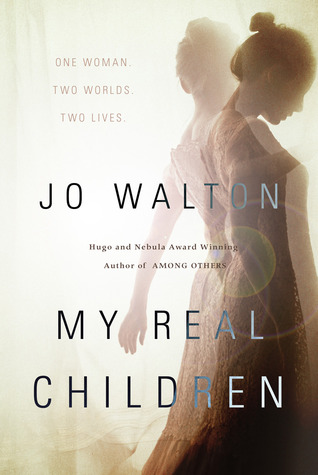
Jo Walton's My Real Children is one of those books that I loved and completely devoured, but I cannot entirely pinpoint why.

The story is about Patricia Cowan.  Patricia is getting older, and she forgets many things, big and small, that have happened to her over the past few years.  But she also remembers things, big and small, that she could swear happened, but don't make sense in her current circumstances.  Patricia seems to be living two lives, in two separate worlds.  Her life was all on a steady path until one day, she made a decision, and based on that decision, her life (and the world she lived in) went in two very different directions.

I love almost any alternate reality or alternate universe story, so I was predisposed to enjoy this one.  I appreciated that it was, for the most part, set after WWII rather than before or during the war.  Yes, the second world war had stunning effects on the world and how it has turned out, but events and decisions made both before and after the war have had enormous impact as well.

I am now about a week removed from having read this book and I admit that I am not sure why I loved it so much.  I gave it an unreserved 5-star rating when I finished it.  I loved Patricia, I loved how she made the best of circumstances no matter what they were.  I felt so saddened by the way her children, in both lives, relegated her to the background as she got older.  I enjoyed the subtlety with which Walton introduced societal prejudices into her narrative.  For example, in one world, Trish and her partner, Bee, seem to have no issues whatsoever with their son being in a polyamorous relationship.  It just seems to be what he chooses and they are fine with it.  They are, however, quietly concerned when their daughter marries a Muslim.  Walton does not delve very deeply into this (though, admittedly, she doesn't delve deeply into very much, which I will get to in a bit).  But most people don't like to examine their prejudices, so in a way, it was quite realistic.

Jo Walton writes about the small, personal, everyday acts of our lives wonderfully.  In all her books.  You get such a vivid sense of a character's day-to-day activities, and I really enjoy how she gives such care and attention to things that all of us view as trivial, but are the events that fill our lives.  She does this so well in very slim volumes; her stories are compact and self-contained and somehow still deeply moving and I love that about them.

That said, in this one, I just feel like there was so much that was left out.  And I say that now, but please remember that I loved it.  It is only now, a week later as I write this review, that I am mulling a bit.  We hear about big world events in an off-hand manner, in both worlds that Patricia inhabits, but never quite enough to understand what the situation is.  We see only minor inconveniences, mainly to outlying characters.  Though we have the idea that there are stresses on Trish's family in one version of her life, we don't see anything very drastic happen.  Again, this is part of Walton's skill; most people don't have hugely dramatic events in their lives, they just make the most of what they have and try to soldier on and be happy.  I wanted a bit more context.

Also, the book takes place over several decades, and in two very different worlds.  Because of that, we hardly get to know any of the other characters at all.  They flit in and out but do not have a solid presence.  Good friends from college are rarely mentioned again, the children are all vaguely there but with hardly any impact on life, spouses are either horrible or perfect with no real personality or depth, and the world keeps turning but what happens on that world is not shared in any great depth.  Because of that, at the end, when Patricia is trying to make sense of whether she would rather have a happy life in a horrible world or a sad life in a much better world, it was hard to feel compelled in either direction; I did not know enough to compare the two worlds at all.

So, this book!  I loved it and read it so quickly and enjoyed it hugely.  But, looking back, I feel like it could have had more depth.  If you want to read about the impact that big events have on small lives, this is wonderful.  If you want something... bigger?  Then, maybe not this one.

Thursday, February 4, 2016

The dramatic, everyday lives of ordinary people

Barbara Pym
Barbara Pym is one of those authors who, to me, is absolutely perfect for a cozy, quiet winter evening at home, curled up with a big, warm cup of tea.  As the tea warms your bones, so Pym's gentle humor warms the soul.  But there is always a touch of melancholy and wistfulness in Pym's writing, an acknowledgement that no one's life has worked out quite the way they imagined.

Pym's An Unsuitable Attachment has been on my shelf for a few years now, so it was a natural choice for me in my annual January guilt read of books that I own.  It is a quick read.  I finished it in a couple of nights.  And it grew on me after I was done; initially on GoodReads, I was thinking about a 3.5/5.  Now, as I reflect back, I think it more of a 4.5/5.  But neither rating seems quite right, as I can't judge the book the way I judge most novels I read.  Pym's writing evokes so much empathy for her characters, for the situations in which they find themselves.  But the characters themselves don't win me over.  They do not have much depth, we don't see very far into their motivations or reactions.  They're kept always at a remote distance from us.  Later on, I'm always very vague on plot details and characters.  But Pym is such a master of emotion and the lightly-turned phrase that it is, in my opinion, impossible not to be impacted by her writing and the situations she describes, even if the characters are somewhat expendable.

An Unsuitable Attachment is centered on church life in a small London neighborhood that is not quite up to snuff.  You know that it's not up to snuff because there are a lot of immigrants there.  The vicar and his wife, the Aingers, live happily with their cat, Faustina.  New congregants Rupert Stonebird and Ianthe Broome (fantastically named characters if nothing else) move into the neighborhood, separately, and everyone speculates about their backstories.  Mrs. Ainger wants Rupert for her sister but it seems that he prefers Ianthe.  Ianthe, however, harbors a secret crush on her thoroughly unsuitable library co-worker, John.  A couple illnesses, a trip to Rome, an awkward garden party, dinner party, and church gathering later, and things seem to sort themselves out.

One of the things I love about this book and about Pym's writing in general is how she uses her novels to show us just how little we know other people.  There are so many small misunderstandings in the book, between strangers, between acquaintances and friends, even between happily married couples.  Everyone has insecurities, about small things - should I let the other two men order the wine, or does that make me seem less masculine? - and big - can I really be attractive to a man five years younger than me, or is he just after my money?  They all say things they wish they hadn't, and they are all hurt by comments other people make.

For example, one evening in Rome, the Aingers go out for a romantic scroll on their own.  The normally very austere Mark Ainger clasps Sophie's, his wife, hand warmly and tells her how much he still loves her.  Sophie reacts by saying that she hopes her sister finds love, that her sister was made to love and be loved.  This was, obviously, not the reaction Mark was hoping for, and he retreats again into himself.

We might think Sophie unfeeling, but we know that she is not because earlier in the book, she let something slip to Ianthe about how hard it is to break through Mark's tough exterior, to feel as though she has any real connection with him.  "...in some ways, we're so far apart.  I'm the sort of person who wants to do everything for the people I love and he is the sort of person who's self-sufficient, or seems to be..."  She then goes on to compare her husband to her cat.  "I feel sometimes that I can't reach Faustina as I've reached other cats.  And somehow it's the same with Mark."

Sophie and Mark both seem unable to talk to each other about their feelings, so instead they shower love on their cat, Faustina.  Sophie also works very hard to get her sister Penelope happily paired off with Rupert Stonebird, though it doesn't seem as though the two have much in common.  Penelope, for her part, really just wants to meet someone; she's frustrated and lonely, going home to a tiny apartment every night with no company.

Ianthe, though, stood out the most in this story.  I felt most connected with her, maybe because she is single in her 30s and seems mostly content with her life, though she doesn't like the expectations people place on her.  In one of Sophie's thoughtlessly cruel moments, she tells Ianthe, "You seem to me to be somehow destined not to marry.  I think you'll grow into one of those splendid spinsters - oh, don't think I mean it nastily or cattily - who are pillars of the Church and whom the Church certainly couldn't do without."  (One of those Excellent Women, perhaps.)  Ianthe asks Sophie if she feels that Penelope will also be one of those women, and Sophie firmly says no.  Her own sister, of course, is not meant to sacrifice her life and happiness.

An Unsuitable Attachment is wonderful because it's so real.  I talk at length above about how honest it is in its portrayal of relationships at every stage of development, but it is also wonderfully funny.  There are so many everyday situations that make you smile, so many asides and inner thoughts that are just so perfectly shared, it is a true pleasure to come across them.  Pym mocks her characters, but she does it gently, and she does it in a way that draws attention to the mistakes and missteps that we all make.  "Be kinder to each other," she seems to be saying.  "Give your friend/neighbor/wife/sister the benefit of the doubt."  None of us is living a perfect life, but there are many memorable, happy moments that we can share.

Thursday, January 28, 2016

The case of the missing foot

Robert Galbraith
I thoroughly enjoy mystery novels and think many of them are excellently written.  I don't generally like to commit to series, but I do enjoy a good mystery series, mostly because I like learning more about characters I love and seeing them grow.  I especially enjoy when authors tackle real issues in their novels, using their characters and the mysteries they confront to provide perspective on the world as it is now.  I think this is why there is often overlap between SFF and mystery fans - the best authors do this really well in both genres.

One author who excels at putting heart and soul (and a lot of humor) into fantasy and mystery is JK Rowling.  Her third book in the Cormoran Strike mystery series, Career of Evil, is a truly excellent book.  It clocks it at about 500 pages; I was at the tail end of a very slow reading year, and yet I managed to plow through the book in only a few days.  I even stayed up quite late one weeknight to finish it, which is rare for me.

What made this book so good?  I mean, yes, there's the whole serial-killer-who-seems-to-have-a-personal-vendetta-against-Strike plot, and that is very compelling to read.  But the mystery portion of a mystery novel is, strangely, never the reason I fall in love with the story.  I spend zero time trying to figure out whodunnit while I'm reading the story (possibly because I almost always skip ahead to the end before I finish the second chapter, but even then, I don't really look for clues while reading the rest of the book).

Really, what made this book for me is that Rowling/Galbraith finally delivered on the Robin Ellacott part of the story.  For the first two books in the series, I really loved Robin as a character - she is strong, kind, loyal and brave - but I hated her fiancee.  I still hate her fiancee, but I understand better now why Robin stayed with him.  We learn much more about Robin in this outing, spend much more time in her head.  I think Robin is where the link to the Harry Potter stories is the strongest in this series (if you happen to be looking for a link).  She is exactly the sort of person Hermione Granger would grow up to be.  And, as you may know, Hermione didn't have the best taste in men, either.

Another plus in this novel's column is that Strike's ex-girlfriend Charlotte gets hardly any mention.  Charlotte was the worst, and I bid her good riddance.  I hope she doesn't return, though that is probably asking too much.  Why both main characters have so much melodrama in their romantic relationships is beyond me.  Much as we learned about Robin in this book, we also learned quite a bit about Cormoran Strike's formative years, and I was a glutton for the information.  Career of Evil was like birthday cake for me.  While I think Strike is coming out to be more of a loner and isolationist than I would have liked, he's still a very interesting person to spend 500 pages with.  I just wish he didn't so easily dispose of women.

Of course, when you have a man and a woman with melodramatic romances in their lives, it's inevitable that there would be sexual tension between them.  And there is, certainly, between Robin and Strike.  It's been building up for three books now, and I'm not sure where it's going or what will happen.  But I assume Rowling/Galbraith knows, and I trust her completely.

The Cormoran Strike (I admit it irks me that the series is named only after Strike and does not mention Robin at all) mystery series absolutely does not fall into the "cozy" subgenre.  They are bloody, dark, and very complicated stories.  But they're also very well-written, and the series improves with each book, so I highly recommend checking them out if you have any interest.  Especially for Robin - it's very difficult not to love her.

Thursday, August 20, 2015

Gloriously diverse Regency era fantasy

Sorcerer to the Crown, by Zen Cho
If you remember my post about Zen Cho's short story collection Spirits Abroad, you'll know that I was super-stoked about Cho's full-length novel coming out, Sorcerer to the Crown.  I got an advance copy of this book through the help of fate and magic and pure luck, and so now I can tell you ALL OF MY FEELS about the novel!

I am probably the prime target for this book because:
1.  It is set in late 18th/early 19th century England.
2.  It is a fantasy novel.
3.  The main female character is half Indian, and that half is from southern India.
4.  The main male character is a former slave.
5.  The other kind-of main character is an old Malaysian woman.

Actually, now that I review the list, I feel like those are five things that would probably make ANYONE want to read this book, though I understand some people don't love fantasy and some people don't love historical fiction, and even though that is my ideal combination of all sorts of books, I know that is not the case for all of you.  In general, I feel sorry for all the amazing stories you are missing, but I get it!  I am probably missing BOATLOADS of awesome stories because I veer away from "literary fiction" and women's fiction.

Anyway, back to Sorcerer to the Crown.

The story centers on Zacharias Wythe, a freed slave with super-impressive magical abilities who, much to everyone else's chagrin, becomes Sorcerer Royal of England.  But magic seems to be leaving England, and Zacharias faces opposition and threats from everywhere, not least from some tiny island nation in the Pacific where vengeful female ghosts are attacking the populace.  Luckily, he meets a beautiful and amazingly talented woman, Prunella, who technically shouldn't practice magic but is really good at it, and the two set off to make everything better.

I admit that if I had a slight problem with this book, it was in the character development.  There are just a lot of people in this book.  And while I enjoyed spending time with both Zacharias and Prunella, and I think they were both awesome, I wouldn't say that they were fully fleshed out, complex people.  I would have liked to dig a little deeper with them.  But maybe Cho just had so much going on in terms of setting the scene and introducing the magical elements and explaining the class/gender/race relations between everyone that there just wasn't enough time to also develop the characters that well.  What I knew of Zacharias and Prunella I liked, but I hope that in future books, they are more full-fledged oil paintings than pencil sketches.

But seriously, I liked so many other things about the story!

One of my favorite things about Spirits Abroad was the way Cho infused all her stories with Malaysian culture, from using dialect to describing food to incorporating folklore and so much else.  She does the same thing here, even though the book is set in London and the main characters are not Malaysian, and I love that.  THIS IS WHY DIVERSITY IN PUBLISHING IS SO IMPORTANT.  How many people would think to combine Indian history with Malaysian folklore, add a healthy dollop of English Faerie, and then make light but awesome references to equal rights for women and people of color?  Not many.

And the feminism, it is awesome.  There so many different women, most of whom wield different sorts of power that complement and contrast with one another.  And Cho doesn't just hit you over the head with the feminism, she really just kind of pokes fun at history and pokes holes in its rules, and it's a lot of fun.  And then she also shows how women in different cultures (English, Malaysian, Indian and, er, faerie) push against their boundaries even while working within their cultures.

And then there's the race stuff, too!  I think Cho maybe could have gone further on the race component than she did, but this is a pretty light book, so I can understand why she didn't.  Suffice it to say that Zacharias (and, to a lesser extent, Prunella) never forgets that he is different, and so much of his personality and actions are informed by that fact.  He's always a complete gentleman, and utterly polite to everyone, so that no one knows just how frustrated and angry he is.  All because he doesn't want to give them any reason to remember how different he is.  It's subtly done but so powerful when you catch on.

All in all, this book is great!  I think you should read it.  And then tell your friends to read it!  Perhaps for A More Diverse Universe :-)

Note:  This review is based on an advance reader's copy.  I received an e-galley of the book in exchange for an honest review.

Thursday, March 5, 2015

Wilkie Collins and the big, bright diamond

The Moonstone, by Wilkie Collins
I avoided reading The Moonstone for several years because of the novel's premise.  I was pretty sure that I would find a Victorian era novel about a representative of the British empire stealing a priceless Indian diamond and the inevitable "Hindoo" curse that followed him and his extended family to be supremely offensive to my sensibilities.  But I decided to give it a shot because people seriously love this book, it's been on my shelf for a long time, I had a feeling it would be pretty amazing as an audiobook, and winter is a good time to settle down with a mystery novel.

The Moonstone centers on a diamond stolen from a temple in India.  It ends up in England and Rachel Verinder receives it as an 18th birthday present, wowing everyone with its size and glitter and value.  She (stupidly) decides not to lock it up at night and then everyone is shocked when the diamond is no longer there in the morning.  Suspicion immediately falls on three Indian men who have been hanging about the village, but things are not quite as clear as they seem.

And I must say that I was pleasantly surprised with this book!  (Caveats to follow shortly.)  I really enjoyed the multiple narrators employed to tell the story.  I always love books with multiple narrators, and Collins gave each of the narrators very distinct personalities and voices.  And Wilkie Collins clearly had a very well-developed sense of humor and probably was a fantastic dinner party guest.  The slightly sarcastic asides, the gentle nudges in your side, the obsession with Robinson Crusoe and God and the rigidity of the class system - it's pretty clear that Collins knew his audience well and used his book to mock them just a little bit.  I loved it.  There are some truly memorable characters and laugh-out-loud moments here (particularly in scenes involving the sanctimonious cousin, who dropped ridiculously-named religious pamphlets like "Satan is in the Pillowcases" everywhere).

It was also a jolly good (the Victorian era has rubbed off on my vocabulary) story.  Yes, there's the mystery, of course, which is pretty great.  But there's so much more, too!  The way in which Rachel inherits her money and how that influences suitors for her hand.  The way in which so many Victorian men led double lives of vice and virtue.  (Vice & Virtue would TOTALLY have been an amazing Jane Austen book if she had lived to write it.)  The way some people claimed to be so religious but really were just self-absorbed.  The very Victorian way people had of bursting/dying/pining/sighing for the people they loved, while remaining stoic on the outside.

So yes!  It's a lot of fun!

BUT I was seriously annoyed with the way everyone kept referring to the three Indian men as being thieves!  I mean, come ON, people, you know how your shady relative stole the diamond, and you KNOW the history about there always being three Brahmin guardians to watch over the diamond, and you KNOW that the diamond is cursed.  And yet!  You still insist that it was Miss Rachel Verinder's diamond and completely ignore all of history to hone all of your resources on the Indian men.  How very British Imperial mindset of you.  #blinderson

Slight spoiler to follow:  (Highlight to see text.)  I admit, if the book had ended differently than it actually did, I totally would have knocked the rating down a serious peg or two.  The entire way through the book, I was concerned about the ending, but luckily Wilkie came through for me.  So perhaps Wilkie was making a point to his crazy countrymen, hmm?  Hooray for him!!

I think Wilkie Collins used this book to highlight many hypocrisies that existed in Victorian England.  He also used the book to tell a pretty great story, and he succeeded in reaching both his goals.  This was a really fun read, and definitely a book I will keep on my shelf.  I also highly recommend you to seek out a good audiobook edition, preferably one with a whole cast to take on the roles of each of the narrators!

Also, the book is probably going to make you want to read Robinson Crusoe.  So, just be prepared.

Thursday, February 26, 2015

"the best natured and best bred woman in England"

Georgiana, Duchess of Devonshire by Amanda Foreman
I have been making a concerted effort to read more of the books on my own shelves.  Many of those books are non-fiction books about 18th and 19th century Britain, which has been my favorite era in history since reading Jane Austen for the first time.  But in recent years, I've moved away from British history, and many of those books have sat unread while my reading tastes have changed.

But I picked up Amanda Foreman's Georgiana, Duchess of Devonshire, and I realized that my tastes haven't changed so much.  While I am so happy to be reading more widely and diversely than before, I do still love the Georgian era.  And very few people personify the era as well as the Duchess of Devonshire.

A fashion icon, a published author, a serious party-goer with a gambling addiction, a political powerhouse much more impressive than her husband, an amateur geologist, and a loving mother, Georgiana Cavendish holds, in one person, all the excess and glory we associate with the late 1700s.  I am not entirely sure how to provide a plot summary for a biography.  Suffice it to say that Foreman gives us insights into every stage of Georgiana's life, from her childhood as her mother's favorite child, to her failed marriage with the Duke of Devonshire, to her desperation to have a son, and her serious, ever-present concerns about her gambling debts.

Foreman also brings the entire era to life (at least, the era as it was lived by the ridiculously rich people at the very top).  She talks about 18th century politics at length and with authority, covers the French Revolution, and gives us a glimpse into the fashionable life.  I admit the descriptions of men's fashion in particular completely bowled me over:
Fox's particular contribution was to experiment with hair color, powdering his hair blue one day, red the next. He wore multicolored shoes and velvet frills...
I mean, can you imagine this man with red hair and velvet frills?  The mind boggles as to why all painters neglected to include this key identifying characteristic in any of his portraits.

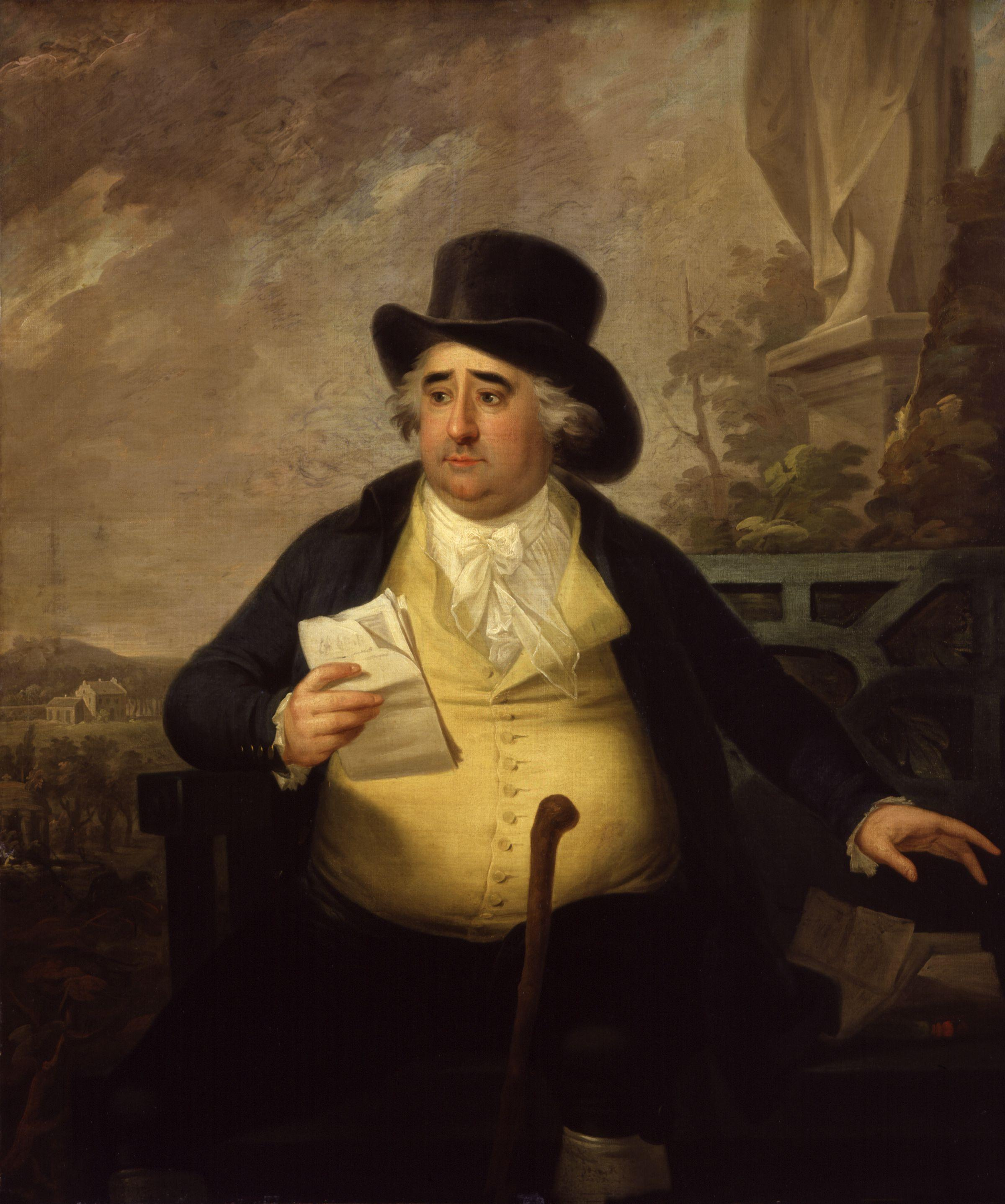
Charles James Fox, alas without red or blue powdered hair

Georgiana was a leader of fashion herself, with the most epic hairstyles you can imagine.  She is probably best remembered for her high-flying lifestyle and the scandalous three's company type existence she lived with her husband and her best friend, Lady Elizabeth Foster.  Bess  also happened to be her husband's mistress for several years and bore two of his children.  But this is unfair to Georgiana.  Foreman admits in her introduction that she fell more in love with Georgiana the more she read about her, and it's hard to read this book without falling in love with her yourself.  Her life was so bittersweet:
She was an acknowledged beauty yet unappreciated by her husband, a popular leader of the ton who saw through its hypocrisy, and a woman whom people loved who was yet so insecure in her ability to command love that she became dependent on the suspect devotion of Lady Elizabeth Foster.  She was a generous contributor to charitable causes who nevertheless stole from her friends, a writer who never published under her own name, a devoted mother who sacrificed one child to save the other three, a celebrity and patron of the arts in an era when married women had no legal status, a politician without a vote, and a skilled tactician a generation before the development of professional party politics.

Seriously, the Duchess was no joke.  We get to know her pretty well, but there are still so many more things I wanted to know.  So many things hinted at but frustratingly hard to find out.  This may be because so many of her papers were lost or censored by later (ahem, Victorian) generations.  It could also be because Foreman didn't have the inclination to write a much longer book.  But there are so many events or people hinted at that fall to the wayside later on - for example, what was so unlikable about the Duke's daughter Caroline that everyone commented upon how awkward and weird she was as a child?  And then she just disappears!  And why in the world did Georgiana's daughter Harryo want to marry her aunt's lover?  And what was Lady Elizabeth Foster really after?  How did Georgiana treat her servants?  How does one even begin to prepare for a dinner party with 1000 guests?  I want to know!

But what I do know, even with those minor frustrations, is that history has given Georgiana the short shrift.  She was so much more than she is given credit for, and when you read her letters and see how desperately lonely she was, and how she overcame that loneliness so much to be politically savvy and wonderfully kind and so generous, you will be as enchanted with her as London society was.

But if it was difficult to read this book and not fall in love with the duchess it was well nigh impossible to read it and not be completely astounded by the amount of money the aristocracy spent, burned, gambled, frittered away or just lost track of.  Many of these people had 7- and 8-digit incomes or personal wealth and practically all of them were in debt.  To each other.  For gambling losses.  I cannot even comprehend how one can be a millionaire one day and then lose an entire fortune that night to a passing acquaintance.  I just... wow.  Even though I feel pretty familiar with the Georgian era, I think I must severely underestimate just how strong the sense of entitlement was among the super-rich.

I thoroughly enjoyed this biography and highly recommend it.  As Foreman points out, Georgiana was in every sense of the word a product of her time.  She brilliantly maneuvered not just in the "women's sphere" of hearth and home but also used her influence and friends to make real and lasting impact on the larger world that we historically associate with men.  She breaks down the entire notion of "separate spheres" and shows just how valuable women could be in the political arena.  She's pretty amazing, and I'm glad to know more about her.

Note:  The Georgians were really, really dramatic in pretty much everything they did.  They wrote very effusive letters, they made grandiose gestures, said very intense things... it was truly awe-inspiring to read.  I think the Victorians were pretty dramatic, too, so WHEN DID WE BECOME SO CALM?  (Written in all capitals for ironic effect.)  I was truly uncomfortable with the hair-tearing, the excessive weeping, the cloyingly affectionate (to me) descriptions - when did this happen?  No wonder no one faints any more.  We are all in a state of perpetual calm.

Thursday, February 5, 2015

Secrets of a xenophobic house in Dover

White is for Witching by Helen Oyeyemi
I think maybe I am not quite smart enough for Helen Oyeyemi.  I am always so enthralled with her, and so proud of myself for (I think) understanding some of the symbolism, drawing the links and conclusions I should be drawing, understanding some of the story line that she hints at but doesn't quite tell us.

And then I get to the last 10-20 pages of the book and am just completely lost.

This happened to me with Boy, Snow, Bird, and it has happened again with White is for Witching.  Luckily, based on a quick Google/blog search, it looks like many other people were also confused by White is for Witching, so at least I am in good company.

I found this book utterly absorbing, even as I had a feeling I was reading on a different plane than the one on which Oyeyemi was writing.  This is a rich and beautifully written story about grief and loss, about the walls we build to make us feel safe and how those walls can turn on us.  There are four narrators of this story, one of whom is a deliciously creepy and unreliable house.  Honestly, I love any book with an unreliable narrator.  I also like books with multiple narrators.  So Oyeyemi had me hooked pretty quickly.

I would try to tell you what this book is about, but I'm not sure I know.  These are the facts:

  • Lily Silver died in Haiti, leaving her husband, Luc, and teenaged twins Eliot and Miri behind.
  • Luc runs a B&B in Dover.  It's hard to keep help because people are very frightened of Miri and (mostly) of the house itself.
  • Miri doesn't eat real food, she just chews on chalk and plastic, and she just got out of the hospital.  She looks very thin and nothing at all like herself.
  • Miri gets into Cambridge and she meets this amazing girl, Ore, there.  Eliot (supposedly) goes to South Africa.
That's pretty much all I can say with certainty about this book, though it is rich with so much more.  I really love Oyeyemi's way of weaving commentary about current events and perceptions into her books.  For example, in White is for Witching, the creepy, evil house is highly xenophobic and very racist, working desperately hard to kick out anyone who isn't white from the house, including the help, the houseguests, and Miri's friend Ore.  This is paralleled by the Kosovan refugees in Dover and Ore's experiences feeling like a complete outsider at Cambridge.

The story also details the deep grief that Luc, Eliot and Miri feel at the loss of Lily (who probably was trying to escape the house, too.  The house likes to kick out certain people but also works really hard to keep others in).  Luc buries himself in his work and makes elaborate, beautiful meals that he hopes and prays that Miri will eat and enjoy (she does not).  Eliot tries to distance himself from his twin sister but finds that he misses her deeply.  And Miri, poor Miri, feels like she is turning into her mother (or her grandmother, or her great-grandmother), losing her own memories.

And then the end of the book comes and I have no idea what happened.  What did Ore do with the salt and the skin?  Did it work?  And why did Sade leave?  Did she do anything to help?  And is Miri now part of the house, or did the house reject her, or what?  WHAT HAPPENED?

So, basically, I have no idea.  But I still thought this book was really well-written and maybe I am just not meant to understand the endings of any Oyeyemi book.  Definitely read this if you like Shirley Jackson!  Or if you like unreliable narrators!  Or if you want to a book to force you to think and wonder but not quite know.

And, er, maybe don't read it right before going to bed like I did.

Thursday, January 22, 2015

If at first you don't succeed, try, try again

Life After Life
I read Kate Atkinson's Life After Life for a book club I just joined.  I read it as an audiobook, which I think was a mistake.  The book jumps around in time so often and references side characters and events quite often and I'm sure I missed quite a bit.  This is a book that requires flipping from one section back to previous ones and forward to new ones as Ursula basically lives a Choose Your Own Adventure.  But it's a long book and I knew I wouldn't get through it in time for the meeting unless I was reading it on my commute, and one of my new years resolutions for 2015 is to get out more and meet new people, so I really wanted to do well for my first book club, so audiobook it was!

The book is about Ursula Todd, a girl born in 1910 who then goes onto live several different versions of her life.  Once, she died at birth.  Another time, she died by drowning.  Another time, she fell off a roof.  Eventually, she manages to grow out of childhood, really coming into her own during WWII.  Sometimes, she lives in Germany during the war.  Sometimes, she lives in London.  In one life (not a spoiler as this is the very beginning of the book), she shoots Hitler but it's unclear what happens after this.  This annoyed me as the book is quite long and it would be nice to know how that life ended...

Monday, December 8, 2014

Review-itas: The TBR Edition


Every once in a while, I will look at the many bookshelves in my house filled with books that have sat patiently unread for years (and seriously... many, many years) and be filled with a sense of panic.  What am I doing borrowing all these books from the library when I have at least a couple hundred on my shelves that I haven't read yet?  It makes me feel guilty and stressed out and pretty far behind.

This past weekend, I did a shelf clean-up and got rid of a few dozen books that I really don't have any interest in reading any more.  My tastes have changed, as you will see from the reviews below.  I frankly no longer really care that much about Medieval England's religious struggles. class struggles, and gender roles.  I really don't care that much about Medieval England at all.  As various periods in English history have prominent placement on my bookshelves, this was a difficult lesson to learn and I don't know if I have fully come to terms with it.  I think I am still a huge fan of 18th and 19th century British history.  I am absolutely fascinated by the class struggles and gender roles in that era and how technological advancement impacted social norms and roles.  At least, I think I am.  But it's been quite a while since I read a book set in that era, too, so I don't quite know.

Also, I read much more diversely now, and my bookshelves aren't very diverse.  This makes it even more difficult to pull books from my shelves to read because I want to make sure I maintain a good balance in the diversity of the authors I read.

Basically, I've come to realize that my bookshelves no longer fully reflect my reading tastes, and I've been having trouble coming to terms with that.  There are still a lot of books there that sound interesting to me!  Hopefully I find some sort of balance and read those in the coming years without panicking too much about how or when I choose to read them.  Until then, though, I will probably continue as I am now, with spurts of reading from my shelves coming all at once, brought on more by guilt and panic than by pure interest.  So it's no surprise, then, that I am fairly lukewarm about the results:

:The
Based on the above, it's probably no surprise that I didn't finish The Illuminator, by Brenda Rickman Vantrease.  I read it because it has been on my shelf for years (at least 8) and it was available on audio download at the library and I wanted to feel like I was making progress on my TBR.  Not exactly the most promising of situations, so I apologize to the author.  No one wants to be up against those odds!

A widow is trying to care for her property and her family, even against the grain of society at the time.  And then a man comes into her life and sets her heart racing and her mind thinking and complications ensue.  And the man is an illuminator who transcribes the Bible (very prettily).  And he transcribes other (Treasonous!  Heretical!) things, too.  Also, there's a mystery around the murder of a corrupt man of the cloth.

Considering that I didn't really have much interest in reading this book, I actually found the story and the audiobook quite engaging.  The characters are real and likable, though they felt very likable to my tastes.  I get that there were dissenters throughout history that had progressive views, but I do think that you can make a character likable and powerful within the confines of their environment rather than always being the one person in a crowd who looks away from a hanging or thinks that servants are basically the same as rich people, except not as rich.  Anyway, later on in the book, one of the main characters expresses very anti-Semitic viewpoints, so that took us right back to the 1300s.  Or the 1940s, anyway.

I think I just didn't finish reading this book because another one came up in my library audio queue that I really did want to read.  And because, while I was interested in the story, I wasn't terribly engaged or excited by it.  I didn't really care what happened next.  Again, I think that is just because my reading tastes have changed.  I can see 23-year-old Aarti being very into this book, and 23-year-old Aarti was pretty great, too, just different.  So if you enjoy Medieval England and tales of religious dissent and the way people of different classes were treated in that period, I think you would really enjoy this one.

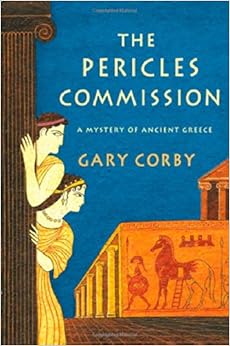
The Pericles Commission by Gary Corby
I distinctly remember reading a review of The Pericles Commission in a newspaper and noting it down because I was finished with the Marcus Didius Falco mystery series set in ancient Rome, and I thought that a mystery series set in ancient Greece would be a good fix.

The Pericles Commission works very well as a Falco substitute.  You have a private investigator who is middle-class and trying to make his way up in the world.  He meets a beautiful and savvy young woman, totally ineligible for him, and the two become partners in crime-fighting.  The guy has a pretty entertaining and fun family that we get to meet and spend time with (including a precocious younger brother named Socrates).  And the author seems to know his stuff - you learn a lot about ancient Athens, from the geography to the historical figures to ancient laws and customs and much more.  There's some humor, too, but if you are used to Lindsey Davis' quick-witted, self-deprecating, and completely lovable Marcus Didius Falco, it will be hard for Nicolaos to compare.

The Pericles Commission was just what I needed.  I had just finished Who We Be, which was an amazing book, but not exactly light reading.  And people were rioting in the streets all over America over a grand jury's lack of indictment over the events in Ferguson, MO.  Basically, I wanted a book that was fun and didn't require me to think very much.  And, damning as that might be to the author, this book really fit the bill, and I enjoyed it for that reason.  There are fun scenes here!  And while sometimes the dialogue (both internal and external) and the clue-dropping (or red herring-dropping) can be clunky, that is to be expected from a first novel.

I am not sure if I will continue on with this series, just because as I've gotten older, I've gotten progressively worse at keeping up with series.  And because I honestly don't think that ancient Greece has the same pull on me these days as, say, 1950s South Africa or 1960s America or ageless Henrietta or countless other settings.  But it was fun and it was light and I learned a bit more about Athens circa 450 BC.  And that was just what I wanted,

Tuesday, October 14, 2014

A lovely collection of stories set in Faerie England

The Ladies of Grace Adieu
I really loved Susanna Clarke's Jonathan Strange & Mr. Norrell when I read it years ago in college.  But probably one of the first words used to describe that novel is "uber-long."  It's a very hefty tome.  So when I heard that Susanna Clarke also wrote short stories, I admit I was a little skeptical.  Can an author who imbues her stories with so much rich detail, who develops characters and plots over hundreds of pages, also excel at the short story format?

Apparently, yes.

As the weather gets colder and the days get shorter, I always find myself drawn to fantasy novels.  Something about magic and mischief and mayhem works so well for me as I am snuggled on the sofa with a big fleece blanket to cover me.

To be fair, I read The Ladies of Grace Adieu on audiobook in my car, so there were no fleece blankets.  But the magic still worked on me!

One of my favorite things about Clarke's writing is how she is so well able to bring in the witty, elegant style that many of us associate with Jane Austen.  This style is just as present in these eight short stories as it was in Jonathan Strange & Mr. Norrell.  

The stories traipse all over England and over several centuries of history, featuring a wide and varied cast from Mary, Queen of Scots to the Duke of Wellington to a poor charcoal burner to Jonathan Strange himself.  And there are faeries!  And many well-known folktales like Tamsin and fairy tales like Rumpelstilskin.

I highly recommend this book if you enjoyed Clarke's earlier novel - the style is the same and the witty language against the sometimes dark and creepy setting is absolutely delicious to read.  And if you think you would like Clarke but are intimidated by Jonathan Strange & Mr. Norrell (and all its footnotes!), then I think this is a great way to dip your toes in and see if you are ready to tackle that book.  An excellent book for the RIP challenge and as we get into the Halloween season!

Monday, September 8, 2014

Sarah Waters proves her mastery over the post-WWI creepy relationship story

It's here, it's here!  Sarah Waters' eagerly anticipated new novel, The Paying Guests, hits shelves on the 16th and is sure to skyrocket to the best-seller list pretty much immediately.  I was absolutely thrilled to get an advance copy from LibraryThing.  It took me a while to get through this book because it is pretty long and, well, summer!  But I made it through to the end and I'm confident that if you enjoyed Waters' other novels, you will really enjoy this one.

The Paying Guests is set in post-WWI London.  The economy is not doing well, the class system is starting to break down, and there are many women living without the support of men.  Frances and her mother are two of those women - Frances' two brothers died in the war and her father passed away, too, leaving an old house and a lot of debts behind him.  To make ends meet, Frances and her mother decide to take in lodgers.  Enter Mr. and Mrs. Barber, a working-class couple who seem to embrace a more carefree, Bohemian lifestyle.  But sometimes, their marriage seems just a little bit less happy than they project to the world.  And as Frances spends more time with the couple and gets to know them better, she becomes intimately involved in their lives and can't quite get away.

I really like the cover shown on this one - not only is it in line with the rest of Waters' books, but I love the sinister look of it.  The woman standing in the light, and then a man to the side, watching her in the dark.  It really does evoke the feel of this book, the unease with which the characters approach each other.

If I could liken this book to another, I think the one that comes to mind is Donna Tartt's The Secret History.  I did not really enjoy The Secret History, and I admit that there were several times during The Paying Guests when I got a little tired as well.  It just started to feel so repetitive!  And I applaud Waters for being able to keep upping the ante and the tension for a good 300 pages or so, but GOSH, I got tired of it!  I would say more, except I am pretty sure that I would be accused of putting in spoilers.  But anyway - a lot of this book is about how relationships can evolve and change and backtrack and go in circles, particularly at times of stress.  It felt quite realistic to me, but also quite painful to read.  By the end, I wasn't really a big fan of any of the characters, though I started the book really liking all of them.

What is awesome about this book, though, is Waters' amazing turn of phrase.  Here are some of my favorites:

"Their friendship sometimes struck Frances as being like a piece of soap - like a piece of ancient kitchen soap that had got worn to the shape of her hand, but which had been dropped to the floor so many times it was never quite free of its bits of cinder."

"How well she filled her own skin! She might have been poured generously into it, like treacle."

"You don't think about all the colors when everything's going all right; you'd go mad if you did. But those colors are there, all the same. All the quarrels, and the bits of unkindness. And every so often something happens to put a chip right through; and then you can't NOT think of them."

"It was like a cure, being with Lilian. It made one feel like a piece of wax being cradled in a soft, warm palm."

Note:  I received an advance copy of this book in exchange for a review.  This review is based on an advance reader's copy.

Thursday, August 7, 2014

Whoa, timelines are complicated when you are a time traveler


Ok, so these books by Connie Willis are absolutely massive, weighing in at over 1100 pages combined.  I am reviewing Blackout and All Clear together as they are technically two halves of the same book, but were separated due to the large size.  However, you really can't read All Clear without reading Blackout.

It's pretty difficult to do a summary of such a huge book without giving away spoilers.  Suffice it to say that three historians travel back in time from 2060 Oxford to 1941 London during the Blitz to observe what life was like for civilians during such a tense and stressful time.  And things go very, very wrong, so the three of them are basically stuck in WWII.  And then they get even more stressed out because it's possible that they are having an impact on historic events - what if they changed the course of history?  Uh-oh!

I have been going back and forth over whether I should even review these books.  There are already a lot of reviews out there, and I am not sure I have much more to add to the discussion.  I fell in love with Connie Willis when I read To Say Nothing of the Dog, which was wonderful and hilarious and romantic and not really in the same style as any of her other work.  Then I read The Doomsday Book, which was not funny at all but very tense and quiet.  Blackout and All Clear are a mix of all of these - there are moments of humor, quite a bit of tension, though not a whole lot of quiet.  Obviously, in the midst of the Blitz, there are a lot of sirens and booms and planes.  The books are long but read very quickly, mostly because you are so stressed out about what is going to happen that you are incapable of doing anything but reading very quickly to find out what happens next.  Willis definitely knows how to write a nail-biting, stomach-clenching story, and she's in fine form with that here.

Willis also really knows her London map, buses to Underground to streets and back alleys.  She makes sure that all her readers know that she knows the map, too.  I think the book could have been cut by at least 20% if she would stop telling us all the directions and transfers that her characters kept taking.  They got old to me after a while, but I can see how telling everyone just how many stops were closed down due to bombs, and all the complicated ways people had to get around instead, was a great way of adding to the setting and atmosphere of this story.

Truly, these books brought to life just how harrowing living through the Blitz may have been.  I think the London Blitz is one of those moments in time that the English like to look back on with pride at getting through, and I expect it's romanticized quite a bit.  After all, it's not like the English weren't crossing the Channel and doing much the same thing to other cities on the Continent.  Willis goes full throttle into the romanticism, calling out the many unsung heroes that kept St. Paul's Cathedral standing, that helped save friends out of the rubble, that worked to keep up the spirits of their comrades with plays and dramas and small, unexpected gifts.  And I liked that.  I am sure that there was looting and fighting and all sorts of horrors that happened during the Blitz, but hey, sometimes you just want to hear about the good things and not the bad.  There is a time for gray areas and people with complex motivations, but perhaps a story about everyday heroes is not the place for them.  I respect that.

My main complaint with this book probably isn't a fair one, so I'll just touch briefly upon it here.  Couldn't there have been just one person of color in the story?!  I mean, there's this Badri guy who seems to just kind of mess up people's space-time coordinates (assuming he is South Asian based on his name), but he is the ONLY ONE, and he can hardly be counted as even a secondary character.  I mean, come on.  These historians are traveling back in time from 2060 - there's probably a lot of mixed race people at that time.  And maybe they are mixed race, but their names and physical descriptions make it hard to believe that they are.  And then there's the people in London, which was the seat of a global empire, and apparently NO ONE there was not white, even so.  It bothered me a lot.  In a book of 1100 pages set in the midst of a massive world war, I feel like there could have been one person.

Anyway, I have talked in zero ways about the plot or the characters of this book, and have managed to write quite a bit.  I don't really want to talk plot or characters. The plot is a bit complex and I don't want to spoil what was really a great ride for you. And while I enjoyed the main characters, I didn't fall in love with any of them. Really, my heart belonged to the secondary characters in this one, and they make so many of the scenes so wonderful that I have a feeling you will fall for them, too.

Thursday, July 31, 2014

Mid-Summer Reviewitas

According to LibraryThing, How Green Was My Valley entered my TBR pile on December 1st, 2006.  And there it sat until, in one of my bursts of TBR pile guilt, I decided to knock it off my list via audiobook.

The book is about Huw Morgan, who grows up in a rural mining community in Wales.  The story is told from the POV of Huw many years later, as he looks back on all the hardships and drama that impacted the people around him, and his fruitless love for his beautiful sister-in-law.

The story is about a coal mining family in the early 20th century, so obviously it's not a super-happy story.  There are strikes and hard times, lusting after other people's spouses, people leaving for better opportunities, and crazy gossip that people take crazy seriously.  The book felt like a well-written soap opera about the working class.

Llewelyn really fits the Welsh stereotype of being wonderfully musical.  His sentences are like songs, with a rhythm and dance all their own.  I am glad I have this book on my shelves so that I can read it with my eyes one day, not just with my ears.

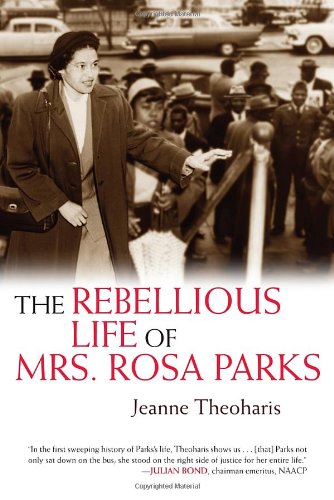
The Rebellious Life of Mrs. Rosa Parks, by Jeanne Theoharis, is one I've had on my Kindle for some months now.  Rosa Parks is a personal hero as well as a national one.  For those who may not know the American Civil Rights movement well, Rosa Parks was the woman "who started it all" by refusing to get up from her seat on a segregated bus in Montgomery, Alabama.  She was used as a symbol to rally around, the impetus for the Montgomery bus boycott that ended in de-segregating the buses, and Martin Luther King, Jr. shot to fame and the Civil Rights movement was underway.

But there was obviously much more to the Civil Rights movement, and there was a great deal more to Rosa Parks, too.  Her refusal to give up her seat on the bus was just one of many acts of defiance - she had been active in the movement for years before and she stayed active for years later; as she said, "It's always amazing to me that people thought it was [startling].  It seems to me it's natural to want to be treated as a human being."  She truly was an amazingly determined woman who "was quiet and sweet, but strong as acid."  (What a fantastic way of describing a person!  I love it!)

I admit this book became a bit repetitive and dry in the later chapters.  Rosa Parks struggled a lot, both in Montgomery and Detroit, and the author spent a lot of time discussing how soul-killing the Civil Rights movement could be, when people thought no change would come in their lifetimes.  But Parks truly was such an inspiring and wonderful person, well deserving of a detailed biography, and I'm so glad to have learned more about her.

JK Rowling/Robert Galbraith's second book in the Cormoran Strike mystery series is called The Silkworm.  This time, Cormoran and Strike are on the case of a missing B-list author whose last unpublished manuscript excoriated many people in the book business.

Between The Cuckoo's Calling and The Silkworm, Rowling has a lot of commentary on the upper echelons of British cultural society.  Most of it isn't very positive, so I wonder how bored she gets at all the publishing galas and dinners that she probably must attend.

This outing is even darker than The Cuckoo's Calling.  The missing author wrote truly bizarre scenes and left chaos in his wake.  Strike's ex-fiancee, Charlotte, is engaged to be married, and he has to come to terms with that and with the tiny jibes that she keeps sending his way.  I admit that, only two books into this series, I am already tired of the whole Strike/Charlotte drama.  It just seems to take up so much of Strike's emotional stores and Charlotte isn't given enough of a personality for us to really care what she does, anyway.  She's just like this succubus, taking time and energy and will away from the story and Strike.

In these two books, I also was annoyed by Robin's relationship with her fiancee.  She's an intelligent, driven, and beautiful woman, and it's hard to believe that she would waste her time on someone who did not value her or treat her well.  Unfortunately, that's pretty much exactly what her fiancee is like.  But through The Silkworm, we get a few hints at what drew her to him in the first place - she says very clearly that she loves him and wants to marry him, and she tells him what she wants to do with her life.  And I appreciated that.  I did not want to be in a story with another beautiful, intelligent woman who just doesn't have the self-esteem to leave the jerk she's with behind.

The relationship I do love in this series is the friendship between Cormoran and Robin.  It continues to develop here, and I look forward to seeing that continue.

Monday, May 12, 2014

Eunuchs and Espionage at the Opera

Anatomy of Murder by Imogen Robertson
Anatomy of Murder, by Imogen Robertson, is the second book in the Crowther & Westerman mystery series set in Georgian England, following Instruments of Darkness.  I read the first book two years ago and do not remember much about it.  All I really know is that I enjoyed it and liked the idea of a platonic man/woman detective team in 18th century England.  So when I saw the second book at the library, I finally picked it up and got around to reading it.

The book picks up fairly soon after the last one ended.  Harriet Westerman's husband has returned to England, though he is not the same man he was when he left.  And then a body is found in the Thames, and all sorts of war secrets are at risk, and the government asks Harriet and her friend Crowther to get on the case.

This is the second book in a series that isn't very popular, so I am not sure how much to give away from the plot of the first book (which I hardly remember, anyway) or from this book.  Luckily, though, the mystery wasn't really the key for me here.  I was reading for the gender roles!

Imogen Robertson was pretty savvy in her setup of these mystery novels.  She has Mr. Crowther, a wealthy and eccentric gentleman that people don't really know but are willing to tolerate because he's rich and comes from an old family.  Then there's Mrs. Westerman, who is married to a naval hero.  However, Harriet Westerman's oddities are less acceptable because she's a woman; she's not meant to go running around town trying to find criminals.

Harriet has a younger sister, who is very proper, and a young son and daughter.  Her sister often disapproves of Harriet's actions and tells her so, pointing out that Harriet is making life a lot harder for her own family, particularly the females.  But none of these lives are as difficult as those lived by the poor people of London, whom Robertson introduces us to through a parallel story.  Thus, in one book, we are exposed to gender roles, class restrictions, and how family can both support and hinder you.

There's a lot going on in Anatomy of Murder, and at times it was a little difficult to follow and seemed to wander a bit.  I admit I lost interest in the whole murder plot about halfway through, mostly because there were so many layers and characters involved that I had trouble keeping everyone straight.

But I had no trouble remembering why I was so excited about this series in the first place, and I'm glad I picked this book up, even though it took me forever to actually start reading it, and then a pretty long time to finish it.  I am very excited to get to know Harriet Crowther better.  And as time goes on and she navigates her conflicting desires to be a good mother, be a valued sister, and still do what she most wants to do, I think her story will only become more compelling.  In this way, Harriet Westerman reminds me a lot of Lady Trent in A Natural History of Dragons, and I think readers who are excited to learn more about Lady Trent's life will enjoy being introduced to Harriet Westerman, too.

Thursday, April 24, 2014

A frothy, fun romance for the landed gentry

I read my first book by Angela Thirkell, High Rising, about four years ago and thoroughly enjoyed it.  I had a lot of trouble finding any other books by her, though, so didn't get to any further in her series.  Luckily, though, I am now part of a large library system and I was able to find the second book in the series, Wild Strawberries.

As far as I know, Wild Strawberries does not have any of the same characters as High Rising, but it has been four years since I read the previous book, so it's possible that I just don't know.  This story is set in a Barsetshire country house, where the Leslies make their home.  The eldest son in the family was killed in World War I, and Lady Emily and her husband have not quite recovered.  But it's the Roaring 20s and the younger set is happy, optimistic and bright, as many wealthy young people often are.  Mary Preston comes to stay as a companion for Lady Emily, and we hear most of the story from her point of view.

Much like High Rising, this book was high on wit and humor, and pretty light on character development and plot.  Mary was naive and silly, though her elaborate imaginings about saving her love from a fire or nobly stepping aside so that another woman could be happy were fun to read.  We didn't get to know the hero very well at all, though we were assured throughout the novel that he was a very kind, intelligent, and thoughtful man.  I think I was turned against John fairly early, though, because he said a horribly racist thing in a quite off-hand manner.  And YES, I get the whole "Oh, Aarti, everyone was racist in the 20s!  Don't hold it against them!" thing (a comment that I find extremely offensive, so please don't say it to me).  But it's hard to give your heart and soul to a character in a book when he makes it so plain that he considers you beneath him.

What Thirkell excels at is in pointing out the foibles and inconsistencies of the British upper class with gentle irony.  One of the characters decides that he is a French royalist, but we find out a bit later that in previous years, he thought himself a Bolshevik, a Communist and all sorts of other things, so we know not to take him too seriously.  Another character, David, kind of wants a job, but he just can't take himself seriously enough to find one.  And then there are the women, all so vague and unaware of their surroundings that you can't help but think they must be addicted to laudanum or something.

This was a fun and light read (except for the racist bit), and while I don't think the characters were as realistic as I'd like, and the plot was pretty shaky, it was a good way to unwind after a tough day at work.  Recommended for fans of Wodehouse.

Monday, April 21, 2014

Oscar Wilde, Feminist

A Woman of No Importance
I think Oscar Wilde was a feminist!  Who knew?  Well, probably a lot of people, especially Jenny, but not me.

After reading a string of very depressing audiobooks, I really needed a pick-me-up.  Oscar Wilde was it!  I picked A Woman of No Importance because it was short and funny and witty and had an interesting title.  And it was a winner!

Apparently, this is not considered Wilde's best work.  I suppose that is reasonable as An Ideal Husband and The Importance of Being Earnest are quite good, but I really enjoyed A Woman of No Importance, too.  It hit on so many important themes and never once stopped being fun.  The audiobook I listened to was also excellent.  Honestly, I feel like a well-acted play on audio is a window to the golden age of radio, because the sound effects and the big casts and all that are just SO FUN to listen to.  I want to listen to more like this.

So, the play.  It is set in an English country house, and an up-and-coming young man from a middle-class background has just been offered a fantastic job as secretary to an aristocrat who is quite rich but also not a very good person.  People are pleased!  Except for the young man's mother, who does not want him to work for such a scoundrel.  And then there is the young man's lady love, who is a Puritan and just wants to make sure that if women suffer for their sins, men suffer, too.  But to be clear, everyone should suffer for wrong-doing.

You are likely to understand exactly what is going on in this book within about ten minutes (which is probably required, as the book was only about 1.5 hours long), and who cares?  It is so much fun to read and the one-liners are so excellent and the cast is so spot-on with their droll aristocratic ways and their earnest middle-class ways and their sincere American ways you can't help but love everything.

What was the BEST, though, was the way that Wilde pointed out the double standards that existed at the time.  There is, of course, the point that a man can be a complete screw-up and horrible person but people think he's da bomb diggity, anyway.  But if you're a woman and do the same thing, you are a social pariah and have to give up going out to parties and having fun and being a person.  I followed up A Woman of No Importance with Sheryl Sandberg's Lean In, and I must say, the two books have many parallels.  Basically, we all have different standards for men than women, and women suffer for that.  Men do, too, but to a lesser extent.  Certainly, the white male aristocrats suffer the least.

What I also loved about this book was the ending, though I suppose telling you why would be a spoiler  Just know, though, that it is a good one and not sappy and stupid and moralizing like many Victorian endings are.

So!  Read this!  Or better yet, watch it live or listen to it on audiobook, because that would be way better than reading stage directions, I assume.

Monday, March 10, 2014

Tolerance is more fun when packaged in a humorous book

Major Pettigrew's Last Stand
I realized after reading The Unlikely Pilgrimage of Harold Fry that I enjoy books with older protagonists.  They have a different perspective on life and what's important, and it's quite difficult in life to really get to know someone who is of a different generation (besides your parents and their friends), so reading about them is a good way to do so.

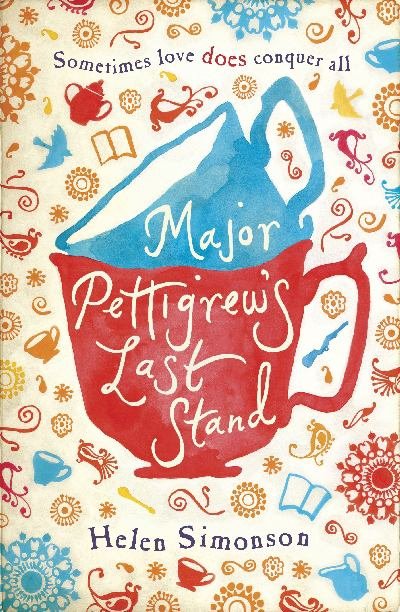
Major Pettigrew's Last Stand, by Helen Simonson, also features older protagonists.  There's Major Pettigrew himself, of course, a man probably in his late 60s/early 70s, and then all of his friends and acquaintance, most of whom are middle-aged or older, too.

Major Pettigrew's Last Stand is a very popular book, so I am not sure that I have much to add to the discussion that hasn't already been said.  Therefore, I'll focus on one aspect of the book in particular in this review - the portrayal of the kind, bumbling but narrow-minded villagers.

Major Pettigrew's Last Stand is set in what I assume is a not particularly diverse English village, where the Major has lived for much of his life.  There is a Muslim widow, Mrs. Ali, who works in the shop (she is of Pakistani descent, but was born and raised in England) with her nephew.  Major Pettigrew gets to know Mrs. Ali after his brother passes away, and the two become fast friends. 

Thursday, March 6, 2014

Review-itas: History Audiobooks Edition

Simon Winchester's The Meaning of Everything is about the epic undertaking of creating the Oxford English Dictionary.  The process took years.  DECADES, even.  Like, more decades than most people in the era really lived.  I suppose this is reasonable, as there are a lot of words in the English language, and I can't even imagine how one goes along cataloging them and defining them.  And how political it can become.  For example, the word American was put into the first edition of the dictionary, but not African.

Winchester shares a lot of anecdotes such as the one above, and others that are much more humorous and interesting as well - a kleptomanic assistant, the little jokes the compilers put into their example sentences, the difficulties with printers... it's an entertaining book, though not supremely fascinating, and I am pretty sure that I won't remember anything from it except that the dictionary took about 70 years to create.  Ah, well.  It was fun!

Longbourn is also set in England, though during the Georgian era, not the Victorian.  This book has gotten a lot of attention recently as it is kind of a spin-off from Pride & Prejudice, but it hardly references the people and actions of that great novel; rather, it focuses its attention on the servants who work for the Bennets.  Poor as the Bennet family is, they are wealthy enough to have servants, and the servants have a very different life view than they do.  All they do, really, is work, and so they are both fascinated and repelled by people who can spend so much of their lives in leisure, and who seem to have no regard or thought for other people's comfort.

The stars of this book are the servants, particularly Sarah, the housekeeper Mrs. Hill, and the new footman James.  I enjoyed learning about how they spent their days, their small victories and never-ending exhaustion.  However, I felt very separate from them in this novel.  Maybe it was because of the narrator, but it felt to me like there was a great distance between the reader and the main characters, which was unfortunate.  Also, I found parts of this book pretty dull.  I really enjoyed learning about the "downstairs" life of a Jane Austen novel, but the characters were just so quiet and tired, I did not grow to love them as I loved Elizabeth Bennet, with her wicked sense of humor and fine eyes.

I am hoping to read more short story collections this year.  One that caught my eye was When the Emperor was Divine, by Julie OtsukaIt's about one family's experience of the Japanese internment camps in the US during WWII.  None of the family members are ever named; they are referred to as "the woman," or "the girl" or "the boy."  This was a little strange, but I think it was done to make us feel like the story could be about any family, not just one.  While the book feels like one story, it really is a series of vignettes told from different POVs.  It was very illuminating to learn about the internment camps; while the "guests" were not necessarily treated horribly in the camps, they were given no compensation after they left, and many people came back to homes that had been poorly maintained, their belongings stolen, and many Japanese-Americans had trouble finding work after the war.

While I didn't love this book, it did really pique my interest in the internment camps.  I have Hotel on the Corner of Bitter & Sweet on my shelf to read, so I'll be sure to pick that one up soon!

Thursday, February 27, 2014

Flavia grows up

The dead in their vaulted arches cover
Not too long ago, I waxed rhapsodic about Flavia de Luce and how much I love Alan Bradley's mystery novels about her. 

But, wait!  There's more!

Soon after my post went live, the sixth book in the series came out, The Dead in their Vaulted Arches.  And this book just cements my love of this series even more.

There are a few things missed from this book that might disappoint some readers.  Mainly, there's not really a mystery; there is a death, but Flavia doesn't spend tons of time trying to solve it.  She's too busy reeling from something else.  Also, the delightful side characters that we've come to love in the previous books have smaller roles here.  We still see her sisters and her fathers and Dogger, and we get a wonderful peek behind the curtain at the woman who is Flavia's Aunt Felicity.  But we don't see the police force or the vicar quite as much.

This is the first Flavia novel I read in physical form; all the rest I did via audiobook.  I only did this in paper form because it came in so quickly at the library!  I did miss Jayne Entwhistle's glorious narration (the voice in my head is not nearly so good at imitating an 11-year-old).  But of all the books to read in physical form, I am glad it was this one because the feel of this book is quite different to the rest and in a way, it felt like me reading the book with my own inner (and older) narration was exactly the right thing to do at this time, as Flavia steps away from her childhood to a new life stage.

This book felt so different from the novels that came before it.  Flavia is almost 12 years old, and she is worried and saddened by the prospect of growing up, and she doesn't want her life to change from what it has been.  But, unfortunately, everything is changing.  Her beloved home is up for sale, her sister is leaving, she's witnessed half a dozen murders in about six months, and she's learned much more about the people around her than she ever knew before.  The Flavia de Luce that narrates this novel is still hilariously precocious and beautifully, achingly naive, but she is also much more introspective and thoughtful than she was in previous books.  Many histories are revealed here, things that were only hinted at in prior books, and in many ways, The Dead in their Vaulted Arches is the end of a story arc.  In fact, Bradley said exactly this in an interview online.  There are still four Flavia books to come, so it will be very interesting to see where he takes his characters in future.  I am eagerly anticipating what happens next to my unorthodox girl crush.  She's such a fun heroine, and I can't wait to see where life takes her next.

Monday, February 3, 2014

The culture shock of coming home after war

Demobbed:  Coming Home After World War II
I have a general goal of reading Alan Allport's Demobbed:  Coming Home After World War II and Julie Summers' Stranger in the House in a close enough time frame to each other that I can get both the soldier POV and the home front POV and compare and contrast the two.  I've now read the first book, so just need to get myself together enough to read Stranger in the House within the next few months.

I've had Demobbed on my shelf for a couple of years now, having purchased it when I was on a kick about learning more about the after-effects of WWII on people's lives.  Some time ago, I read and really enjoyed Soldier from the War Returning, which focuses on American men coming home after WWII.  Demobbed focuses on British soldiers and their families attempting to return to civilian life after six years of war.  It talks through the whole demobilization plan, the efforts to get everyone employed, and the difficulty of picking up a life that had been on pause for so long.