Showing posts with label Georgian/Regency. Show all posts

Thursday, February 26, 2015

"the best natured and best bred woman in England"

Georgiana, Duchess of Devonshire by Amanda Foreman
I have been making a concerted effort to read more of the books on my own shelves.  Many of those books are non-fiction books about 18th and 19th century Britain, which has been my favorite era in history since reading Jane Austen for the first time.  But in recent years, I've moved away from British history, and many of those books have sat unread while my reading tastes have changed.

But I picked up Amanda Foreman's Georgiana, Duchess of Devonshire, and I realized that my tastes haven't changed so much.  While I am so happy to be reading more widely and diversely than before, I do still love the Georgian era.  And very few people personify the era as well as the Duchess of Devonshire.

A fashion icon, a published author, a serious party-goer with a gambling addiction, a political powerhouse much more impressive than her husband, an amateur geologist, and a loving mother, Georgiana Cavendish holds, in one person, all the excess and glory we associate with the late 1700s.  I am not entirely sure how to provide a plot summary for a biography.  Suffice it to say that Foreman gives us insights into every stage of Georgiana's life, from her childhood as her mother's favorite child, to her failed marriage with the Duke of Devonshire, to her desperation to have a son, and her serious, ever-present concerns about her gambling debts.

Foreman also brings the entire era to life (at least, the era as it was lived by the ridiculously rich people at the very top).  She talks about 18th century politics at length and with authority, covers the French Revolution, and gives us a glimpse into the fashionable life.  I admit the descriptions of men's fashion in particular completely bowled me over:
Fox's particular contribution was to experiment with hair color, powdering his hair blue one day, red the next. He wore multicolored shoes and velvet frills...
I mean, can you imagine this man with red hair and velvet frills?  The mind boggles as to why all painters neglected to include this key identifying characteristic in any of his portraits.
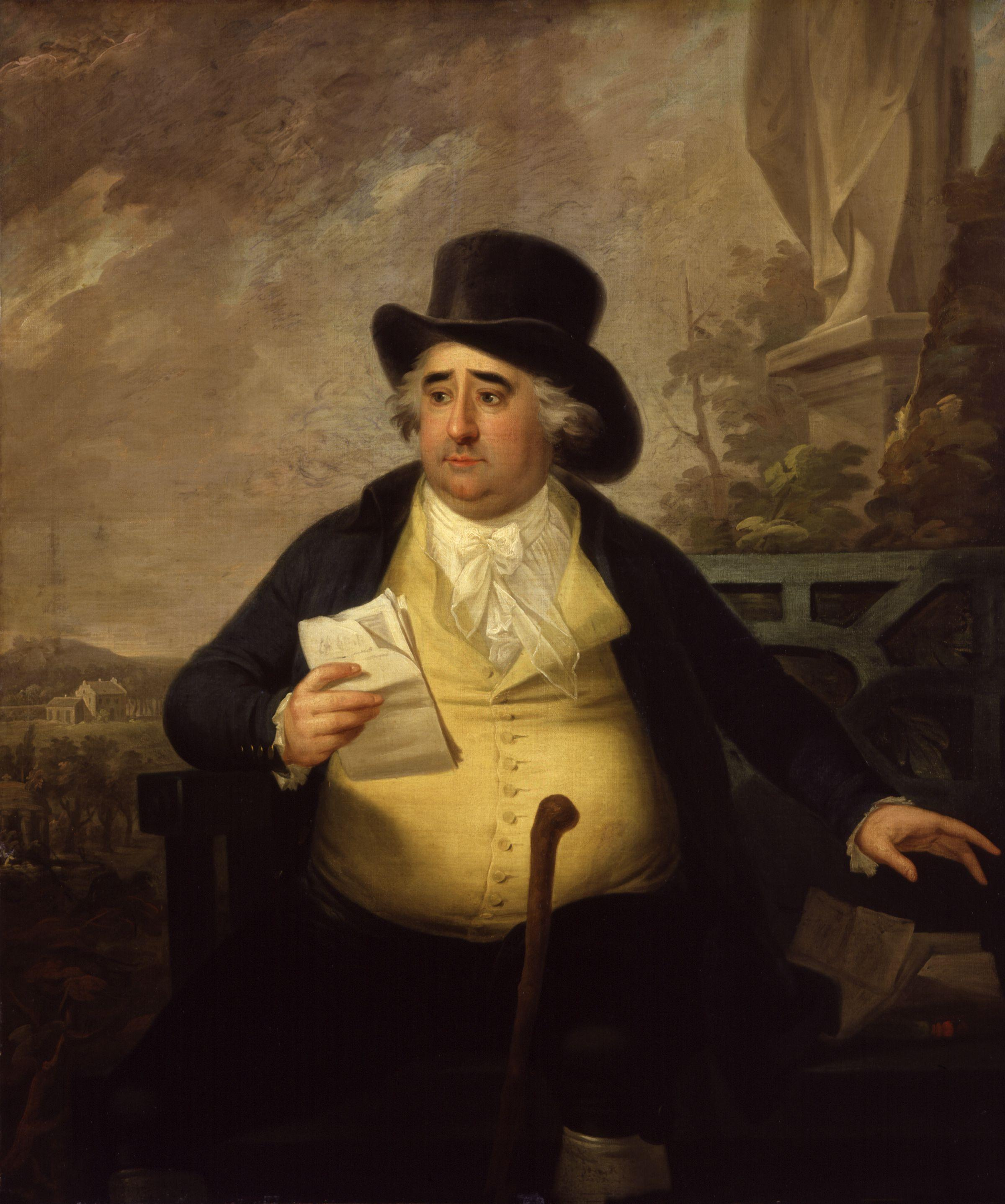
Charles James Fox, alas without red or blue powdered hair

Georgiana was a leader of fashion herself, with the most epic hairstyles you can imagine.  She is probably best remembered for her high-flying lifestyle and the scandalous three's company type existence she lived with her husband and her best friend, Lady Elizabeth Foster.  Bess  also happened to be her husband's mistress for several years and bore two of his children.  But this is unfair to Georgiana.  Foreman admits in her introduction that she fell more in love with Georgiana the more she read about her, and it's hard to read this book without falling in love with her yourself.  Her life was so bittersweet:
She was an acknowledged beauty yet unappreciated by her husband, a popular leader of the ton who saw through its hypocrisy, and a woman whom people loved who was yet so insecure in her ability to command love that she became dependent on the suspect devotion of Lady Elizabeth Foster.  She was a generous contributor to charitable causes who nevertheless stole from her friends, a writer who never published under her own name, a devoted mother who sacrificed one child to save the other three, a celebrity and patron of the arts in an era when married women had no legal status, a politician without a vote, and a skilled tactician a generation before the development of professional party politics.

Seriously, the Duchess was no joke.  We get to know her pretty well, but there are still so many more things I wanted to know.  So many things hinted at but frustratingly hard to find out.  This may be because so many of her papers were lost or censored by later (ahem, Victorian) generations.  It could also be because Foreman didn't have the inclination to write a much longer book.  But there are so many events or people hinted at that fall to the wayside later on - for example, what was so unlikable about the Duke's daughter Caroline that everyone commented upon how awkward and weird she was as a child?  And then she just disappears!  And why in the world did Georgiana's daughter Harryo want to marry her aunt's lover?  And what was Lady Elizabeth Foster really after?  How did Georgiana treat her servants?  How does one even begin to prepare for a dinner party with 1000 guests?  I want to know!

But what I do know, even with those minor frustrations, is that history has given Georgiana the short shrift.  She was so much more than she is given credit for, and when you read her letters and see how desperately lonely she was, and how she overcame that loneliness so much to be politically savvy and wonderfully kind and so generous, you will be as enchanted with her as London society was.

But if it was difficult to read this book and not fall in love with the duchess it was well nigh impossible to read it and not be completely astounded by the amount of money the aristocracy spent, burned, gambled, frittered away or just lost track of.  Many of these people had 7- and 8-digit incomes or personal wealth and practically all of them were in debt.  To each other.  For gambling losses.  I cannot even comprehend how one can be a millionaire one day and then lose an entire fortune that night to a passing acquaintance.  I just... wow.  Even though I feel pretty familiar with the Georgian era, I think I must severely underestimate just how strong the sense of entitlement was among the super-rich.

I thoroughly enjoyed this biography and highly recommend it.  As Foreman points out, Georgiana was in every sense of the word a product of her time.  She brilliantly maneuvered not just in the "women's sphere" of hearth and home but also used her influence and friends to make real and lasting impact on the larger world that we historically associate with men.  She breaks down the entire notion of "separate spheres" and shows just how valuable women could be in the political arena.  She's pretty amazing, and I'm glad to know more about her.

Note:  The Georgians were really, really dramatic in pretty much everything they did.  They wrote very effusive letters, they made grandiose gestures, said very intense things... it was truly awe-inspiring to read.  I think the Victorians were pretty dramatic, too, so WHEN DID WE BECOME SO CALM?  (Written in all capitals for ironic effect.)  I was truly uncomfortable with the hair-tearing, the excessive weeping, the cloyingly affectionate (to me) descriptions - when did this happen?  No wonder no one faints any more.  We are all in a state of perpetual calm.

Thursday, March 6, 2014

Review-itas: History Audiobooks Edition

Simon Winchester's The Meaning of Everything is about the epic undertaking of creating the Oxford English Dictionary.  The process took years.  DECADES, even.  Like, more decades than most people in the era really lived.  I suppose this is reasonable, as there are a lot of words in the English language, and I can't even imagine how one goes along cataloging them and defining them.  And how political it can become.  For example, the word American was put into the first edition of the dictionary, but not African.

Winchester shares a lot of anecdotes such as the one above, and others that are much more humorous and interesting as well - a kleptomanic assistant, the little jokes the compilers put into their example sentences, the difficulties with printers... it's an entertaining book, though not supremely fascinating, and I am pretty sure that I won't remember anything from it except that the dictionary took about 70 years to create.  Ah, well.  It was fun!

Longbourn is also set in England, though during the Georgian era, not the Victorian.  This book has gotten a lot of attention recently as it is kind of a spin-off from Pride & Prejudice, but it hardly references the people and actions of that great novel; rather, it focuses its attention on the servants who work for the Bennets.  Poor as the Bennet family is, they are wealthy enough to have servants, and the servants have a very different life view than they do.  All they do, really, is work, and so they are both fascinated and repelled by people who can spend so much of their lives in leisure, and who seem to have no regard or thought for other people's comfort.

The stars of this book are the servants, particularly Sarah, the housekeeper Mrs. Hill, and the new footman James.  I enjoyed learning about how they spent their days, their small victories and never-ending exhaustion.  However, I felt very separate from them in this novel.  Maybe it was because of the narrator, but it felt to me like there was a great distance between the reader and the main characters, which was unfortunate.  Also, I found parts of this book pretty dull.  I really enjoyed learning about the "downstairs" life of a Jane Austen novel, but the characters were just so quiet and tired, I did not grow to love them as I loved Elizabeth Bennet, with her wicked sense of humor and fine eyes.

I am hoping to read more short story collections this year.  One that caught my eye was When the Emperor was Divine, by Julie OtsukaIt's about one family's experience of the Japanese internment camps in the US during WWII.  None of the family members are ever named; they are referred to as "the woman," or "the girl" or "the boy."  This was a little strange, but I think it was done to make us feel like the story could be about any family, not just one.  While the book feels like one story, it really is a series of vignettes told from different POVs.  It was very illuminating to learn about the internment camps; while the "guests" were not necessarily treated horribly in the camps, they were given no compensation after they left, and many people came back to homes that had been poorly maintained, their belongings stolen, and many Japanese-Americans had trouble finding work after the war.

While I didn't love this book, it did really pique my interest in the internment camps.  I have Hotel on the Corner of Bitter & Sweet on my shelf to read, so I'll be sure to pick that one up soon!

Monday, December 16, 2013

Rusticating in Georgette Heyer's world

The Nonesuch Georgette Heyer
The Nonesuch holds a special place in my heart because it was the first Georgette Heyer novel I ever read and it really got me so excited about the author and kicked off my obsession with Regency England.

At this time of year, I often turn to Georgette Heyer, though I usually go to one of her mystery novels as I have not finished all of those.  (Though I have not finished all her historical novels, either.)  This time, though, I wanted light and frothy fun so I returned to The Nonesuch.

After having read this book again, I can see that it takes some inspiration from Pride & Prejudice.  A very wealthy and attractive man inherits property in a small town and comes to see what can be done with it.  The town obviously goes crazy.  Sir Waldo Hawkridge, other than having one of the most memorable names ever, is extremely eligible but has never been interested in marriage before.  Miss Ancilla Trent is a governess-companion to a beautiful, spoiled brat of a 17-year-old, and while she is very attracted to Sir Waldo, she hates the sporting set that he leads and represents.  But, of course, the two meet and hit it off and chaos ensues, as it so often does in books like this.

The main reason that The Nonesuch appealed to me as a teenager was Sir Waldo.  He was not only tall, dark, handsome and confident, but he also was just a really nice person.  He was exactly the sort of person you could trust in a crisis, and I loved that.  I think I also LOVED all the slang that Heyer used in this novel (though this time, I was a bit overwhelmed by it).

The main reason The Nonesuch was quickly replaced by other Heyer novels on my favorites list is Ancilla Trent.  The whole conceit of the "misunderstanding" between her and Sir Waldo is completely ridiculous, in my opinion, and really lowered the quality of the book for me.  Also, Ancilla must tell Sir Waldo, a gazillionaire, how very well-paid she is at least four times over the course of the novel.  That is like me telling Bill Gates that I have tons more money than is conscionable.  It got so annoying!

But in my reading this time, I had some sympathy for Ancilla.  She is a governess in a small town that is rife with gossip.  She has no woman around her that she can really trust or go to for advice.  And her experience of the world is far more limited than that of her suitor, so she has a lot of angst trying to understand if Waldo is serious about her or just using her for a light flirtation to pass the time while he rusticates.  It was easy to see how she could get overwhelmed and frightened, and I couldn't help but pity her.  It really hit home how isolated she was, and how vulnerable she would be if Sir Waldo was just playing with her.  That is something that I think I must have missed on prior readings of this novel, and it really does have a very important effect on the characters and their interactions.

And of course, a Heyer novel would not be complete without a full cast of side characters!  With the exception of one horribly spoiled and selfish person, these were a delight and so much fun.  I really enjoyed this reread!  I wish the library had more Heyer titles on audiobook because I think that would be a new, fun way to experience the books.  Perhaps that is what will finally motivate me to get an audible account :)


Thursday, June 28, 2012

Musings: Death Comes to Pemberley

Death Comes to Pemberley
Before I even start this review, I should say something.  I knew when I bought Death Comes to Pemberley that it was poorly received.  People do not seem to like this book, either as a Pride & Prejudice continuation or as a mystery novel.  But I was weak.  I had just seen a fantastic play version of Pride & Prejudice at the Lifeline Theatre with one of my awesome friends, and I was on a serious Austen high.  So when I saw the book in beautiful hardcover at a reasonable price at the pretty bookstore, I just grabbed it and decided to heck with poor reviews.

Sigh.

Death Comes to Pemberley picks up six years after the events of Pride & Prejudice.  Elizabeth and Darcy ("Fizz" to those who know him well.  Just kidding.) are living a tranquil and ideal life at Pemberley, raising their two boys, preparing to host their annual ball, hanging out with Georgiana and the Bingleys, when Lizzie's sister Lydia comes careening to Pemberley in a carriage, screaming that her husband has been killed and everyone must drop everything to look for him or save him.

Darcy ("Fizz"), with much justification, thinks, "Will I never pay enough money to be rid of Wickham?!" and then goes out with his cousin the Colonel to find his ne'er-do-well brother-in-law, who is unfortunately alive while his best friend Denny is dead from a blow to the head which Wickham claims he did not deliver.  This obviously creates a lot of Drama, and the story takes off from there.

Sunday, June 10, 2012

Musings: The Shadow of Albion

The Shadow of Albion
The Shadow of Albion is the first book in the incomplete (and probably never to be completed) Carolus Rex trilogy by Andre Norton (whom I found out in the introduction is a woman) and Rosemary Edghill.  It's the sort of book that appeals to all my literary weaknesses - a fantasy novel set in an alternate 19th century England, with a strong helping of mystery and espionage and a dash of romance thrown in.

Here, the Stuarts still reign over the British Empire, after Charles II passed on his crown to his oldest (Protestant) son rather than to his younger (Catholic) brother.  They also still rule the colonies in the US and are constantly at war with France.  England is one of the few Protestant nations in Europe, and that fact informs a significant amount of the action in this book.

The book begins with the Sarah Conyngham, Marchioness of Roxbury on her deathbed, in a world different than our own.  The marchioness it turns out, has a part to play still in the history of her country and so her death would be hugely inconvenient.  Instead, she changes places with another Sarah Cunningham, this one an American from our world.  Sarah Conyngham dies in our world and Sarah Cunningham takes over her role in the alternate history.  There she meets many people, including her long-time fiancee, the Duke of Wessex, who also happens to be a high-level spy for the King.  As you might expect, crises of international importance follow, and it's up to Sarah and the Duke to keep England safe.

Sunday, June 3, 2012

[TSS] Musings: Instruments of Darkness

Instruments of Darkness
Instruments of Darkness is the first book in Imogen Robertson's mystery series set in 1780s England.  One morning, Mrs. Harriet Westerman comes across a dead body on her property.  She immediately notifies one of her neighbors, Mr. Crowther, a recluse well known for his scientific studies and papers.  They find a signet ring on the corpse that matches the coat of arms of the Earl of Thornleigh, the most prominent landholder in the region.  Could the body be that of the long-missing heir?  And if not, how is the dead man involved in all the dark doings of Thornleigh Hall?

If you've been reading this blog for some time, you know that I am basically obsessed with Georgian era Britain.  I've branched out a bit in my reading in recent years, but the long 18th century in England is still the one that I am most comfortable with as a setting and the setting for which I am most likely to make an impulse buy.  It seems like these days, historical mysteries are a dime a dozen, particularly those set in this general time period.  So I'm not sure why a blurb review drew me to this series over all the others.  But I'm so glad that it did.

Tuesday, May 8, 2012

Musings: Behind Closed Doors - At Home in Georgian England

Behind Closed Doors
I read and enjoyed Amanda Vickery's book The Gentleman's Daughter:  Women's Lives in Georgian England, so I was really looking forward to getting my hands on her newest book, Behind Closed Doors:  At Home in Georgian England.  Vickery did so well in describing the lives of women, their roles in the home, in the village and in the city, that I was very excited to read more about their historical domicile, the house.  But Behind Closed Doors is firmly not only about women, but also about the men.  Vickery points out that we often associate the home with women, but that men were at home doing all sorts of things, too- they just wrote about it far less often than women did.

Similar to her previous book, Vickery uses court records, letters, account books and many other primary sources to pull together her stories here.  But, to me, the book felt less like a set of stories and more like a thesis that Vickery was trying to prove.  She seemed set in each chapter on proving something to her audience, and instead of a very interesting and detailed description of life in England during the "long 18th century," we get proof that women's taste was not historically "feminine" and that men really did respect women's opinions on things such as wallpaper and furniture.  The result is a book that is full of interesting facts and fascinating characters, but is also drier and less engaging than its predecessor.

Monday, December 26, 2011

Musings: An Accomplished Woman

An Accomplished Woman
Jude Morgan's An Accomplished Woman is one of his novels set in the late 18th century.  In the style of Jane Austen's Emma, it centers on an independent woman living in the country with her aging father and her many strong opinions.

In 1799 Lincolnshire, Lydia Templeton has just reached the age of 30.  She spends most of her days reading and walking and enjoying her life, but all that goes astray when her godmother Lady Eastmond asks her to accompany a beautiful young heiress, Miss Phoebe Rae, to Bath for a season.  Phoebe is young and naive and impressionable and has managed to fall in love with two men and needs help choosing between them both.  Lydia dreads this task like no other, but ultimately decides to become Phoebe's companion.  Luckily, her neighbor, former suitor, and witty friend Mr. Durrant will be there, too, hoping to find a wife and cut his useless nephew out of his succession.

Tuesday, December 13, 2011

Musings: The Heiress Companion

The Heiress Companion
I was very excited to receive Madeleine Robins' The Heiress Companion from LibraryThing's Early Reviewers program because I love the author's Sarah Tolerance mysteriesThe Heiress Companion is a reissue of a Regency romance Robins wrote in the 1980s, and I was excited to get wrapped up in the complex world and witty interplays that define Madeleine Robins for me.

The Heiress Companion is about Rowena Chartwell, a wealthy and independent 27-year-old orphan who decided to become paid companion to the widowed Lady Bradwell rather than be forced to live under the chaperonage of old tabbies.  We meet Rowena as she's planning a party for the widow's second son, Mr. Lyndon Bradwell, who has been away on the Continent for several years but is now returning home.  As you might expect, Mr. Bradwell comes upon Rowena unexpectedly, the two mistake each other's identities, dislike each other and then fall in love.

Wednesday, November 23, 2011

Joint Musings: The Sleeping Partner

The Sleeping Partner is the third book in Madeleine Robins' Sarah Tolerance mystery series (see my reviews of the first book, Point of Honour, and the second book, Petty Treason) set in an alternate Regency England in which Queen Charlotte rules as Regent (currently).  I am a huge fan of this series because I love the way Robins has played so subtly with the Regency to bring attention to gender roles and sexual power in this historical period.  I also love the series because Sarah Tolerance is awesome.  She is in the perfect position to straddle all levels of society, from the cream of the Ton that comprise her clients all the way to the young boys that work menial jobs sweeping the streets.

In this outing, Sarah Tolerance is hired by a lady whose sister Evadne has gone missing.  She's terrified for her sister's well-being though she's also quite frank about the fact that, now that her sister has been missing for several days, her future even if found safe is pretty dire.  Sarah, being a Fallen Woman herself, immediately feels for the missing girl and sets out to find her, embroiling herself deep in a sordid family history that involves war profiteering, re-encountering her own lost family and meeting both Mary Wollstonecraft and Mary Shelley along the way (hey, it's an alternate history, so it's possible!).  And all the while, she's struggling with figuring out her complicated feelings for her good friend Sir Walter Mandiff and trying to determine if her brothel-keeper Aunt Thea is going insane or just being odd.  Sarah's a busy girl, but she's up to the challenge!

I read this book with my friend Sudha, whom I introduced to the series when I first started reading it.  Sudha is the one who alerted me to the fact that a new book was out, and we were both excited to drop everything we were reading at the time to get cracking on this one.  Below are our thoughts on the book.

Wednesday, August 24, 2011

Musings: Venetia

Venetia Sourcebooks cover
Venetia, by Georgette Heyer, is one of her most romantic books (in my opinion).  It's about beautiful, fun and kind Venetia Lanyon, a 25-year-old woman who has never been far from her beloved Yorkshire home and has led a very sheltered existence.  One day, she meets her new neighbor, Lord Dameral, whose life has been as scandalous and talked-about as Venetia's has been virtuous and sheltered.  The two have an instant attraction to each other, and before long, become the very best of friends.  This blossoms into more than friendship, but there is such a gulf between their life experiences and and so much trouble with Venetia's two brothers and their lives, that Dameral feels certain they'd never be happy together, and that Venetia should be with someone else.  Venetia, though, is quite certain of herself, and sets upon a path to ensure that her happiness is secured.

Monday, May 16, 2011

Musings: Mairelon the Magician

Mairelon the Magician
I loved Patricia C. Wrede's Enchanted Forest Chronicles growing up, but I strangely never knew she had written anything else.  I certainly did not know that she wrote a duology set in a magical Regency England, way before setting fantasy books in historical time periods was cool. So when I heard about Mairelon the Magician about a month ago, I bought it (and its sequel) almost immediately.

Kim is a 17-year-old girl who dresses like a boy, making her independent way by stealing and spying in London.  She's done well so far, but she has some people she'd rather avoid, like Dan Laverham.  She's hired by a shady-looking gentleman for a ridiculous amount of money to find a silver bowl in Mairelon the Magician's wagon.  She looks for it, but is caught by Mairelon himself, who instead of turning her into the authorities, offers to take her in as an apprentice.  Kim agrees, wanting to put as many miles as possible between her and Dan Laverham, and they go off together along with Mairelon's faithful sidekick, Hunch.  But people are still after that silver bowl and Mairelon, she finds, is trying to solve a mystery of his own.

Sunday, January 30, 2011

Musings: Mistress of the Elgin Marbles

Mistress of the Elgin Marbles
Mistress of the Elgin Marbles:  A Biography of Mary Nisbet, Countess of Elgin is one of the many books I've purchased over the years based solely on the criteria that it is non-fiction about the Georgian and Regency eras in Great Britain.

Looking at the portrait on the cover here, I thought Mary was an elegant, proper and snobbish member of the British upper crust (the very highest crust, really, as she was the greatest heiress in the country).  But I suppose most portraits make the sitters look like that, and it always makes me think that they are probably very misleading.

This book is about Mary Nisbet, who probably was elegant and proper and snobbish, but was also much more.  She was witty and charismatic and loved to play practical jokes on people with her father.  She traveled all over Europe and parts of Asia, making a positive impression on everyone she met, becoming the first woman to ever see many "men only" sights in Turkey and visit the Topkapi Palace.  She also pioneered the use of the smallpox vaccine, paying for people to obtain it out of her own pocket.  She and her husband, Lord Elgin, were political prisoners of Napoleon, but Mary somehow got onto good terms with that wily minister, Talleyrand.  Her marriage soon fell apart and her husband, seeking her immense fortune to help cover his enormous debts, sued for a very public and scandalous divorce.  He obtained the divorce, but Mary fought hard for control of her own money and miraculously managed to win it.  She went on to remarry and she and her second husband, Robert Ferguson, became champions of several social causes, including voting rights.  They were also big supporters of the arts.

Saturday, January 1, 2011

Musings: Indiscretion

Indiscretion by Jude Morgan
I discovered Jude Morgan about seven years ago when I read his novel The King's Touch while studying abroad in London.  Since then, every time I see a book by him on sale, I buy it.  But, until now, I had never actually read another one of his novels.  I picked up Indiscretion as my last full read of 2010 because it was a treat for me.  It was my 100th book of the year (exciting!), a feat I am unlikely to match ever again, and it is a gentle romantic romp set in Regency England in the mode of Jane Austen and Georgette Heyer, so I knew I'd be happy with it.

Indiscretion is about Miss Caroline Fortune (yes... her name is Miss Fortune), a young woman who takes care of her unreliable father while the two are pursued by creditors.  But now her father is completely out of money and his new scheme is for Caroline to become a companion to a wealthy old woman, Mrs. Catling, known for treating both her family and her servants badly.  Caroline takes the role and is off to Brighton with Mrs. Catling, where she meets the rich widow's niece and nephew, both hoping for a place in her will, and several other characters.  It seems wherever Caroline goes, trouble follows, though, and before long she is caught up in a complicated mess that involves not only her, but some of her best friends, too.

Wednesday, September 22, 2010

Review: Cooking for Kings - The Life of Antonin Careme

I really enjoyed Ian Kelly's biography of Beau Brummell when I read it in 2006 and so when I saw Cooking for Kings:  The Life of Antonin Careme, the First Celebrity Chef soon after reading Brummell, I snatched it up.  And then let it languish on my shelf for over three years before finally picking it up to read.  But every book has its day and I've finally met the French culinary genius!
This is a fairly short biography- only 225 pages, and several of those pages are full of illustrations.  There is an extensive list of recipes at the back of the book, all of which Careme detailed in his many cookbooks.


The biography portion of the book is actually quite scant on details of Careme's life.  No one knows exactly when he was born, why he chose to marry who he married, why his daughter felt such animosity towards him or what his private thoughts on his many illustrious employers are.  All we know is that Careme started in the slums, rose through patisserie shops during the French Revolution, became a general chef who commanded the attention of such august personages as Bonaparte, the Prince Regent, Talleyrand, the Russian Tsar and the Rothschilds.  He invented the chef's hat.  And souffle.  He also was one of the first chefs to write his recipes down and share them with people- and to make a great deal of money by doing so.  Sounds like he must have had a pretty fascinating life, right?  But he is mum on his relationships with employers and mum on a great deal of subjects besides his own recipes.  So... what we get in the biography is a list of menus, some interesting anecdotal information on his employers and a lot of food commentary.  While I personally love looking at historic menus and reading detailed food descriptions, I wish that there was more information about Careme himself.

Friday, March 12, 2010

Review: Bellfield Hall

Bellfield Hall, by Anna Dean, is an English country home murder mystery set during the Georgian era (1805). Miss Dido Kent arrives at the hall after her niece summons her there- she soon finds out that not only has her beloved niece's fiancee called off their engagement, but also that a woman no one knows has been murdered in the shrubbery. Dido promises to help her niece discover why her fiancee so abruptly called off their marriage, and in the meantime, she does some of her own sleuthing on the murder.

I enjoyed this story. I don't think it was amazing (and I don't agree with Anne Perry's assessment that the mystery becomes "more urgent with every page," as stated on the front cover), but I think there is certainly room for the series to grow and strengthen if the author continues with it, and I'm looking forward to the next book in the series.

Tuesday, February 2, 2010

Review: A Truth Universally Acknowledged

A Truth Universally Acknowledged
A Truth Universally Acknowledged:  33 Great Writers on Why We Read Jane Austen, edited by Susannah Carson, is a book I had on my wish from the moment I heard it was being published.  Granted, I snatch up pretty much any non-fiction work about Jane Austen and the extended Regency period in England, but this sounded perfect for me.  If I were to go to a bookstore looking for the perfect gift for me, this would be very high on the list of qualifying books.

A Truth Universally Acknowledged needs no real summary because it's all right there in the very descriptive title.  It's 33 writers- all of them big fans of Jane Austen- talking about why they read her novels, over and over again.  Note that they are talking specifically about reading her novels.  They are not talking about reading other people's sequels to her books.  Not talking about reading Pride & Prejudice & Zombies.  Not talking about watching the many film adaptations.  No- they are talking about reading Jane herself, in all her subtle, ironic and hilarious glory.

Sounds great, right?  And it is!  Except when it's not.

Wednesday, September 30, 2009

Review: Petty Treason

Title: Petty Treason

Author: Madeleine E. Robins

Publisher: Tor Books

# of Pages: 316

Read my review of the first book in the Sarah Tolerance series here.  My review of the third book is here.

Plot Summary:
The second (sadly, of only two) book in the Sarah Tolerance mystery series set in an alternate Regency period of British history. Miss Sarah Tolerance is a Fallen Woman living in Regency London, making her living by doing private and discreet investigations for the well-to-do. She is approached by a Mr. Colcannon to investigate the violent death of his brother-in-law, the Chevalier d'Aubigny, who was found bludgeoned to death in his own bed. As Miss Tolerance soon discovers, there are more people that wished the Chevalier dead than alive, as he was a cruel husband, a lakcluster employee and all around, a bad apple. As Sarah delves deeper into the mystery, she comes into contact with London's darker, seedy side and a plot that may involve treason and royalty as well as murder.

Here I go again, indulging in my love of all things Georgian and Regency! I thoroughly enjoyed Madeleine Robins' first book in the Sarah Tolerance series, and as I wanted a shorter story to read before picking up Hilary Mantel's large Wolf Hall, I thought this would be the perfect book for me to read at this time. It does not disappoint. Regency London in Robins' world is one in which women are given just a bit more freedom than they were during the actual English Regency- just enough to make for some compelling adventures on the part of Sarah Tolerance. I also had a lot of fun trying to pinpoint the changes Robins made to history, particularly the history involving the Royal family, and why she chose to make those changes. It was amusing for me and says a lot about Robins as a writer, I think. Alternate histories can be difficult, depending on the initial point at which the author chooses to break with history. The main basis of this series is that, rather than the Prince of Wales becoming the Regent, George III's wife took on the role. However, she is very sick in the books, and so there is a huge power struggle between all the king's sons as to who may become the next Regent. It's fascinating and I'm quite depressed we don't have any further books in the series to read. But maybe Robins will find a small press publisher for Sarah Tolerance and my world will be righted once more.

If you are not a Regency aficionado like me, but just enjoy historical mysteries, I think you'd find the Tolerance books up your alley as well. The story moves quickly, the mystery has many nuances and levels, and the characters are engaging. It's also interesting to learn about judicial history and how it used to work. Or did not work, as the case may be. Also, Sarah Tolerance is a very interesting character, and I would really enjoy getting to know her better through more books. She does not indulge in self-pity, she refuses to let the world dictate how she should act, and she is handy with a sword. Good stuff all around, I think.

Monday, September 28, 2009

Review: Lady Vernon and her Daughter

Title: Lady Vernon and her Daughter

Author: Jane Rubino & Caitlen Rubino-Bradway

Publisher: Crown Publishing Group

# of Pages: 304

US Publication Date: October 6, 2009

Favorite Line: Mrs. Johnson and Mrs. Manwaring congratulated Lady Hamilton, declaring what a fortunate thing it was for a girl when an early engagement relieved her of the tedious business of accomplishment.

This review is based on an advanced reader's copy.

Plot Summary:
Lady Vernon and Her Daughter is a full-length novel based on Jane Austen's early, unpublished work, Lady Susan. Austen's epistolary work portrays Lady Susan as conniving and amoral, determined to find well-to-do husbands for herself and her daughter. The mother-daughter author team of this novel turns Austen's on its head, portraying the two in a much more favorable light. I have never read Lady Susan, by Jane Austen, so I cannot say how plausible the Rubinos' spin on the tale is. I found their version of the story to be engaging and entertaining.

Lady Vernon is widowed suddenly by a husband whose will was not changed before his death. She and her daughter are left with very little money, as most goes to her husband's heir, his brother. Susan unwittingly becomes the desired object of a married man, and thus becomes the focus of unkind rumors that scurry about society in letters and exaggerated conversations. This is mostly because she is recently widowed and of course, everyone wants to pair her up with someone. Her daughter, Frederica, is not spared, either. She is described as being dull and stupid, a fairly harsh assessment of a girl whose father has just passed away. The story explains how mother and daughter deal with the rumors about them and find happiness (in true Jane Austen fashion) at last.

In terms of language and interaction, I found this novel true to Austen's sharp wit. The authors made an effort to convey the tone of Austen's writing, and I appreciated that. The main characters, too, were fleshed out and interesting, though there was a very large cast, and I found the connections confusing. There is a family tree provided at the beginning of the novel which I used a great deal at the beginning. An additional cast of characters not directly related to the Vernons would have been useful as well. But Jane Austen never provided that and fully expected her readers to grasp the connections between her characters, so I can only applaud the ability of authors 200 years later to do the same thing.

The main quibble I had with the novel was one misunderstanding on the part of gossip-mongers that persisted throughout the whole story, about which gentleman was courting which lady. That seemed to stretch past the belief point to me- I don't know why people kept insisting on those particular pairings when other ones would make far more sense. I apologize if that is a very vague and hard-to-understand statement to make, but if you read the book, I think you'll know what I mean. I also thought that one of the love stories was rushed. As in, it seemed that the gentleman fell in love with the lady over the course of one conversation. I think the romance could have developed over more time.

Other than that and a few minor plot points (and a confusion as to how the main character went from Lady Susan in Austen's work to Lady Vernon in this one- having not read the original story, I can't say if this is a great change in the story), I enjoyed this novel. I generally do not like Austen sequels or rewrites, but I think I enjoyed this one because I've never read Lady Susan and so did not automatically compare it with Austen's novel. The Rubinos did a great job of being true to Austen's tone, littering the story with gentle irony and poking fun at high society.

Tuesday, June 16, 2009

Review: The Private Diary of Mr. Darcy

Title: The Private Diary of Mr. Darcy

Author: Maya Slater

Publisher: W. W. Norton

# of Pages: 324

Rating: 5/10

This review is based on an advance reader's copy.

From Booklist
It is a truth universally acknowledged that Jane Austen’s Mr. Darcy is one of the most fascinating heroes in literature. Other writers have tried, with varying degrees of success, to capture some of that old Darcy magic. This time around, we are made privy to Darcy’s secret diary. Though the story presented in the diary entries adheres to the structure of Pride and Prejudice, the Bennets, even including Elizabeth herself, are very much in the background, while other characters, such as the Bingleys and Darcy’s sister Georgiana, play a larger role. While trying to fend off his growing attachment to Lizzie, “an undersized young lady of doubtful family,” Darcy recounts his day-to-day activities—managing his estate, looking after his sister, engaging in pastimes with his disreputable friend Lord Byron that would make the ladies at Longbourn blush. Austen knockoffs should always be judged on their own merits, and if the Darcy presented here isn’t quite her Darcy, or yours, the book is still a smart and entertaining period piece.

I respectfully disagree with Booklist on this novel. I have always been very wary of fan fiction novels, and there is an overabundance of published Jane Austen fan fiction. But what can I say- I love Mr. Darcy! At least, I love Jane Austen's Mr. Darcy. I don't really care for Maya Slater's one way or another.

Mr. Darcy has always seemed to me a brooding and mysterious man who, very much against his will, falls in love with a bright and lovely young woman who is his social inferior. He is not boring. He certainly is not the sort of person who would be friends with Lord Byron. He is not unfashionable, and he certainly doesn't spend his days cataloging his library. However, that is who he is to Maya Slater, which is unfortuate. I am not entirely sure why Maya Slater even likes Darcy, based on her portrayal of him.

One thing that annoyed me, period-wise, in this book: Darcy refers to Bingley's sisters as Mrs. Luisa and Miss Caroline. This is incorrect for Regency language; they should have been Mrs. Hurst and Miss Bingley (unless there is another older, single sister present. This was not the case). I know it is a small detail, but detail is very important in historical fiction!

Also, I just do not understand how Mr. Darcy (and to an even greater extent, Mr. Bingley) could have possibly been friends with someone like Lord Byron. They spend a great deal of time together in the book, and it just does not work, chemistry-wise. I feel that Slater introduced Byron to the novel so that she could share some of the more risque aspects of Regency life. However, I don't think Darcy was really the sort who would do such things. He is, after all, very proud of how proper he is. I am not saying he went to his wedding night a sainted virgin, but I can't imagine that he was nearly as dissolute as Slater makes him out to be in this novel.

My biggest complaint, though, is that Darcy in Slater's novel is just boring. He is not a three-dimensional character at all. In the novel, he barely even interacts with Elizabeth Bennet, so it is very hard to see how he falls in love with her. He spends a lot of time mulling things over (which, granted, goes well with his brooding character). Most of his diary entries, in my opinion, are quite dull. He talks about going shooting, cataloging books, feeling guilty about Charles Bingley, and remembering Elizabeth Bennet's eyes. It is interesting insofar as we get a glimpse of his relationships with his sister, with Lady de Burgh and with Caroline Bingley, but we do not really get to know Darcy himself. Even in his diary, he seems to hold himself just aloof enough to withhold any information we really want to know. And since the plot, really, follows the same timeline as Pride & Prejudice, and we know, generally, what will happen... this book didn't really add much to my experience of Jane Austen's novel. If you want to read Pride & Prejudice, then read the original. If you want to read it from Darcy's point of view, I have it on good authority that Pamela Aidan's series is the best. And if you want to see a fantastically brooding Darcy... then go find Colin Firth!