Showing posts with label Victorian. Show all posts

Monday, July 20, 2015

Steampunk computer scientists!

by Sydney Padua
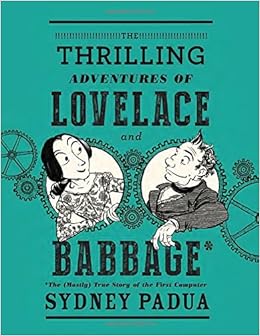
Pretty much as soon as I heard about Sydney Padua's graphic novel The Thrilling Adventures of Lovelace and Babbage, I wanted to read it.  A graphic novel set in some sort of alternate universe in which Ada Lovelace grows old and uses computers to solve crimes with her genius-but-awkward partner, Charles Babbage?  Yes, please!

I was a little overwhelmed by this book at the beginning.  There are a LOT of footnotes, basically at the rate of one per sentence.  Most of them are related to mathematical theories, historical writing, obscure (to me) Victorians, etc.  I admit I didn't read all of the footnotes (mostly because, in addition to footnotes, there are also extensive endnotes), so it's possible I missed some key action points in the book.

But honestly, I didn't really care.  This book was fun, regardless.  I love the idea of just turning Victorian society on its head and showing us that maybe some of them had well-developed senses of humor and mischievous smiles and poorly-timed snorts of derision.  I always imagine Victorians as either completely buttoned up or letting loose in bizarre ways, and I liked how Padua made the Victorians much more vivid and real and relatable.


And at the center, of course, are Ada Lovelace and Charles Babbage.  (And, to a lesser extent, Queen Victoria.)  Partly because of the sense of motion and vigor in the artwork, partly because of Padua's great sense of fun, and partly because Ada Lovelace and Charles Babbage were just amazingly larger-than-life characters, they really made the stories come alive.

But it's not all fun and games.  Well, it is.  But it's also science and math and economics and probability and so much more.  Basically, these stories are based on the premise that Lovelace and Babbage design and refine a very complex machine (the Difference Engine) that Queen Victoria would like to use to solve ALL THE PROBLEMS.


And they make many reasonable (and unreasonable) attempts to do so, or solve more mundane matters, even including a fantastic cameo by George Eliot.  But generally, they don't really make great progress.  But again, who cares?  It's so fun.

I really enjoyed everything about this book, and I learned a lot of fun history and science along the way.  It is so entertaining and just so fun to read; I highly recommend it to anyone with even a modicum of interest in Ada Lovelace, computers, technology, Victorian England, pocket universes, or anything else.

Thursday, March 6, 2014

Review-itas: History Audiobooks Edition

Simon Winchester's The Meaning of Everything is about the epic undertaking of creating the Oxford English Dictionary.  The process took years.  DECADES, even.  Like, more decades than most people in the era really lived.  I suppose this is reasonable, as there are a lot of words in the English language, and I can't even imagine how one goes along cataloging them and defining them.  And how political it can become.  For example, the word American was put into the first edition of the dictionary, but not African.

Winchester shares a lot of anecdotes such as the one above, and others that are much more humorous and interesting as well - a kleptomanic assistant, the little jokes the compilers put into their example sentences, the difficulties with printers... it's an entertaining book, though not supremely fascinating, and I am pretty sure that I won't remember anything from it except that the dictionary took about 70 years to create.  Ah, well.  It was fun!

Longbourn is also set in England, though during the Georgian era, not the Victorian.  This book has gotten a lot of attention recently as it is kind of a spin-off from Pride & Prejudice, but it hardly references the people and actions of that great novel; rather, it focuses its attention on the servants who work for the Bennets.  Poor as the Bennet family is, they are wealthy enough to have servants, and the servants have a very different life view than they do.  All they do, really, is work, and so they are both fascinated and repelled by people who can spend so much of their lives in leisure, and who seem to have no regard or thought for other people's comfort.

The stars of this book are the servants, particularly Sarah, the housekeeper Mrs. Hill, and the new footman James.  I enjoyed learning about how they spent their days, their small victories and never-ending exhaustion.  However, I felt very separate from them in this novel.  Maybe it was because of the narrator, but it felt to me like there was a great distance between the reader and the main characters, which was unfortunate.  Also, I found parts of this book pretty dull.  I really enjoyed learning about the "downstairs" life of a Jane Austen novel, but the characters were just so quiet and tired, I did not grow to love them as I loved Elizabeth Bennet, with her wicked sense of humor and fine eyes.

I am hoping to read more short story collections this year.  One that caught my eye was When the Emperor was Divine, by Julie OtsukaIt's about one family's experience of the Japanese internment camps in the US during WWII.  None of the family members are ever named; they are referred to as "the woman," or "the girl" or "the boy."  This was a little strange, but I think it was done to make us feel like the story could be about any family, not just one.  While the book feels like one story, it really is a series of vignettes told from different POVs.  It was very illuminating to learn about the internment camps; while the "guests" were not necessarily treated horribly in the camps, they were given no compensation after they left, and many people came back to homes that had been poorly maintained, their belongings stolen, and many Japanese-Americans had trouble finding work after the war.

While I didn't love this book, it did really pique my interest in the internment camps.  I have Hotel on the Corner of Bitter & Sweet on my shelf to read, so I'll be sure to pick that one up soon!

Monday, October 7, 2013

Helen Keller, in her own words

The Story of My Life
I became obsessed with Helen Keller when I was in grade school.  At my school, every year for your birthday, you got to go to the principal's office and choose a book from a small bookshelf.  And then the principal, Mrs. Webler, would put a pretty birthday sticker on the inside cover and write you a personalized note, and you were so excited to go home and read the book!

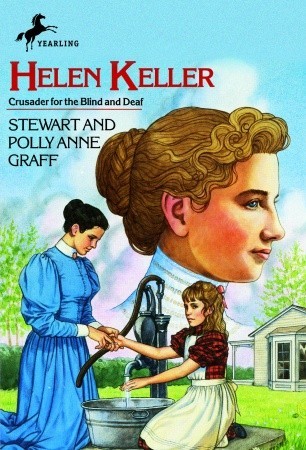
One year, I picked a book about Helen Keller.  (See below.)  And it was so good!  I still remember it vividly.  It started with her birthday and she threw a serious tantrum, and then her teacher Anne Sullivan enters the picture and the world explodes and things get way better.  Now that I've read Helen Keller's The Story of My Life, I can tell that the book I read as a kid was based on this autobiography.

I enjoyed Helen Keller's story, though I did not realize The Story of My Life (which, from the title, sounds like it would be a COMPLETE autiobiography) only went from her childhood through early college.  I was hoping it would be about her later life, when she became such a great advocate for women, the handicapped, minorities, socialism and all sorts of other causes.  She was such a radical!  I wanted to read all about it.

I assume those parts of Keller's life come up in her other books, as they did not come up at all in this one.  This makes sense, as Keller wrote The Story of My Life when she was 22, so she was obviously quite young.  But the only other autobiography she wrote, The World I Live In, was written only five years later, so I am not sure if it will give me everything I want to know, either.  She lived into her 80s!  I thought there would be more memoirs.  But perhaps I should read a biography of her by someone else instead - anyone have any recommendations?

The Story of My Life is an interesting book to read even though it wasn't exactly what I expected.  It gave so many great insights into Helen Keller's personality and her determination to do well.  How does someone who barely remembers sound learn how to speak?  It's amazing that she was able to do so, by spending hours feeling people's mouths and tongues and throats to mimic the movement and therefore make the sound.  She also learned how to use a typewriter and used the typewriter for her college entrance exams and exams while in college.  She would type up her answers and then someone would read them back to her and then she could make annotations or amendments at the end.  It's really fascinating!

It was interesting the way that Keller described things, too.  She would use color imagery even though she did not know colors, because she knew that other people would understand that and the scene would come alive more for them that way.  I wish she hadn't done so much of that, actually.  She was so good with words, so eloquent, that I think knowing how she experienced the beach or the warmth of the sun or autumn - any of those experiences that so many of us take for granted - would have been revelatory to know about.  She did go into some detail about how she prefers the country to the city because the air just feels different, and I wonder if she preferred one season to another for similar reasons.

Helen Keller is one of those monumental people whom history has stripped of opinions and rough edges and made into a saint of some sort that we know more in the abstract than in the actual.  Much like Johnny Appleseed and George Washington, we admire them for the vague sound bites we know of them without really understanding their personalities or motivations.  By reading The Story of My Life, I got a better hint of Helen Keller's self (or, at least the self she was willing to share publicly), and I appreciate that.  But it didn't give me everything I wanted to know about her, so I still need to find a more thorough lens through which to view her life.

Monday, March 25, 2013

Schoolgirls Form Clique, Discover Other Realms

A Great and Terrible Beauty
I continue my quest to make a dent in my TBR pile, often with the assistance of the Chicago Public Library's extensive collection of e-books.  I've had A Great and Terrible Beauty on my shelf since 2006.  As often happens when it takes you more than six years to read a book, I don't think this is one that I would pick up nowadays.

It's a young adult book about four teenagers in a Victorian era finishing school who find that they can do magic.  The main character is Gemma, who I guess is fine, though "not handsome enough to tempt me" into wanting to read two more books about her life.  In fact, I decided to read this book mostly so that I could get it off my shelf as I had a feeling I wouldn't be continuing with the series.  This has been confirmed.

Gemma, then.  She feels a lot of guilt over the death of her mother, has a priggish older brother, and feels very awkward and out of place in boarding school because she grew up in India (a country she despised while she was there).  But then she finds other girls who also have Heavy Weights to bear (even though they aren't very nice) and they discover magic together and things seem to improve.

So, I admit that this book set up my back from the very first because of just how ridiculous the portrayal of India and Indians was.  The very first page starts like this:
"Please tell me that's not going to be part of my birthday dinner this evening."
I am staring into the hissing face of a cobra.  A surprisingly pink tongue slithers in and out of a cruel mouth while an Indian man whose eyes are the blue of blindness inclines his head toward my mother and explains in Hindi that cobras make very good eating.
SERIOUSLY?!  Yes, because Indians eat cobras all the time and obviously, when you encounter a man with a snake on the street, you assume that he is offering to sell it to you for a meal.  I am surprised she didn't first describe him as charming it with a flute.  I am not even five sentences into the book and already I am thoroughly offended.

 And quite honestly, Libba Bray could have been outstanding from that point onward and I would probably still not forgive her.  But I don't think this book was for me.  The characters seemed very one-dimensional.  Gemma's brother is a supremely stereotypical Victorian male who thinks women shouldn't do anything but be ornaments.  Her roommate is a poor orphan who also happens to be ugly and have a stutter.  There's the cruel, beautiful girl that, for some reason, everyone wants to be friends with, and that Gemma stands up to when no one else will.  And all the girls spend a lot of time bemoaning their futures as Victorian women.  Which I get, as they always revolved around marriage and not making a fool of yourself and making sure your corset was tied tightly.  But also, I don't think that many teenagers would spend so much time thinking about how unfair it was.  I don't remember spending much time thinking about feminism when I was in high school, but perhaps I am an anomaly.

I think what originally appealed to me most about this book was that it was fantasy set in the Victorian era.  While this genre has recently exploded and we're filled to the gills with steampunk and other novels of the sort, I do think Libba Bray was one of the earlier authors to write in this vein.  So thanks to her for that!  But I just couldn't get over those first scenes in India, and the rest of the book didn't draw me in enough to make me want to continue with the series.  Perhaps if I had read this book right when I got it, I would have been swept away and pulled into the magic of it, but six years later, it wasn't for me.

Tuesday, February 5, 2013

Two Women Race Around the World, Wearing Bustles

Eighty Days by Matthew Goodman
After reading Ten Days in a Madhouse by Nellie Bly last year, I became fascinated with this plucky, intrepid reporter who broke gender barriers in Victorian New York.  I was excited to see that there was a new book out about Nellie Bly's record-breaking trip around the world - and that another woman was involved in this race, too.  Eighty Days:  Nellie Bly and Elizabeth Bisland's History Making Race Around the World, by Matthew Goodman, was one book I was very excited to open.

But, once opened, it took me a long time to make much progress in this one.  The book isn't inordinately long - it clocks in at 376 pages - but it was filled with so many tiny, unnecessary details.  It felt much more like a slog than it should have, considering how amazing the two women profiled were.

First, Nellie Bly, undercover reporter extraordinaire.  She got her start by sending a snarky letter in response to a newspaper editorial that extolled the virtues of women staying in their sphere, the home.  Nellie pointed out that this wasn't an option for poor women and that the writer should open his eyes to the world around him.  (Good stuff, Nellie!)  This got her a full-time job and she eventually moved to New York City, becoming an undercover reporter who brought attention to the plights of the poor and forgotten and was glamorous enough to have an on-again, off-again, super-handsome might-be boyfriend.

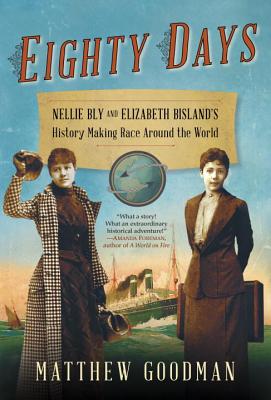
Then there's Elizabeth Bisland, a woman who has been mostly forgotten to history but was well-known in her time.  Often described as being a beauty (interestingly, Nellie Bly was always described as being plain, but the two women in the pictures on the cover look very similar to me), she was a southern woman whose family became destitute after the Civil War.  She got her start by publishing poems and then became literary editor of The Cosmopolitan magazine.  Bisland held literary salons and had a really awesome group of friends.

Monday, January 21, 2013

A Victorian Role Reversal Mystery

The Thing about Thugs
There are so many good aspects of Tabish Khair's The Thing About Thugs.  It is a sort-of mystery set in Victorian London, which is always a fantastic setting for a mystery.  It features a narrator with two narratives - one he tells an Englishman looking for a story about the Thugee cult, and one that is his real life story.  There are body-snatchers hatching nefarious plots, wealthy lords obsessed with detailing the biological differences between the races to prove that whites are the best.  Taking center stage in the second half of the story is a fascinating Indian immigrant woman who solves the mystery and brings things to a very satisfying conclusion without ever leaving her home.  So many good things happening here!  And yet.

But let's start at the very beginning (a very good place to start).  Amir Ali journeys to England with Captain Meadows after sharing a story about his life as a member of the famed Thugee cult.  But we quickly learn that Amir's story is not so straight-forward.  He used Captain Meadows just as much as Captain Meadows used him, to achieve his own ends.  And when he comes to England, he has big plans to start a new life.  But a series of brutal murders in which the victims are decapitated and left without their heads has shocked London and Ali, foreigner and former thug, is the prime suspect.

Monday, December 10, 2012

Musings: Dodger

Dodger Terry Pratchett
Terry Pratchett's Dodger is set in Victorian era London and populated by many notables of that period - Charles Dickens, Sweeney Todd, Sir Robert Peel, and a few more names that will jog your memory.  The main character, though, is the Dodger of the title, a happy-go-lucky, street savvy teenager who makes his living by finding coins in the sewers.  Dodger has a chivalrous streak; one night, he sees a woman being beaten by thugs and saves her life.  And then spends most of the book trying to figure out who did it and how he can keep her safe.

 Dodger is very kind person - that's clear from the very beginning and it's one of the most simple reasons I love Terry Pratchett so much as an author.  All of his main characters are very nice and clever and practical.  This may seem like a small thing, but I don't know that it is - there are a lot of authors who write a few nice characters, but not many who write so many consistently nice characters as Terry Pratchett does.  Sure, that may lead to very black and white renditions of good vs. evil, but I don't think that is in any way a negative with Pratchett.  He brings to light so many OTHER things that you probably don't think of very regularly that the whole good vs. bad thing kind of takes a back seat.

Tuesday, November 13, 2012

Musings: The Third Miss Symons

The Third Miss Symons is a remarkably well-written novella about a remarkably unlikeable Victorian woman.  It's a story that warns of the danger of an idle mind and a bad temper.  Hop on over to the Project Gutenberg Project site to see what I thought of it.

Thursday, October 11, 2012

Musings: The Lost City of Z

The Lost City of Z
David Grann's The Lost City of Z has been on my radar for a while, but came to the fore recently after I read 1493.  I wanted to learn more about the ancient Americas and the civilizations that thrived there, and Grann's book seemed like a good introduction to the topic.

I listened to The Lost City of Z on audiobook, a format I've found can either be really good or really bad for me.  I have the propensity to let my mind wander while driving to work or working out at the gym.  This is generally not a good idea with non-fiction titles as I lose track of chronology and the cast of characters and then struggle to get back into the groove of the book.  That happened to me with this book, too.  While I found the parts I did pay attention to absolutely absorbing, I must admit that there are some characters who seemed to show up out of nowhere to me and others that disappeared without a trace, and I'm sure that is due to my lapses in attention.

Monday, September 10, 2012

Musings: The Richest Woman in America

The Richest Woman in America
Janet Wallach's The Richest Woman in America:  Hetty Green in the Gilded Age is ostensibly about Hetty Green, a woman who inherited a lot of money, sued a lot of people for even more money, and died even richer than she was originally because she was a very shrewd investor.  She sounds like a really feisty and interesting woman, but unfortunately, Wallach doesn't seem to have had much information about Hetty herself.

The book is very general in tone.  Green was a very private woman, and she wasn't particularly well-liked by her peers.  She wanted women to have access to greater education, but she did not support women's suffrage.  She hated lawyers, but she loved suing everyone.  She used her money to stabilize the financial system and lent money to New York and Chicago, but she also could hold a deep grudge and made sure that those she disliked were punished.  It would have been really, really great to get some insight into her character.  But Green left no diaries.  She didn't share anything very deep in her interviews.  There is no depth to her in this book.  We see her go through the motions of her life and defend what she considered to be her own, but we get no read on her truly complex personality.  For someone who was so rich, she seemed terrified of being left poor and alone and spent very little money.  She didn't get along well with anyone in her family.  She was controlling and paranoid.  But she was also brilliant.  And, for me, Wallach failed to bring that complexity to life and make Green a 3-dimensional person.  Instead, the richest woman in America seemed flat, stingy, and paranoid.

Wallach drew a lot of parallels between life in the Gilded Age and life now.  She compared Hetty Green to Warren Buffett and points out that rampant speculation caused recessions in the late 19th century just as it is doing in the early 21st century.  Not exactly revolutionary thought.  She also shared some of Green's quotes, none of which seemed particularly revolutionary, either.  Hetty Green, for example, believed in buying when prices are low and selling when prices are high.  (Isn't that what everyone believes?  It's the actual execution of this that is difficult.)

The book provides a picture of the financial markets in the Gilded Age, which I enjoyed because I don't know much about that era at all.  But the book did not provide any great detail or insights into a woman who succeeded so brilliantly in a man's world, and that's what I wanted.

Note:  This review is based on an advance reader's copy.  I received this book for free to review. 

Monday, July 30, 2012

Musings: The Woman in White

I can't have been the only person to read this and think, "Clearly, Hartwright is in love with Marian and just doesn't realize it because she has a mustache."

RIGHT?

I mean, seriously, what does Laura have going for her besides an angelic countenance?  She's obviously not particularly bright, can't draw to save her life, has a pretty warped sense of priorities, suffers from a seriously weak immune system for no apparent reason, and signs away a hefty fortune.  But Marian.  The woman is amazing!  She is smart, brave, intrepid, well-formed, loyal, kind, and scrappy.  How cruel, Wilkie Collins, to make her some sort of monstrosity to look at to compensate for her overwhelming awesomeness.  What, a woman can't be smart, pretty, and brave?

So many things happened in this book!  And it was populated by so many well-drawn characters, all of whom had such distinct, individual voices (except for Laura, who had very little personality at all, but she was pretty and that's all that matters).  Want to know more?  Check out my review on the Project Gutenberg Project blog.

Monday, June 25, 2012

Musings: Ten Days in a Mad-House

 It's hard to resist a title like that, isn't it?!  I certainly couldn't.  I listened to an excellent Librivox recording of intrepid Victorian undercover female journalist Nellie Bly's book on her time spent at the Women's Lunatic Asylum on Blackwell's Island in New York City.  Wow.  It was really eye-opening.  And Bly didn't stop there - she went on to travel the world in just 72 days (take that, Jules Verne!) the next year, and soon settled down to marriage with a millionaire industrialist 40 years her senior.  Oh, and registered a few patents in her own name.  Ain't no thang.

The woman was fantastic!  And Ten Days in a Mad-House was a good read, too (not FUN, but wow).  I highly recommend it!

If you'd like to hear more of my detailed thoughts, they are at the Project Gutenberg Project blog.


This is just such a hilarious caption I couldn't resist.


Monday, June 18, 2012

Musings: Tooth and Claw

Tooth and Claw
I recently came to the sad conclusion that I have no love for Victorian writers.  They are moralistic, long-winded, class-conscious and often sexist.

But after reading Tooth & Claw, by Jo Walton, I realize that my problem with Victorian novels is that they are not written from the point of view of dragons.  As a rule of thumb, dragons make everything better, but they infinitely improve a Victorian novel.

I first encountered Jo Walton's supreme awesomeness in Among Others, where she casually referenced about 500 science fiction novels to help tell her coming-of-age story of a girl from Wales.  Just as Walton played with the tropes of magical realism in that book, here she plays with the traditional Regency and Victorian comedy of manners novels of old.  But she doesn't do this in a Pride & Prejudice and Zombies or Abraham Lincoln:  Vampire Hunter way.  Walton doesn't infuse the Victorian novel by adding fantasy to an already existing novel.  Rather, she refreshes it in a way that yes, involves dragons (for which we are all grateful), but also brings attention to the real issues and difficulties faced by individuals of the time by alluding to them through the fantastical world she's created.

Wednesday, May 30, 2012

Musings: Emily Fox-Seton (The Making of a Marchioness)

I (tried to) read an omnibus edition of Frances Hodgson Burnett's The Making of  Marchioness and The Methods of Lady Walderhurst.  I got through the first book, though I didn't enjoy it much.  I did not make it through the second book because I came across one sentence that so angered and offended me that I had no desire to continue.

If you want to read more details on my reaction to these books, check out the Project Gutenberg Project blog, where I have posted my review.  Let me know what you think!

Monday, May 21, 2012

Musings: The Log-Cabin Lady

"It will probably surprise you to learn that when I was fourteen years old I had never seen a table napkin. My family were pioneers in the Northwest and were struggling for mere existence. There was no time for the niceties of life. And yet, people like my family and myself are worth serving and saving. I have known what it means to lie awake all night, suffering with shame because of some stupid social blunder which had made me appear ridiculous before my husband's family or his friends."

The Log Cabin Lady is an anonymously told American Cinderella story.  A country bumpkin goes to New York and meets a handsome blue blood.  The two fall in love and marry.  But, for Cinderella, that marks the beginning of a very difficult transition from country girl to society girl, one that caused her no end of panic and grief.

To see my thoughts on this book, head to the Project Gutenberg Project blog- hope to see you there!

Friday, March 16, 2012

Musings: Island of Vice

Island of Vice
Island of Vice:  Theodore Roosevelt's Doomed Quest to Clean Up Sin-Loving New York is one of those non-fiction books with very eye-catching, scandal-promising titles that hopes to lure you in with the promise of sex and sin.  There's a little sex and sin and scandal, but mostly this book is about Teddy Roosevelt himself and his rise from Police Commissioner of New York City to President of the United States.

The vast majority of the book, though, is about his time as police commissioner.

Theodore Roosevelt is the favorite president of many of my friends.  He led quite a storied life- not only was he an East Coast blueblood, but he also had a ranch out west where he bucked broncos, he was a hero in the Spanish-American war, and he established our system of national parks.  He also was very emotional and passionate, easy to anger.  As the Washington Post once said, "He slays a hippopotamus or cracks a flea with the same overwhelming ardor."

When people write about Roosevelt, they often brush over or idealize his stint as police commissioner.  But, as this book details (in great detail), Roosevelt faced a lot of criticism in his time as commissioner and set up a lot of backs of both his Republican party and the very corrupt Democratic party.  His efforts make the police force strong and get rid of corruption shook a lot of things up, and his determination to enforce all laws - particularly the law banning the sale of alcohol on Sundays - made him very unpopular in the city.

Tuesday, January 24, 2012

Joints Musings: The Wonderful Adventures of Mrs. Seacole in Many Lands

Mary Seacole Diary
I've mentioned many times before that my great love for my Kindle stems almost entirely from the massive, obscure, esoteric and fabulous free library that is at my disposal through Project Gutenberg.  I often look through the Gutenberg website specifically for memoirs written by women, and I came across The Wonderful Adventures of Mrs. Seacole in Many Lands in exactly this manner.

Mary Seacole was a mixed race woman born in Jamaica in the 19th century.  She was married and widowed young, and never remarried, instead running several hotels throughout the Caribbean and becoming a very capable nurse.  When the Crimean War started, she decided to take her healing skills to the front and took on a substantial loan to travel from Jamaica to England and then to the Crimea to open a hotel and tend the soldiers there.  She was a very strong, determined and fascinating woman and I was so excited to read about her.

Ana from things mean a lot read the book, too, and below is the first half of our conversation about the book (and a much more general conversation that stemmed from the book but doesn't relate directly to it).  For the second half of the conversation, visit Ana's blog- it has a lot of the good bits on a woman's place in Victorian England and the fine line between what we say drives us to do things and the motivation that actually does drive us.  I hope you enjoy it!

Thursday, June 16, 2011

Musings: The Map of Time

The Map of Time
The Map of Time, by Felix Palma, is a massive novel about H. G. Wells, time machines, the power of suggestion and the desire to change past decisions.  It is really three novellas in one volume, all revolving around H. G. Wells' novel The Time Machine and a man named Gilliam Murray who claims he can transport people to the year 2000 to witness the final battle between the survivors of the human race and the automatons.  The first is about Andrew Harrington, a wealthy young man who falls in love with a Whitechapel prostitute who is then murdered by Jack the Ripper.  The second is about Claire Haggerty, a woman who believes herself to be in love with a hero from the future that she met while time traveling.  The third is about H. G. Wells himself, and the task set for him to save the world from rogue time travelers.

Weighing in at over 600 big pages, there's a lot going on in the plot that I didn't fit neatly into the three sentences above.  There is, in fact, so much plot that I didn't feel much connection to the characters; they seemed dwarfed by the story arc Palma created.

Friday, May 20, 2011

Musings: The American Heiress

The American Heiress
Daisy Goodwin's The American Heiress is a book that I was both excited and nervous to read.  It is full of those ridiculous accolades books these days get- comparing it to the works of Jane Austen and Edith Wharton and probably any other author who writes about the English class system.  This generally sets off warning bells in my head because well, quite frankly, there aren't many people who can write like Jane Austen (or Edith Wharton, I presume, though I've never read her myself).  It's putting a lot of pressure on Goodwin to compare her to those two.

There were other blurbs, too, saying that The American Heiress was a "guilty pleasure" of a read, and that set off all sorts of warning bells.  Jane Austen and Edith Wharton aren't really guilty pleasures reads to me.  I think more of Phillippa Gregory and the bodice-rippers as guilty pleasures.

So it was with some trepidation that I started this book, especially upon learning the heroine's name was Cora Cash (I mean, really?) and that one of the opening scenes is her bullying her maid into teaching her how to kiss properly, complete with a practice run between the two girls.  (Pretty sure Jane Austen would never write that scene!) Cora is the richest heiress in America in the 1890s, and her mother is determined that her daughter will have an English title to go along with all that money.  So they travel to England where Cora has an unfortunate riding accident, is rescued by an attractive man who just happens to be a duke, and spends about a week recovering at his ancestral home, much to her mother's delight.  (Jane Austen definitely already wrote that scene.)  The duke eventually proposes, and Cora begins her life as the Duchess of Rakeham.  But she soon learns that money does not a duchess make, and must deal with the travails of English high society even while she realizes that she doesn't know her husband very well at all.  And her maid?  She's got problems of her own to deal with, too.

Thursday, April 7, 2011

Musings: A Spy in the House

A Spy in the House
A Spy in the House is the first book in a new Victorian era mystery series called The Agency.  The Agency is a secret spy network of women in London who are called upon to investigate situations that call for discretion and observational skills- two things that Victorian women are very good at, particularly in comparison to their male counterparts.

Mary Quinn is the newest recruit to The Agency and her first assignment is to act as a companion to a spoiled brat of a young woman whose father is suspected of illegally importing opium and rare Indian jewels to England.  While with the family, Mary meets Mr. James Easton, who is investigating the family for his own personal reasons.  The two team up in hopes of quickly understanding what is happening, before anyone gets hurt.