Showing posts with label African-American. Show all posts

Tuesday, May 30, 2017

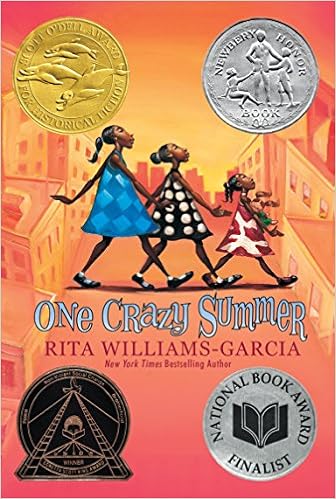
Rita Williams-Garcia's One Crazy Summer

Rita Williams-GarciaI first heard about the book One Crazy Summer, by Rita Williams-Garcia, on Ana's blog in 2014.  Me being me, I read the book in 2017.  So I'm a little late to the party, but the party is still excellent!

One Crazy Summer is set during the summer of 1968.  Delphine and her sisters are shipped from their home with their father and grandmother in Brooklyn, New York to stay with their mother (who emphatically did not want them) in Oakland, California.  Their mother, Cecile, is pretty eccentric and hands-off, so Delphine and her sisters spend much of their time in a summer camp run by the Black Panthers, learning about civil rights, strength, and unity. 

Williams-Garcia's note at the end of the book emphasized that there were children also involved in the fight for civil rights, and this book is a brilliant way of showing that involvement.  It's also about as complex as a children's novel can be about familial baggage. Cecile left her family and took off for the other side of the country.  She isn't motherly or very caring at all in the book, to the extent that the resolution at the end felt a little forced to me.  But as an adult reading the book, it's easy to empathize with her and her desire to make her own choices and live her own life.  Serious kudos to Williams-Garcia for making Cecile a complex, complete person with her own struggles and motivations, some of which are unrelated to her role as a wife or mother or caregiver.

And Delphine and her sisters are wonderful.  I loved the way they stick together and then bicker and then come together again.  I love how they all know each other so well but continue to surprise and challenge each other.  I love that they all just got up and went to San Francisco together for a day on their own.  I loved the sweetness of Delphine letting herself go one moment to scream with joy as she goes down a big hill, instead of always being the grown-up.

One of my favorite things about this book is the way it portrayed the Black Panthers.  This is not the paramilitary, extremist organization that many people learn about in school.  It's one that provided free meals in neighborhoods and organized summer camps that taught children that they were important and valued.

 I read this book for a bit of lighthearted fun after so many heavy, difficult books over the past few months.  It was so easy to read and so lovely, but it certainly has depth and more heart and kindness than you would expect in such a slim, quick read.  I can't wait to continue the series!

Monday, April 17, 2017

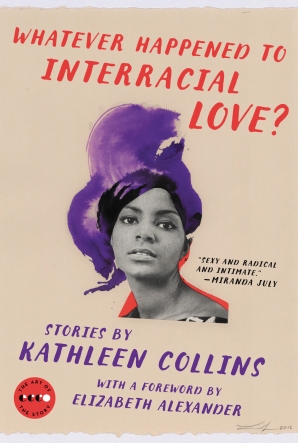
Whatever happened to interracial love?

I heard about Kathleen Collins and her collection of short stories, Whatever Happened to Interracial Love?, in the New York Times Book Review, where I get many of my reading recommendations (and which has gotten better at reviewing books by people who are not white and male).  Kathleen Collins was active in the civil rights movement of the 1960s, but most of her artistic work (films, plays, short stories) was produced in the 1980s.  Her short stories were, for the most part, never published.  Her daughter discovered them in a trunk.

It's always hard to judge artistic talent by stories left unpublished in a trunk, mainly because it's hard to know if these stories were complete or if the author still wanted to work on them.  But the romance of the whole situation is just too much to pass up!  Undiscovered author!  A trunk!  The perfect cultural moment!  Stories on race, gender, sexuality!  It's a lot of awesomeness.  If it could happen for Emily Dickinson, can't it happen for other people, too?

I think it can, sometimes.  But sometimes the collection can also be pretty inconsistent.  I think that's true for Kathleen Collins.  There is so much wit in her stories, so much that speaks to how fascinating and vibrant she must have been, how much fun she must have been to talk to.  But there are other stories that feel unrefined or directionless.  Whatever Happened to Interracial Love? is more a collection of what was great potential, lost too early (Collins died of cancer in 1988 at age 46). 

The stories are mainly pretty short, and race is alluded to in almost all of them.  One story is told from the point of view of a man describing the perfect family, a close-knit unit that was beautiful, intelligent, and got along well.  But then cracks start to show, and it turns out the family's future is not nearly as happy as one would hope.  In another, a woman loyally sends letters and gifts to her husband in prison.  When he gets out and moves to a foreign country (without her), she finds peace in a small, rural home and some new friends.  In "The Uncle," the narrator relates the story of his uncle, who is ill and whom many describe as lazy for his whole life.  But the narrator, upon reflection, thinks that his uncle was a hero, just for surviving..
But his weeping, wailing, and gnashing of teeth brimmed potent to overflowing in the room, and I began to weep for him, weep tears of pride and joy that he should have so soaked his life in sorrow and gone back to some ancient ritual beyond the blunt humiliation of his skin, with its bound-and-sealed possibilities; so refused to overcome his sorrow as some affliction to be transcended, some stumbling block put in his way for the sake of trial and endurance; so refused to strike out against it, go down in a blaze of responsibilities met and struggled with.  No.  He utterly honored his sorrow, gave in to it with such deep and boundless weeping that it seemed as I stood there he was the bravest man I had ever known.
There was silver and gold in all the stories collected here, even if all of them didn't stick with me.  So much about how difficult life can be when people expect so little of you, or treat you like you are less than what you know yourself to be.  So much about the struggle to understand your parents or your children, about competing priorities for different generations and what they decide is worth fighting for.  It's a lovely collection and well worth seeking out.  Not only because it's amazing to discover the unknown work of a feminist civil rights cultural icon, but because the stories are quite good, too.

Wednesday, April 5, 2017

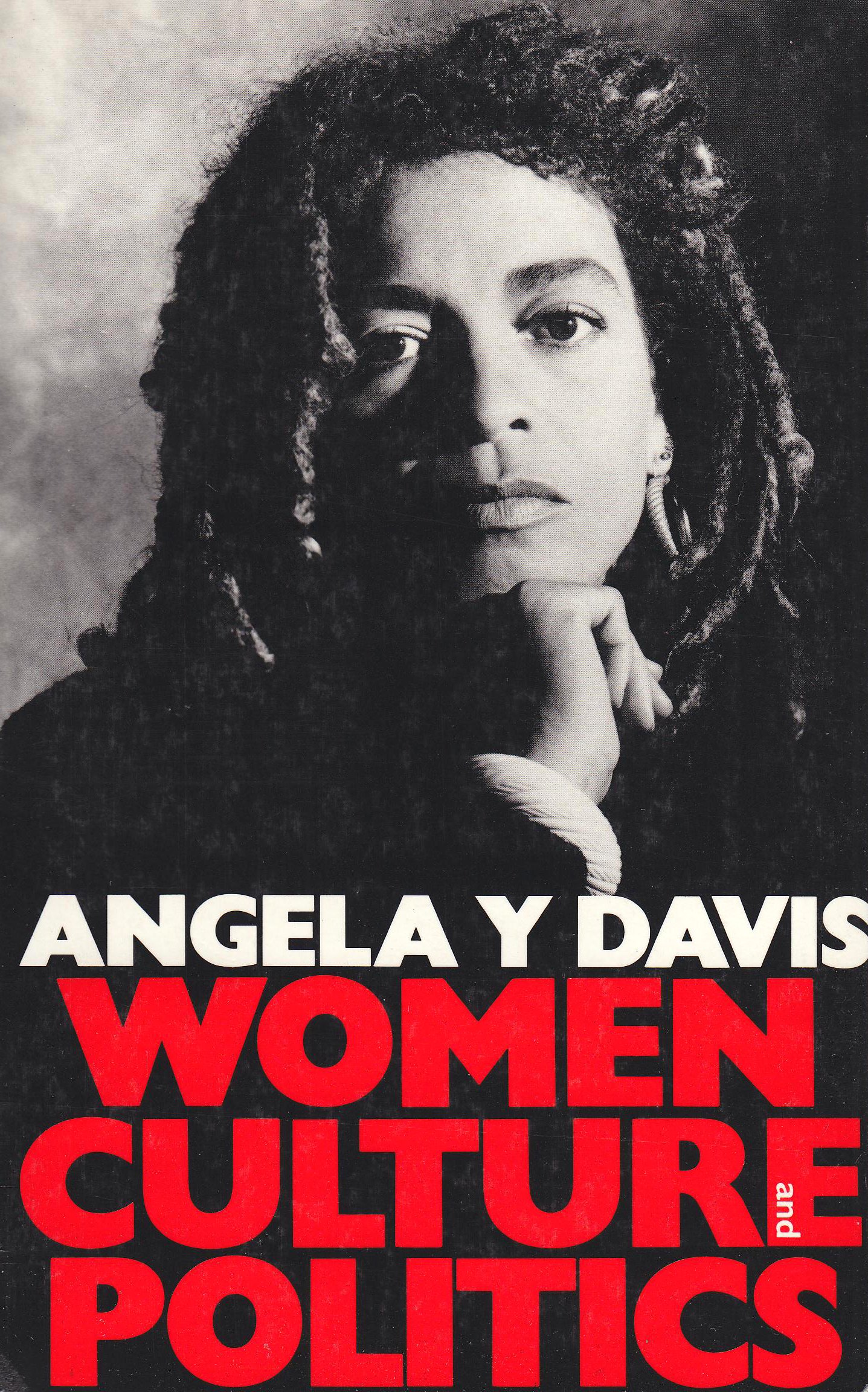
Women Culture and Politics

Angela Y Davis
Women Culture and Politics is the first Angela Y Davis book I've ever read.  For those of you who may not know, Angela Davis is a hugely influential feminist communist activist.  She was very active in the 1960s with the Civil Rights movement, fought hard against Ronald Reagan when he was governor of California and when he was president, and continues to serve as a voice of resistance and strength.

Women Culture and Politics is a collection of Davis' essays and speeches from the 1980s and 1990s.  I am not sure if it is the best book to start with, but I think this is mostly due to the format.  I admit that my grasp of history from the 1980s and 1990s is not quite as extensive as I would like, and Davis' essays are very much commentary on the times.  I wish that there was an introduction to the collection as a whole or to each specific essay so that I had a better grasp and understanding of the context in which she was writing the essay or delivering the speech.  That would have helped me a lot to fully understand Davis' points.

[Side note:  That said, I really need to learn more about the entire Reagan presidency.  Does anyone have a book they recommend for that?  I feel like Reagan comes up a LOT these days, and I would like to understand more of our history with Russia and Latin America and all the rest.  So, please let me know if there is any book you think would be a good one to get some background!]

While some of the context of Davis' points was lost on me, a concerning number of points were still very relevant.  I suppose in the grand scheme of things, 30 years is not so long a time in which to make real change in society.  But it still feels depressing. 

One thing Davis talked about in her essays comes up a lot in liberal discussion these days.  And that is identity politics.  I have been very up and down on identity politics and the impact of identity politics on our election and on the way people describe themselves now.  I 100% believe that people should feel comfortable being their truest, best selves, and that they should feel safe enough to be open about who they are.  But I also can feel exhausted by the number of identifiers everyone feels the need to use these days.  And I am very concerned by the way identity politics has led to white nationalism and supremacy.  Davis' approach to this is that everyone should come together. 
"...we must begin to merge that double legacy in order to create a single continuum, one that solidly represents the aspirations of all women in our society.  We must begin to create a revolutionary, multiracial women's movement that seriously addresses the main issues affecting poor and working-class women."
This comes up again and again in Davis' writing, this idea that rich, white women seem to fight a completely different battle than working class women of color, and that they often forget to fight for the rights of people who are not as well off as they are.  This is still relevant today, and it came up a lot with the Women's March on Washington and it continues to come up with women's rights now when we talk about Planned Parenthood (which we seem to talk about all the time).  It continues now as people obsess over the rural white vote.  I feel like there must be a way to talk about the issues in ways that are less divisive but that doesn't make people feel left behind.  But do we all just jump too quickly now to take offense, to say, "What about me?  You mentioned everyone's suffering but mine!"  And instead of giving a person the opportunity to go back and consider and grow, we assume the worst and shame the person and then the person gets so nervous about saying anything wrong, but doesn't actually change his/her inner thoughts.  Just hides them.  And then we are where we are.

There is a LOT in this book that is amazing.  I folded so many pages down to note down quotes.  It would be too much for me to share them all with you, so I recommend that instead, you just read the book and feel all the feels and become a Davis fangirl.  I plan to read much more by her, and I look forward to the way she will challenge my thinking.

Monday, January 9, 2017

The Warmth of Other Suns, by Isabel Wilkerson

Isabel Wilkerson
I took advantage of having a big chunk of free time off work between Christmas and New Year's to tackle a big, meaty book.  I saw Isabel Wilkerson speak during the Chicago Humanities Festival after the election in November, and I had a feeling that her book would be a great one for me to read to start the new year.

The Warmth of Other Suns is about the Great Migration, the movement of African-Americans from the Jim Crow South to the North over several decades in the 20th century.  Wilkerson conducted hundreds of interviews.  Her book compiles many people's stories, though she focuses on three people who left various areas of the South at different times and went to New York, Chicago, and Los Angeles to start new lives.

This book is excellent.  It is 540 pages of personal stories, which probably sounds like a lot, but it is not.  It feels like you are in the same room as these people as they tell you about their lives, the decisions they made, the regrets they have, the people they knew.  It's almost like a gigantic, written version of This American Life.

Like many people, I am struggling to come to grips with the way the world seems to be moving backwards to tribalism, distrust, and fear.  Reading Wilkerson's book was empowering.  When she came to speak at the Humanities Festival, she said something that I keep going back to.  I am paraphrasing, but the gist of it was, "The lesson of the Great Migration is the power of an individual choice.  They freed themselves."

Often, when reading books about minorities in the US, the general trend of stories is the same.  People who are different show up.  The people who are already there become angry.  They treat the newcomers badly (sometimes, really really badly).  The newcomers fight for their rights.  Sometimes they win.  It's an important story to tell because it happens so consistently, probably everywhere, but definitely in the United States.  But it's also just depressing and disheartening.  People are so frightened by anything that is different, no matter how superficial that difference might be, or no matter how ridiculous that fear is.  And they fight back in terrifying, brutal ways.

 But even against all that, a backdrop of hate and threats and physical violence, people fight.  And that's what was so, so wonderful about this book.  Even people with very little of their own, barely scraping by and with no rights of their own - they resisted and they fought and they made the world a more accepting and welcoming and equal place for all of us.  As Wilkerson said, "The Great Migration... was a step in freeing not just the people who fled, but the country whose mountains they crossed... It was, if nothing else, an affirmation of the power of an individual decision, however powerless the individual might appear on the surface."

A few snapshots from this book really stood out to me:
1.  Ida Mae Gladney coming to Chicago in the 1930s and realizing that she had the opportunity and the right to vote and that her vote would be heard and counted.  She had never even bothered trying to vote before.  Many, many years later, she would vote for Barack Obama for Illinois state senator.

2.  Robert Foster's desperate search for a motel to spend the night on his drive to his new life in Los Angeles.  He went from motel to motel and was denied a room at every single one.  Finally, he broke down and told one couple that he was a veteran, that he was a physician, that he meant no harm to anyone and just wanted to sleep.  They still refused.

3.  The story of a man who worked with the NAACP, was locked up in a mental institution, and then escaped with the help of a coordinated effort that had him in a coffin and traveling across state lines in different hearses.

4.  The store clerk who owned a dog and taught that dog many tricks.  One trick was for the clerk to ask the dog if he'd rather be black or dead.  The dog was trained to respond by rolling over and playing dead.

There were many more stories about oppression and resistance, the times people bowed to authority and the times they defied it.  The many ways that people faced indignities and swallowed the insults, turned the other cheek, and then came back to fight another round.  The consequences of leaving behind family and friends to start a new life.  The consequences of working long, hard hours to make a better life for a family that you rarely get to see.  The consequences of moving from the rural south to the industrial north.

I don't think I've done a good job of describing why this book is so moving.  But it's a huge book, and it covers so much!  It's hard to cover all of that in one post.  All I can say is that it is an excellent story of how much progress we've made and the cost of that progress, not only for the country as a whole but for so many individual people.  And it serves as an important reminder that individual decisions matter and can make a difference in the world.

Monday, December 19, 2016

Yaa Gyasi's Homegoing

Like many of the books I review, I first heard about Yaa Gyasi's Homegoing in the New York Times The Warmth of Other Suns is very high on my list of books to conquer in 2017) gave it an excellent review.  When I saw it in a local independent bookstore, I bought it.  This is actually quite rare for me these days; I don't buy books any more as I get most of my books from the library.  But sometimes, I'm willing to splurge on a hardcover book that I have never read before.  I did that for Homegoing, and I'm so glad I did.  The book will be staying on my keeper shelf.
book review.  Isabel Wilkerson (whose book

Yaa Gyasi's novel is about two sides of a family, completely unknown to each other.  Effia, a beautiful girl growing up in what is now Ghana, and her descendants mostly stay in Ghana.  Esi, Effia's unknown half-sister, is sold into slavery and her descendants live in America.  Both sisters and their families are involved in and impacted by the slave trade.  Gyasi follows the families through six generations, showing how much we all struggle to come to terms with our past and how other people's actions can impact our own lives.

Many stories that follow one family over several generations are hundreds of pages long or sprawl out over a long series of books.  In contrast, Gyasi contains her stories in 300 pages.  Because of this, we do not get to know each character very deeply; when we leave a character, we rarely find out what happened to him or her, we only get glimpses from the next generation.  This was very unsettling for me.  I imagine it was even more unsettling for the people whose lives were completely upended through history.  Gyasi's intent seemed more to give us a glimpse into a life, how slavery and colonialism ravaged that life, and how that individual strove to rise above it, from the late 18th century to the present day.

In America, we learn about slavery (though we don't learn about it enough, and we learn about it more in the political sense than in the emotional and individual sense).  I suspect that in Ghana, they learn about colonialism and the slave trade (though they probably don't learn enough, either).  It is rare to see both sides of the coin presented together.  Gyasi does that here to great effect.  The impacts of slavery are felt far beyond America's shores, and the impact of the "peculiar institution" continues to this day.  I loved how Gyasi brought this to life through individual lives.  She obviously did not have the space or time to discuss everything, but she alluded to quite a lot.  Mostly, about how difficult it can be to be black in America, and how haunting it is for people not to know where they come from and what family and traditions they are missing.

In her review for the New York Times, Wilkerson expresses frustration at the way Gyasi shows the African side of the family as fighting for freedom, holding true to their traditions, and enjoying a rich culture, while the American side descends into stereotypes of men who like big butts and do drugs, women who feel like they don't fit in with anyone else because they like reading.  It's a fair critique, though a lot of that might have to do with the fact that Gyasi did not give herself the luxury of spending many pages sharing the characters' stories with us.  Wilkerson wrote a book about the Great Migration that in itself is 600 pages; it would be hard to get that sort of depth and nuance from Gyasi's much shorter novel.  One could flip Wilkerson's frustration and say that Gyasi also seemed to gloss over the impact of colonialism and war on Ghana, with only brief allusions to the fight for freedom.  The scope of world history over the past 250 years would be extremely difficult to fit into one book, so Gyasi chose to allude to more things than to bring them front and center.

What I did love was the way she continued to weave the two sides of the family together, generation after generation.  Recurring dreams that occur on both sides of the Atlantic, a fear of fire and an aversion to water.  Even so loosely connected as the characters are, Gyasi makes clear that there is still a connection.  Similarly, even as each character finds a way to remove himself or herself just a little further from slavery, you can see just how much slavery still impacts their lives.  There are no tidy solutions here.  The past happened, and we must accept that it continues to change and mold the world today.

Slavery is “like a fisherman casting a net into the water. He keeps only the one or two fish that he needs to feed himself and puts the rest in the water thinking that their lives will go back to normal. No one forgets that they were once captive, even if they are now free.”

Tuesday, November 15, 2016

Jeff Chang on the Resegregation of America

A collection of essays by Jeff Chang
Jeff Chang's Who We Be:  The Colorization of America was one of my favorite books of 2014.  When I saw his newest book, We Gon' Be Alright:  Notes on Race and Resegregation at the library a couple of days after the most recent election, I grabbed it as quickly as I could.  Chang excels at showing readers just how politicized race has become.  In Who We Be, he talked about the difficulty of living in both a "multi-cultural" and yet "colorblind" society (basically, you can't have both) and how that leads to erasure and exclusion.  In We Gon' Be Alright, he focuses a lot on violence and segregation.

This book was particularly poignant for me to read after this week's elections for many reasons.  As many, many people have mentioned, a lot of urban "liberal elite" Americans do not know or understand rural America, and this is an issue.  We have left them behind.  They are suffering and they see no great future ahead, and everyone else is "cutting in line."

Chang does not come right out and say it, but one of my main takeaways from this book was that rural Americans isolated themselves.  They were frightened of people who were different than them, so they made it really hard for people who were different than them to move in.  When people did manage to move in, the whites up and moved out again, taking resources with them.  And they kept doing that.  And continued to self-segregate.  Chang quotes Thomas Sugrue in his essay about white flight.  "Fear - not forward-looking optimism - shaped the geography of metropolitan America.  Sprawl is the geography of inequality."  Whites are by far the most segregated group in America, and they are that way because, quite often, they choose to be.

All of the essays in this book are excellent, just as I suspected they would be.  One that I found very interesting was the one on student protest movements on universities.  These movements have made the news a lot in recent months/years, mostly because people seem to think a lot of students are silly and coddled for demanding "safe spaces" and attention.  Chang points out that, after affirmative action was derailed, the percentage of minorities at universities dropped substantially.  There is very little representation at top schools, and even when there is representation, there is very little support.  So these universities decrease the number of diverse students they let in, provide very little support structure for them, ignore their legitimate complaints of racism and discrimination, and then everyone thinks the students are whiny, entitled brats when they make the news, asserting their rights to free speech and to be heard  Media latched onto the story that students were demanding certain speech codes and that trigger words be removed.  But almost always, what students were overwhelmingly demanding was more staff and faculty of color, emphasis on recruiting minority students (and retaining them), increased funding for cultural centers, counseling, etc.  All things that make a whole lot of sense if you feel marginalized, afraid, and lonely.  And if you are the victim of racism, which happens much more often than people realize or admit, and which is often ignored.
...while we are engaged in the culture wars, the most difficult thing to do is to keep the "race conversation" going, because its polarizing modalities are better at teaching us what not to say to each other than what to say, better at closing off conversation than starting it.  In this way those who believe that protesters are dangerous and those who believe they are merely misguided join together to end the necessary discussion the rest of us might want to have, in fact need to have.  If the choice is framed as one of silence versus noise, in the long run most people prefer silence.
One of the most interesting points that I took away from this book was the difference between diversity and equality.  My whole life, I have heard a lot about diversity, to the extent that people make jokes about "the token black/Asian/gay, etc. friend."  I have not heard nearly as much about equality.  I never even considered diversity and equality to be two sides of the same coin, two potential outcomes to one huge problem.  But they are very closely related.  And much of what we do, at the school level, at the government, at work, is a lot about diversity and not much at all about equality.  And so we have student protests because they feel underrepresented and alone, we have a limited pipeline of multicultural talent in government and companies, and we continue to live very segregated lives.

The central essay in this book was called "Hands Up" and focused on police brutality.  In the wake of the presidential election, I feel so many things.  But one of the main ones is fear of police violence and a lack of accountability for that violence.

I don't want to say that one essay spoke to me more than the others, but the last essay in the book, "The In-Betweens" was about the awkward and strange experience of being Asian-American.  It is something I have thought a lot about over recent months and years.  As an Asian-American, I am often shielded from the most virulent and violent racism, mostly because Asian-Americans appear invisible to many.  When Trump talks about deporting people, he is not referring to Asians.  When he talks about how people used to "take care of things" with regard to protestors, he is not referring to Asians.  When people fight affirmative action, they are not fighting Asians in their schools and jobs.

For much of their time in the United States, Asian-Americans have been in this weird "almost white" space.  We don't receive the full benefits of whiteness because, well, we're not white.  We don't receive the benefits that under-represented minorities receive because we are usually not under-represented.  And we don't face the racism that Blacks and Latinos face most of the time, either.  Racism against Asian-Americans is usually more subtle (but not always).  But we still face racism.  And we still are not white.  And we try so hard to work the system both ways to our advantage, which just feels very uncomfortable and wrong and horrible.

For example, Trump went out of his way to appeal to Hindu-Americans.  (Note that he did not try to appeal to Indian-Americans, because many Indian-Americans are Muslim.  And he does not want them.)  When I went to the Chicago Cubs victory parade, there was a plane flying overhead with a banner that said, "Chinese-Americans for Trump!"  Asian-American students are suing universities for discrimination, saying that they are being denied seats in schools that they earned through being seriously stellar students.  I understand that.  I get it.  Asian-Americans work so hard at winning by following all the rules, and then it is disheartening not to get ahead when you have followed all the rules.  It feels like discrimination.

But this has very real consequences for everyone.  Asian-Americans' anti-discrimination lawsuits have made it even more difficult for Blacks and Latinos to succeed.  On the west coast, all of these schools with disproportionately high Asian-American numbers - they tout their "diversity," but it's not really diversity if everyone is the same, and if it still results in other people being woefully under-represented. 

Chang speaks passionately and eloquently for integration, for a shared sense of responsibility and kindness to others.  He ends with a quote from James Baldwin, who wrote, "To love all is to fight relentlessly to end exploitation and oppression everywhere, even on behalf of those who think they hate us."

Are you interested in learning more about this topic?

BOOKS
Who We Be:  The Colorization of America, by Jeff Chang - the first book I read by Chang that really challenged a lot of assumptions
Evicted:  Poverty and Profit in the American City, by Matthew Desmond - an in-depth look at segregation and housing policies and how those impact cities and people
The Making of Asian America, by Erika Lee (I have not read this yet)

ARTICLES
"Racism on Campus:  Stories from New York Times Readers"
"Campuses Cautiously Train Freshmen Against Subtle Insults"
"With Diversity Comes Intensity in Amherst Free Speech Debate"

PODCASTS
The Uncertain Hour by Marketplace - about welfare and how differently it works vs how you probably think it works
More Perfect:  Object Anyway - an episode about how even the best of intentions can lead to very concerning outcomes

Monday, August 1, 2016

A beautiful, troubled city

Natalie Y. Moore
Hello again, friends.  Once again, it has been a while.  I have been very up and down over the past several months, and certainly since my last post.  Sometimes, I feel very optimistic about the future and really believe that good people doing good things can make good changes in the world.  And sometimes, I'm just exhausted and saddened.  I have been reading, though not as much as I usually do.  And not many books that I feel compelled to review.

I have been drawn to non-fiction of late, possibly in the hope that my reading facts will compel the rest of the world to trust in facts.  Or to help me make sense of how the world came to be the way it is now (though I do feel strongly that fiction can help just as much as non-fiction in that regard).

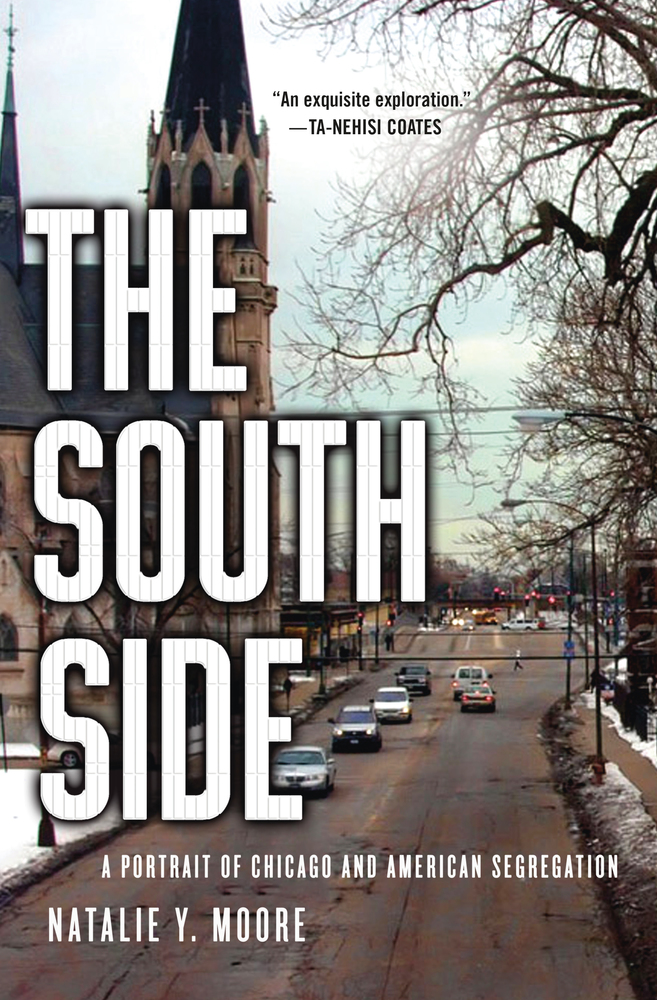
I recently read Natalie Y. Moore's The South Side:  A Portrait of Chicago and American Segregation.  As I think many of you know, I have lived in or around Chicago my whole life, and I love the city so much.  But it is a city with deep-rooted problems.  It's a city that can break your heart if you let it, from a legacy of corrupt politicians, gang violence, police brutality, and segregation.  Martin Luther King, Jr. said that he had never faced such virulent racism anywhere as he faced in Chicago.  The beautiful, striking skyline that locals love so much came at a huge cost to many communities and people.

Natalie Moore writes about her own life growing up on Chicago's south side (the historically black area of the city) and then settling back on the south side as an adult.  Her book is so many things:  an homage to her happy childhood, a guide to so many of the city's overlooked neighborhoods (and restaurants!), and an indictment of how little the government has done to invest in black neighborhoods.  The facts she shares about what it's like to be Black in America are pretty horrifying, not only because it's so obvious that racism is there, but because it just seems so endemic.  I know that a lot of racism is under the surface now, even sub-conscious.  But its consequences are just as real and impactful, and it's just so sad.

The chapter that most affected me was the one on gun violence in Chicago.  Some have given the city the nickname "Chiraq" due to how many people have been killed here (one year, more than the number of US soldiers killed in Iraq).  As someone who lives in the city, I would say the news of shootings and killings is absolutely constant, particularly in the summer.  It's unending.  It's horrifying.  It's such a tragedy I don't even know how to describe it without sounding trite.  And it makes Chicagoans themselves scared of their city.  People don't take public transportation after a certain time.  We don't walk in parks after dark.  We tell people when we reach home safely.  And there are some neighborhoods that people just won't go to.  Such as many, many neighborhoods on the south side.  We won't even stop for gas there, let alone think of shopping or eating there, or definitely not living there.

I have, of course, always been aware that violence in Chicago has an indelible impact on communities.  Kids who can't play outside, teens who can't go to school, family structures broken down.  But I don't think I realized just what a huge economic drain it is, too.  If everyone is too scared to visit a neighborhood or to even walk around outside, then business suffers.  And if businesses don't feel like they can invest in a neighborhood, then no one is ever going to move to them.  And property values decline, and people move out, and the city continues to shrink, to condense in the very gentrified central area.  And when you refer to a community as a "war zone," you automatically think about punishment and strong enforcement as the only means of solving the problem.  You don't think about how to work with the community for longer-term solutions or addressing the root of the issue because you're so busy scrambling to save lives in the moment, to stop that next gun from being purchased.  Its consequences are much more far-reaching than I ever considered, and it makes me even sadder for my city than I was before.

I also really enjoyed the chapter about food and access to food.  Whole Foods is opening a massive store in Englewood, one of Chicago's poorest (and most dangerous) neighborhoods, and it created quite a stir.  Were they trying to gentrify the neighborhood?  Were they trying to do good?  Would people be able to afford to shop there?  Were they going to bring some cheapened version of their store that wasn't as nice as the other Whole Foods in wealthier neighborhoods?  It was so fascinating to read multiple points of view on this.  The store is slated to open this fall, and I hope it helps the community.

Moore talks about many more topics in her book - public housing and public schools, her own childhood, property values, the pros and cons of integration vs access to the same resources, and so much more.  Her own love (and frustration) with the city comes through strong and clear.  Obviously, people who live in or around Chicago are probably most likely to be interested in this book, but I think much of what is true about Chicago is true around America, or at least the Midwest.  And if you are not American, and look at America now and wonder what is happening, I think this book would be a good primer to help you understand.  It's really well-written, very evocative of the city's highs and lows, and I am so glad I read it.  There's a reason that I came out of my semi-blogging retirement to write about it and urge you all to read it.  I hope you do.

Monday, February 15, 2016

Claudia Rankine's American Lyric

Claudia Rankine's Citizen intimidated me because it is a book of poetry and essays, often with references to modern art, video collaborations she's worked on, and past events.  I do not read a lot of poetry, and I worried that I wouldn't get as much out of this book as Rankine put into it.  That I wouldn't really "get" a lot of what she referenced if I didn't know how to approach and analyze art.

But once I started reading Citizen, it felt much more approachable.  It is, first of all, a beautifully published work.  The cover, with its strikingly poignant image of the hoodie so often associated with black males.  The spacing of the words in the essays and poems.  The full-color reproductions of art pieces, video screen shots, photographs.  The shading of letters on one page that just has line after line starting with "In memory of..." and then lists black victims of police violence.  The haunting poem across from that list:

Because white men can't
police their imagination
black men are dying

But Rankine spends the bulk of Citizen discussing microaggressions, those small, subconscious acts we do that speak volumes about our beliefs and can lead to so many misunderstandings.  She talks about a friend who, for some inexplicable reason, referred to her as a "nappy-headed ho."  Cashiers who ask only black customers if cards will swipe without issue.  People never taking the available seat next to a black man on the subway.  Colleagues assuming that Rankine only got her job because of her race.

(Even in my book club, some members speculated that this book only won so many awards because of Rankine's race and the current political environment.)

One of the situations that stood out most to me was when Rankine had her (black male) friend babysit her children.  People thought her friend, taking a phone call outside the house, looked suspicious and called the cops on him.  After the incident, even Rankine mentioned to her friend that perhaps in future, he should take his calls in the backyard, not the front yard.  Her friend looked at her for a long, hard moment, and then told her he could take phone calls wherever he wanted.

Rankine spends quite a bit of time at the start of the book discussing Serena Williams.  I found this entire section absolutely fascinating and eye-opening.  As I am writing this on Super Bowl Sunday, I would say this section made me think of the way people complain about Cam Newton being too celebratory when things go his way.  People think this is unprofessional.  They generally don't mind when white football players celebrate, though.  Serena Williams' displays of emotion on the tennis court have rubbed many people the wrong way.  Rankine digs deeply into this, into the way the Williams sisters respond to criticism, into the number of times they have felt rage but had to shake it off.  Because calling people out on things like that is unsportsmanlike behavior.  You can't bring up subconscious racism in professional sports; people think you're just being a sore loser.

There are so many moments like that in this book, and I am so glad that Rankine wrote about them because they make racism more personal, more approachable.  I became more reflective.  How many times have I perhaps stood by and watched someone be stereotyped against?  Why didn't I speak up, show my support for the victim?  What can I do to make my world a more welcoming and kinder place for people who do not feel safe or valued?

There is a poignant free verse essay/poem in which Rankine describes how she got on a train and saw that everyone avoided sitting next to a black man.  She went and sat next to him, did not make eye contact or interact with him in any way.  She just wanted to show solidarity.  She wanted him to know that she saw him.  It was very moving to read.

Usually, I stand on public transportation.  Mostly because I think the seats are probably pretty disgusting.  But the last time I got on a train, I too noticed that many of the seats next to black men were empty; people chose to stand instead of sit.  So I went and sat down.  And, surprisingly, the man turned and smiled at me, welcoming me to the train or to the city or just greeting me, acknowledging my presence and our shared space.  I smiled back.  I like to think that Rankine inspired a moment of connection in a situation that most often is one of silent anonymity.  Hopefully, the book will inspire many such connections.

Monday, January 25, 2016

Growing up Black in America, continued

Back in September, I posted a review of Ta-Nehisi Coates' Between the World and Me.  The book is often compared to James Baldwin's The Fire Next Time, so I took the opportunity recently to read Baldwin's work.  While I can certainly understand the parallels between the two books, I think they are absolutely complementary and having read one only makes your experience of the other even better.

James Baldwin's book was written in 1963, a response to the centennial of the Emancipation Proclamation.  It is deeply personal, a call to action to all Americans to accept that this has always been a multi-cultural, multi-racial society.  Baldwin has so many strengths in the way he writes, but the one that most draws me in is the passion that he puts into every word.  You can almost imagine him sobbing as he writes about his difficult relationship with religion, clenching his fist as he tells us about the many times he's been treated badly.  And yet, through it all, he stresses kindness and compassion over anger and revenge.  This is a deeply intimate book, and I can only imagine how much it took out of Baldwin to write it, to share his own story and his own misgivings and so much of himself.

Some quotes that stood out to me while reading this book:

“There is no reason for you to try to become like white people and there is no basis whatever for their impertinent assumption that *they* must accept *you*. The really terrible thing, old buddy, is that you must accept them. And I mean that very seriously. You must accept them and accept them with love.” 
- To his nephew

“If the concept of God has any validity or any use, it can only be to make us larger, freer, and more loving. If God cannot do this, then it is time we got rid of Him.”

“It happened, as many things do, imperceptibly, in many ways at once. I date it - the slow crumbling of my faith, the pulverization of my fortress - from the time, about a year after I had begun to preach, when I began to read again. I justified this desire by the fact that I was still in school, and I began, fatally, with Dostoyevsky.” 
- On his struggles with religion and the way people use religion

It truly is a thoughtful, articulate, and beautifully written book, and I hope you will read it.

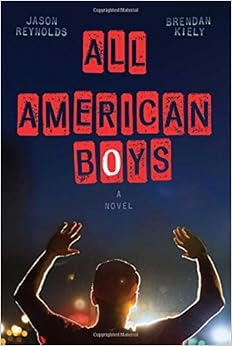
Immediately after finishing The Fire Next Time, I read a recently-released young adult novel called All-American Boys.  The novel is written by two authors, Jason Reynolds and Brendan Kiely, and has two narrators, Rashad and Quinn.  Rashad is the victim of police violence when a cop assumes that he was trying to steal a bag of chips.  Quinn witnesses his best friend's older brother beating up a kid outside a convenience store.  In case you didn't already assume - Rashad is black, and Quinn is white.

 I first heard about this book in the New York Times Book Review, and honestly, the review is pretty much spot on.  I highly recommend you to just go read that one.  It convinced me to immediately request this book from the library, and I hope it convinces you to read it, too.

What I appreciate most about this book is that it takes both Rashad's and Quinn's journeys seriously.  While Rashad lays in a hospital bed recovering from a broken nose, broken ribs, internal bleeding and more (which, even when you give a cop the benefit of the doubt, is a terrifyingly extreme reaction to someone getting a bag of chips), he feels vulnerable and scared.  One scene that especially stood out to me was when Rashad's father was grilling him about the incident, demanding to know why he would steal, why he would resist arrest, why he would fight.  It's clear that he wants so badly to believe that if you just follow the rules, if you are a good person, then you will be safe.   But Rashad did all of that and still ended up in the hospital.  And it could happen to him again.  And it made his father feel so powerless and frightened to know that he could not protect his son from that.

Quinn, on the other hand, has to come to terms with his own privilege.  He saw a beating and walked away from it.  He could continue walking away from issues like this his whole life and his life would be fine.  He worries that someone saw him at the store, that maybe he was caught on video, that the incident will mess with the dynamics of the school's basketball team and his chance at a scholarship.  Finally, his friend points out that he's not the victim here, that it's not about him, and something clicks.

I love that this book is out there for people to read and consider and use as a way to broach what can be a difficult discussion topic.  There are so many vignettes and conversations that can be used as jumping off points for discussion, so many useful questions and comments that people can use as they consider their own lives and decisions.  I especially think if you have middle school or high school kids who are aware of everything happening in the US right now but don't really know how to process it or how to respond, this is a great book to give them.  And then talk to them about it, too.

Monday, January 4, 2016

Martin Luther King, Jr., in his own words

Ed. Clayborne Carson
I don't need to say this, but we've had a tumultuous several years in this world, haven't we?  So many steps forward and so many steps backward, and it's hard to appreciate all the good in the midst of so much that is bad.

Police brutality has been in the news all over the United States and recently, my beloved Chicago has (deservedly) gained national attention due to the practices of its police department.  There is not a federal investigation into the police department and there have been many protests in the streets, people demanding the mayor to step down.

Perhaps I have become very cynical lately, but I don't really see the point of protesting without very concrete demands; if you want the mayor to step down, then you should have someone ready to step up to the plate, take on the role.  Otherwise, it feels incomplete and less compelling.  This is happening all over America and probably the world.  A lot of people are protesting and are 100% justified in protesting.  But it's hard to understand what the next step will be.

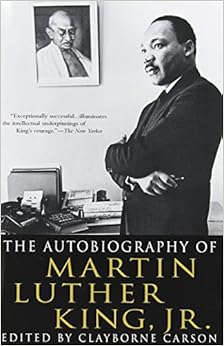
All of this really made me want to learn more about leaders for positive change.  And, given the environment and the country I live in, Martin Luther King, Jr. seemed the obvious choice.  The Autobiography of Martin Luther King, Jr. is not technically an autobiography in that MLK did not sit down to write his life story.  But the book is comprised of his notes and letters and speeches and truly succeeds in bringing him to life.  I highly recommend the audiobook version, which includes audio clips of MLK himself, so that you can truly understand what a charismatic and passionate speaker he was.

It is impossible to read this book and not think about the current climate in America.  So many things that MLK brought up and fought for are still issues today.  Clearly, police brutality still exists.  Schools are still highly segregated, even if they are not meant to be.  There are still slums, still low-paying jobs, still a disproportionate economic impact of recession.  In the book, Martin Luther King is quoted as saying that he never faced such racism and hatred anywhere in America as he faced in Chicago, and while I hope that's changed, I don't know that Chicago has done much to earn accolades.  The city is still segregated, many people refuse to even drive through certain neighborhoods, and there are more victims of gun and gang violence here than probably anywhere else in the country.  Most of those victims are black.

Living through the most recent political and social movements in the world, from Occupy Wall Street to Arab Spring to all the other protest movements that ebb and flow, the success of Martin Luther King and the civil rights movement are even more striking.  It is very difficult to make the status quo into an issue that people will care about, that they will fight for, that leaders will take notice of.  I am truly amazed at what they were able to do.  It is inspiring to read about and listen to and think about where we are now vs where we were then, and where we want to be in another fifty years to continue to progress and become the people, the society, the world that we want to be.

This is an excellent read for anyone who wants to learn more about Martin Luther King and the civil rights movement.  And for anyone who needs to believe that a small group of people can make great big changes in the world.  Highly recommended.

Thursday, October 15, 2015

#Diversiverse Review: Balm, by Dolen Perkins-Valdez

I thought Dolen Perkins-Valdez's first novel, Wench, was excellent.  It was so well-written and so evocative of what life may have been like for a slave woman in the American South.  So many conflicting loyalties.  So little power.

It's not surprising, then, that I was so looking forward to Perkins-Valdez's new book, Balm.  I mistakenly thought that Balm was a companion novel to Wench.  It is not; it's a completely different story with completely different characters.  Personally, I did not find these characters nearly half as compelling or three-dimensional as the characters in Wench, so this book did not quite hold up to the promise of the first.

Balm takes place at the end of the Civil War and centers on three people who are all dealing with the ghosts of their pasts, some more literally than others.  Madge comes to Chicago from Kentucky, where she inherited a supernatural power to heal from many generations of women.  Hemp is a former slave who comes to the city looking for his wife and her child, both of whom were sold off without him.  And Sadie is a widow, haunted by the ghost of a Civil War soldier.  The three of them meet in Chicago, but before they can move forward with their lives, they have to face their pasts.

I appreciate the intent of this book.  After tackling the antebellum South, Perkins-Valdez moves north to give us a glimpse into what life was like for blacks and whites in the north as the tide of war turns.  War obviously leaves multiple wounds on people, but Perkins-Valdez has just as much empathy for the wounds people carry from before the war, and how those wounds can impact life for years and years later.

I admit that I found this book pretty boring.  I didn't connect with any of the characters, which was disappointing after how much empathy I had for Perkins-Valdez's characters in Wench.  I just didn't think any of the histories were that compelling and didn't really care to see the story through to ensure that all of them came to terms with their pasts and moved on.  I read this one on audiobook, and I don't think the narrator was all that great, either, so that possibly had a huge impact on the way I read this book.

Balm wasn't a hit for me at all, but based on GoodReads and Amazon and LibraryThing reviews, it's quite popular with other readers!  That said, I would still highly recommend that you read Wench over Balm, and that you read Wench very soon.


Thursday, September 24, 2015

Another trip to Gateway City

Only the Strong, Jabari Asim
I thoroughly enjoyed Jabari Asim's collection of short stories set in the fictional (St. Louis-inspired) Gateway City, A Taste of Honey.  I picked it up on a whim at the library, and it was one of my favorite reads of 2014.  A couple of weeks ago, the library had Asim's newest book on display, so I immediately picked it up.

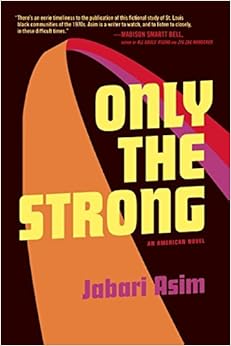
Only the Strong is also set in Gateway City, though most of the action is in the 1970s, vs the 1960s setting in A Taste of Honey.  The set-up is similar, though.  While Only the Strong is hailed more as a novel, it feels more like three novellas, each one picking up where the last one left off.  The first section features Guts Tolliver, a man in love who still carries the weight of his past misdeeds.  The second section focuses on Dr. Artiness Noel, a prominent doctor locked in a long-term affair with a gangster; and the third section is told from the perspective of Charlotte, a foster child whose world opens up when she goes to college.

I enjoyed this novel just as much as I enjoyed A Taste of Honey.  The characters are just as flawed but truly well-meaning, the tight-knit community and the relationships that form between people are at the core of the story, and the setting of Gateway City is just as much a character here as it was in the previous book.

My favorite character in this book was Guts Tolliver.  I loved spending time with him, and every time he would pop up in the second and third sections, I would be thrilled to see him again.  He really exemplifies what happens to good people who feel like they have no choices, or who feel like life just isn't fair.  And he just does down a dark hole and then struggles and struggles to come back up and redeem himself.  The entirety of his life story is just so sad and then so sweet and then just absolutely beautiful, and I love Asim for bringing Guts to life in such an empathetic manner.

Both Dr. Noel and Charlotte's sections were excellent, too, though.  I enjoyed reading about how Dr. Noel worked so hard to become such a prominent physician, and all the sacrifices she made along the way.  I loved how passionate and excited Charlotte got when she went to college and learned SO MANY THINGS and met SO MANY PEOPLE.  It can be a heady experience, and it was fun to go through it again with Charlotte.

I would not say that this novel is a companion to A Taste of Honey.  You can absolutely read one without reading the other, and while some of the characters overlap, I don't think you miss anything if you read one and not the other or read in whatever order you would like.  I hope some of you give Asim a try.  I have really enjoyed his books, his writing style, and especially his characters.  I so look forward to more from him.  Hopefully, his books will continue to be prominently featured in my local library branch!

Monday, September 21, 2015

Growing up Black in America

Ta-Nehisi Coates
In accepting both the chaos of history and the fact of my total end, I was freed to truly consider how I wished to live - specifically, how do I live free in this black body?  It is a profound question because America understands itself as God's handiwork, but the black body is the clearest evidence that America is the work of men.
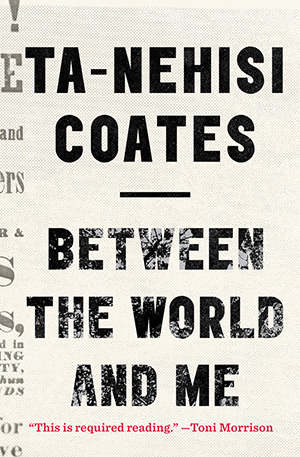
Ta-Nehisi Coates' letter to his son, published as the book Between the World and Me has justifiably garnered a lot of attention since its publication.  As Americans struggle to understand their racial legacy, Coates' book provides us with a glimpse of what it was like for him to grow up Black.

For that reason alone, I think as many Americans as possible should read this book.  I am lucky enough to have a diverse group of friends with whom I can frankly and honestly discuss race and gender issues.  I realize that many people do not have that luxury, which is yet another reason why reading diversely is so important.  Between the World and Me offers those people with an idea of just how terrifying it can be to be Black here.  And it serves as a reminder to everyone that fear runs both ways.  As frightened as a middle-class white man can be to see a black guy walking the streets of his neighborhood, it's pretty much guaranteed that the black guy feels just as frightened, except add in the fact that he probably doesn't trust the police to protect him, either.

There are so many parts of this book that made me so very sad.  Coates is such an emotionally charged author.  He pushes you and challenges you, and it was such a good lesson.  Soon after finishing this book, I took a trip to Charleston, SC, and I think because the stories were so fresh in my mind, I found myself constantly telling myself and my friend, "Do not forget that these beautiful houses were built by slave labor.  Do not forget, do not forget, do not forget."  Of course, it's easier to remind yourself when you are a Northerner visiting the South, as Northerners love to think we have some sort of moral superiority to the South.  We like to forget so much of our own horrifying history.  Or the fact that when half the country uses slave labor, the entire country benefits from slave labor.  I hope that all my reading about the black experience in America will help me to flush out my own biases, and constantly remind myself that my experience of America is not universal.

Other quotes that really stood out to me and the reasons why:
I have no desire to make you "tough" or "street," perhaps because any "toughness" I garnered came reluctantly.  I think I was always, somehow, aware of the price.  I think I somehow knew that that third of my brain should have been concerned with more beautiful things.  I think I felt that something out there, some force, nameless and vast, had robbed me of ... what?  Time?  experience?  I think you know something of what that third could have done, and I think that is why you may feel the need for escape even more than I did.  You have seen all the wonderful life up above the tree-line, yet you understand that there is no real distance between you and Trayvon Martin, and thus Trayvon Martin must terrify you in a way that he could never terrify me.  You have seen so much more of all that is lost when they destroy your body.
 That one had me in tears, really.  The possibility of a life well-lived, lifelong friends, the potential and opportunity to do something extraordinary, so much of that passes through Chicago schools every day, and so much of it is lost to horrible schools, violence, and issues at home.  Think of all the amazing, brilliant, artistic, world-changing people that our country has lost.
You may have heard the talk of diversity, sensitivity training, and body cameras.  These are all fine and applicable, but they understate the task and allow the citizens of this country to pretend that there is real distance between their own attitudes and those of the ones appointed to protect them.  The truth is that the police reflect America in all of its will and fear, and whatever we might make of this country's criminal justice policy, it cannot be said that it was imposed by a repressive minority.
Many times in this book, Coates reiterates the point that no matter how successful, how polite, how friendly, how un-confrontational a black man can be in every moment of his life, it can all fall apart so quickly and so easily because someone else can just see you and feel frightened and take action.  Many people move out of unsafe neighborhoods as quickly as they can, put their kids into excellent schools as early as they can, give them experiences and gifts that expand their minds in hopes of helping them become good, successful, happy people.  But black men have to work so much harder for that to happen, and the possibility that it can all be taken away is ever-present.
"And one racist act.  It's all it takes."

Monday, March 23, 2015

Review-itas: People coming together in difficult times

A Game for Swallows, by Zeina Abirached
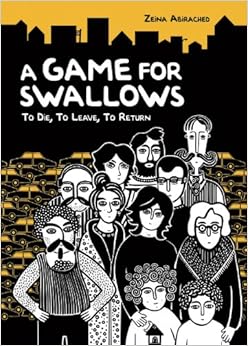
Zeina Abirached's graphic novel A Game for Swallows:  To Die, to Leave, to Return is one of the most beautifully illustrated books I've seen.  The drawings are in black and white, but the style and personality that come through is so strong and evocative.  You can tell on the cover itself - the hairstyles, the faces, all of the characters are so distinct.

The book takes place one evening in Beirut.  Zeina's parents went to visit her grandmother and telephoned to say that they are on their way home, but it's been hours and they have not yet returned.  So all of the other residents of the apartment block come to spend time with Zeina and her brother.  Zeina tells their stories in asides and flashbacks.  By the end, readers have seen several personal stories about life in Lebanon during the civil war.

I enjoyed this book, but I found it a little difficult to follow the story line.  I was often confused by whether we were in a flashback or the present day, and I didn't always know who the narrator was, since different characters would tell either their stories or other people's stories.  And I didn't fully understand all of the context.  For example, Abirached describes how her family went from using the entirety of their apartment to slowly using only one room, but I didn't quite know why their lives had become so constricted.  And I didn't understand why snipers would be on every street trying to shoot all these civilians instead of fighting other soldiers.  I have been lucky in never living in a war zone, so I didn't always understand the whys or hows behind what Abirached was saying.

But the main takeaway, that war made everything difficult and changed people's lives so completely, was easy to understand.

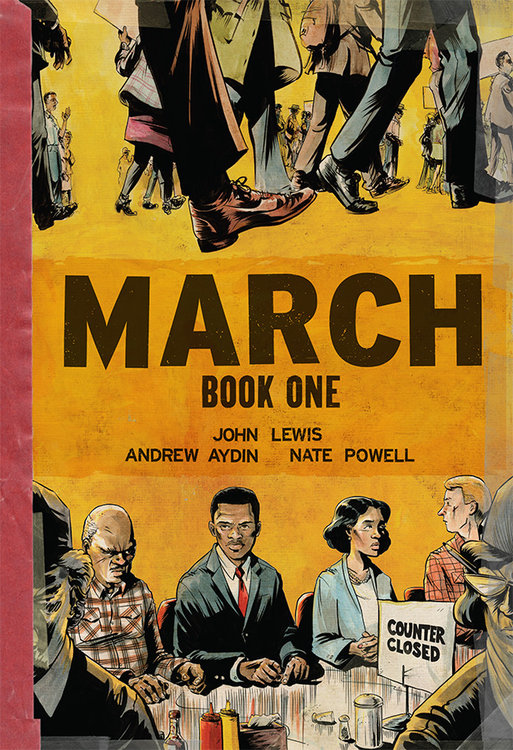
March:  Book OneThe first two volumes of March, by John Lewis, Andrew Aydin and Nate Powell, relate John Lewis' childhood and college years working for the civil rights movement.  John Lewis is one of the "Big Six" civil rights leaders in American history; he spoke in Washington with Martin Luther King, Jr. and is now a US senator.

It is timely that these graphic novels about the struggle to end Jim Crow and obtain equal rights and voting privileges for African-Americans came out recently, as it becomes more and more clear that Blacks are still fighting for so many rights.

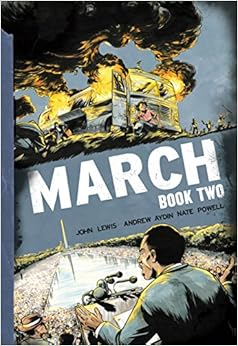
I really enjoy this series and hope that it continues.  I liked the second volume more than the first one, but I think that's because it focused a lot on the freedom riders and the lunch counter protests vs the first volume, which had more to do with setting up John Lewis as a character.

Hopefully, by writing his memoirs in a graphic novel format, John Lewis will reach a new set of American readers who don't always read memoirs or history books.  I'm of the opinion that, for important topics such as this one, it's vital to tell the history in as many ways as possible, to reach as many people as possible.  I've read a bit about the civil rights movement in recent years, but I really appreciate getting multiple perspectives and visions to bring the period to life for me.  These books show just how terrifying it was to be a civil rights leader - they must all have lived in near-constant fear for their lives, and still they went out every day to make a better world.

March:  Book 2
For some reason, a memoir written in graphic novel format feels so much more personal and intimate to me than one written in only prose.  I'm not sure why, but I feel like I know John Lewis much better now for having seen his actions brought to life in vivid artwork.

Highly recommend this read to anyone who wants to better understand the American civil rights movement.

Monday, February 9, 2015

It's time to do some serious soul searching

Go Tell it on the Mountain by James Baldwin
After reading Azar Nafisi's The Republic of Imagination, I immediately wanted to read all of James Baldwin's work.  I started with his first major work, Go Tell it on the Mountain, the book Baldwin said is "the book I had to write if I was ever going to write anything else."  The semi-autobiographical novel focuses on John, a 14-year-old boy in Harlem growing up under the watchful eyes of his father, a very stern and religious evangelical preacher.  Over the course of one day at the church, we learn about John's life to date and gain insight into the lives of his hypocritical father, Gabriel, his mother, and his aunt.

Through all their stories, there's the common thread of the Great Migration, when many Blacks moved from the racial oppression of the Deep South to the promise (often left unfulfilled) of the North.  Each of them has something deep and complex to offer the reader, not just about the pursuit of the American Dream and the likelihood of finding happiness, but also about the very painful and beautiful relationships people can have with God.  There is a lot of fire and brimstone here, with nearly ever character promised eternity in heaven or hell based on one event or act from the past.  There is rage, frustration, and desperation in much greater amounts than you are likely to find in most books written in the 20th century.  In many ways, the fears and threats that came through here made me feel almost like I was in a time warp back to the Middle Ages, but the setting really is mid-20th century America.

This book was very different than I was expecting.  I thought the story would revolve much more closely around John coming of age in a very strict household, in a very restricted and segregated space.  Instead, the book is mainly about the relationships multiple characters have with John's father, Gabriel, a man who is chased by his own demons and seems determined to ensure that no one in his life forgets for a moment that hell is just one slippery slope away.  I also wasn't expecting nearly so much religion, and I am positive that there was a TON of Biblical imagery in this book that just went completely over my head.  For example, I'm sure John's father being named Gabriel means something, and that the extremely (and I mean seriously extreme) intense vision that John had at church before finding God probably had WAY more going on than I could catch.

I think I would have found this book a bit tedious except that the language is so amazingly powerful.  Baldwin brings so much passion to his craft that I feel like when he was writing the book, his pen must have left deep scores in the paper.  He's one of those authors who pours everything he feels into his art, and the result is absolutely stunning.  I really wish I knew the Bible better because I am sure I would have been even more moved and amazed by the story if I could get all of the allusions.

Because of the deep religious tones to the novel, Go Tell it on the Mountain also made me think more about religion and spirituality.  I am not personally a very religious person, and I don't spend a lot of time actively thinking about how God would see and interpret my actions.  I have a vague belief in the "If you're a good person, then you'll be fine" train of thought, but many of the characters in this book spend years trying to atone for one thing, or spend a lot of time thinking about how to make someone else pay, and worrying about hell.  It made the quest for religious enlightenment seem much more personal (and very, very lonely) in a way that highlighted to me just how differently people can follow the same religion.

I plan to read more of Baldwin's books and essays because he is a wonderfully passionate, eloquent author who I want to know better.  However, if you aren't ready for a deep, soul-searching book that focuses a lot on religion, then this may not be the book for you right now.  I recommend you keep Baldwin on your list, though, because his way with words will probably floor you.

Thursday, January 29, 2015

Murder at Belle Vie Plantation

The Cutting Season by Attica Locke
The Cutting Season is a murder mystery by Attica Locke set on a historic Louisiana plantation.  A migrant worker's body is found one morning out past the old slave quarters, and her death seems to have many parallels with a man who went missing more than 100 years ago from the same area.  Caren Gray is the manager of historic Belle Vie plantation.  She grew up there, helping her mother in the kitchen.  And several generations of her family have worked there, many as slaves.  Now she lives on the plantation with her 9-year-old daughter, and her family is comprised of the other people who work at the historic home.  When one of her co-workers is arrested for the murder, Caren gets deeply involved in working to clear his name.

In her book The Republic of Imagination, Azar Nafisi talks at length about the Southern novel in American literature and her discussion with a classmate about how it is distinct from all others, and can only be fully understood by someone from the South.  It's lucky that I read The Cutting Season right after finishing The Republic of Imagination because I can see what Nafisi's classmate meant.  There is so much Gothic atmosphere in this novel, you can practically smell the heady scent of flowers and feel the weight of history on the shoulders of everyone even tangentially connected to the Belle Vie plantation.  I haven't spent a lot of time in the south, but Jenny says that Locke does brilliantly with this, and I trust Jenny as a true southern gal to know what's authentic.

Reading The Cutting Season in the midst of the Ferguson and NYC grand jury aftermath, with the massive distrust that currently dominates the relationship between minority communities and the police, a lot of the decisions and actions that Caren and the other characters made were much more understandable.  I can see why none of them wanted to involve the police (and, as the police were not particularly effective, why they were so frightened that everything they did and said would be misconstrued).  I appreciated how Locke really brought these to life - even very successful, very intelligent people were scared of what the police might do.

I also appreciated the way Locke mixed current events with historic ones to show just how completely the past impacts the world we live in today.  It was so well-done, having Caren learn more and more about her own past and what happened on the plantation generations ago and have that story parallel the one happening currently.  It brought up all sorts of themes that Locke alluded to but never went into great detail on - the case for reparations, the source of money for so many wealthy families, the consequences of trying to ignore or eradicate historical fact.  Not to mention the parallels between the death of a slave and the death of a migrant worker.  Seriously, so many levels!

And Caren's own personal history of going to law school and then dropping out, and her reasons for doing so, and the way her employer kept saying things to her like, "You know, I've done so much for you and your family over the years" as though her family had done nothing for him and his family over the years, and how Caren interacts with the plantation family - all of it is so good!

If you're itching for a super-atmospheric mystery novel, this is a good one to try.  Especially if I have gotten you hooked on Malla Nunn - Locke creates the same stifling atmosphere, brings up similar points about racism and its effects, and the complications that can arise from family drama.

Monday, December 22, 2014

Review-itas: Life through the 20th century

Bud, Not Buddy
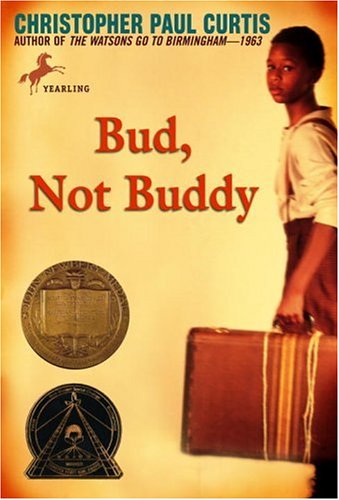
Bud, Not Buddy, by Christopher Paul Curtis, is about a 10-year-old orphan boy living through the Great Depression in Michigan.  Bud's mother passed away when he was six and he never knew his father.  But in his suitcase filled with his most prized possessions, he has fliers that his mother saved over the years.  The fliers show a jazz band, and Bud's sure that his father is in that band, so he sets off to go find him.

I read Curtis' The Mighty Miss Malone earlier this year and quickly decided that I should read all of his other books, on audiobook if possible.  Bud, Not Buddy is my second Curtis book and Deza Malone even has a cameo!

I like the way Curtis writes about a black child's experience of the Great Depression.  While the Great Depression was difficult for everyone, it was particularly hard on people of color who were passed over for jobs, often couldn't own property, and were discriminated against in many ways.  I think Curtis does really well in bringing these important facts to life in ways that would make children curious to learn more and have a discussion with their parents or a teacher about how people experience the same world differently.

As with The Mighty Miss Malone, I liked how Curtis showed examples of different family structures.  Bud is an orphan but has many happy memories of growing up with a single mom.  He meets a stranger who is a proud father of a growing (and very fun) family, and a jazz band that acts as a family.  While I didn't love Bud, Not Buddy as much as I did The Mighty Miss Malone, I did enjoy learning even more about the Great Depression and am looking forward to Curtis' perspective on other important historical events in American history.


Brown Girl Dreaming
Jacqueline Woodson's memoir in free verse, Brown Girl Dreaming, is set in the 1960s and moves from Ohio to South Carolina to New York.  I did this book on audio.  I do better with poetry in audio since I don't worry so much about whether I am getting the pacing and the rhythm right.  Like pretty much everyone else, I loved it.

Woodson's stories tell of her early childhood growing up during a tumultuous time in American history, struggling with school, and falling in love with words and the art of story-telling.  I wish I had read this in physical form because the poetry is stunning.  I love the way Woodson confused facts and stories - she would hear something and then immediately incorporate that fact into a story about herself.  It wasn't lying, it was learning the art of the story, and she excelled at it.  This excerpt sums up very well the way I felt reading this book - I didn't want it to end, either:

“I am not my sister. 
Words from the books curl around each other
make little sense
until
I read them again
and again, the story
settling into memory. Too slow my teacher says.
Read Faster.
Too babyish,
 the teacher says.
Read older.
But I don't want to read faster or older or
any way else that might
make the story disappear too quickly from where
it's settling
inside my brain,
slowly becoming a part of me. 
A story I will remember 
long after I've read it for the second, third, 
tenth, hundredth time.” 


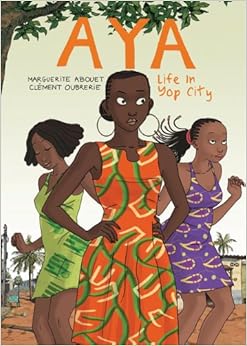
Aya:  Life in Yop City, by Marguerite Abouet and Clement Oubrerie is about 3 teenaged girls growing up in boom-time 1970s and 1980s Ivory Coast.  Aya is dedicated to going to medical school and doesn't let anything distract her from that goal.  Her friends Adjoua and Bintou, however, are more easily distracted.  The three of them deal with a lot of family drama (seriously - everything from paternity drama to secret second family drama to homosexuality and everything in between).

I am a little torn about this book.  On the surface, it's like a soap opera, with twists and turns on every level.  I don't know much at all about what life is like in a polygamous society, but it seems very complicated!  It was so interesting to learn about such a foreign culture, from the funeral parties to beauty pageant, from polygamy to witch doctors.  Everything was new to me!

On another level, though, the book touches on some really important themes.  For example, Aya wants to be a doctor, but her father just wants her to get married to some rich guy.  Aya's girlfriends seem sexually liberated and like they just want to have fun in life, but they both deal with very real consequences of their promiscuity while the men seem to get off pretty easily.  Aya's mother wrestles with the knowledge that her husband sleeps with many other women but gets very little sympathy because every man does that.  And the two gay men in the book struggle with their homosexuality and what to do, knowing that they will never be accepted.  And there are more examples of this - the beauty pageant, Aya's friend's impending marriage to a much older man, the catcalls every woman faces each time she walks down the street...


This is why I think perhaps the translation was a little lacking.  The translator did a great job of getting the humor and wit across in each panel, but it was harder for me to understand the deeper issues and social commentary that were under the current here.  Was Abouet just writing a fun drama?  Or did she have more meaningful messages that she wanted to share?  My opinion is that the latter is true (but I also probably look for feminism everywhere).  In any case, this book is worth reading just for the immersion in another culture and the fantastic, vivid art.  And, PS, it was made into an animated movie!  I'll have to try and find it (with subtitles).


Monday, November 3, 2014

Leave the past behind you

Michele Norris' The Grace of Silence began as a book about race and America's conversation on race after Barack Obama was elected president.  Over the course of her research, Norris realized that her own family had a lot of secrets that were withheld from her growing up.  The Grace of Silence is about her discovery of these facts - her father being shot in Birmingham, Alabama after he came back from WWII; her grandmother's stint as a traveling Aunt Jemima, selling pancakes under a trademark that many still view as racist.  Norris takes us on a journey to her past - first, her time growing up in the Twin Cities, then further back to her ancestral home in the Deep South.  We get to know her parents, grandparents, and extended family, and her quest to learn more about the things no one talks about.

I am an NPR junkie.  I'm also fascinated by looking at American history (and all history) through different lenses and perspectives.  So The Grace of Silence was right up my alley.  I really enjoyed the way Norris interspersed facts about American history into her personal story.  For example, her father fought in World War II, but when he came back to the US, he still faced institutional racism and a lot of hate.  When her parents bought a house in Minneapolis, they were the first Black family in the neighborhood; nearly all of their white neighbors moved out as quickly as they could, frightened by mortgage lenders and real estate agents that their home values would plummet if they stayed.

Norris didn't spend as much time on her grandmother's story as I would have liked, probably because there wasn't a lot of information.  But I was surprised to hear about the women who traveled the Midwest (and other regions of the country), dressed up as Aunt Jemima (who resembles the "Mammy" of the antebellum South).  There aren't many records of these women because most of them worked for a regional sales force, not a centrally managed one.  And not many people are around today that would remember that period.  (And so, small pieces of history are lost.)  And Quaker Oats has struggled with how to deal with the baggage that comes from a trademark that started out looking like this:


Evolved from a caricature to a real woman, though the woman spoke in quite the dialect:


The Grace of Silence

And now is a painting that looks like this and never talks:


Norris talks about how Quaker Oats wanted a celebrity spokesperson for the brand after the last one passed away in the 1950s, one to bring Aunt Jemima forward and modernize her.  The only problem was, no one wanted to be a spokesperson for the brand any more.  It's hard to forget that racial baggage.

No one told Norris about her grandmother's early job acting as Aunt Jemima, probably because they were ashamed.  Similarly, no one ever told her about her father being shot by a policeman in Birmingham one evening.  Norris' take is that her family wanted to let go of the hate and move forward.  They didn't want her to grow up thinking that all the odds were stacked against her.  They wanted her to be what she wanted to be, without restriction.

Norris makes an interesting point.  In the US, we talk about race incessantly, often with people who look and think like us, and not often across the color barrier.  The conversations, then, don't evolve as they could because they continue to be one-sided.  Once you bring another race in, people clam up.  White people are scared that they'll be seen as racist, Blacks are afraid they'll seem angry and confrontational, and it becomes uncomfortable very quickly.

Obviously, the US has a lot of racial baggage.  But should we continue to tell white children not to trust black children, and tell black children not to trust the police, and continue on as we are?  Or should we try to stop that cycle?  Keep our negative experiences and biases to ourselves so that the next generation can grow up with a little less fear and distrust than we did?  It's a point worth considering, though obviously it runs the risk of all of us forgetting our collective history.  But as science shows us, more and more, just how similar we all are, and just how small and fragile our world is, and just how massive and varied is the universe out there, maybe it's not the worst thing to use the mindset of a global citizen, rather than one tied to any one country or region.

Lots to think about in this book.  Check it out and let me know your thoughts!