Showing posts with label GLBT. Show all posts

Wednesday, February 8, 2017

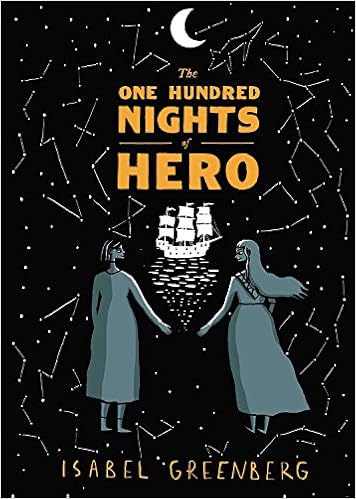
The One Hundred Nights of Hero, by Isabel Greenberg

Isabel Greenberg
I adored Isabel Greenberg's The Encyclopedia of Early Earth, so as soon as I heard about her new book The One Hundred Nights of Hero, I put it on hold at the library.  And this book was just what I needed.  It's all about women being amazing, about the power of stories, about the importance of resisting, even in the face of inevitable failure, and so much more.

 I debated whether I should review this book or not because it's one of those books that I just really loved because it was kind and beautiful.  However, The One Hundred Nights of Hero tackles some really big topics in a gloriously feminist way.  While The Encyclopedia of Early Earth was complex in its layering of stories within stories, the stories themselves were not super complicated (that I remember) and the story was centered on a man seeking love.  The One Hundred Nights of Hero is centered on two women in love.  Cherry is married to an imbecile who challenges his friend to seduce her in 100 nights.  His friend agrees, and is pretty clear that if seduction doesn't work, force will.  Cherry and her love, Hero, come up with a plan to distract the nefarious villain with stories each night.  But not just any stories, stories about women and the power of knowledge and the importance of choice. 


In none of these stories is there a happy ending of "Girl meets boy, girl marries boy, they live happily ever after."  There are stories of love and how beautiful a thing it can be, but Greenberg always stresses that the ability of a woman to choose her fate is equally, if not more, important.  Some of the stories end happily because women find ways to live independently.  Many of them end sadly because the women featured in them do not fit neatly into the strict definitions that patriarchal societies have set for them.

That makes it sound as though this is a melancholy and depressing book, but it is not that at all.  It's absolutely amazing.  There is so much humor, so much kindness and friendship and loyalty, and glorious sisterhood.  Also, the illustrations are beautiful.  And then, of course, there are the stories.

It's an excellent, gorgeous book, and I intend to splurge and buy some Isabel Greenberg for myself for my birthday this year - she's absolutely worth having on your keeper shelf.

Thursday, April 7, 2016

Two lives lived well

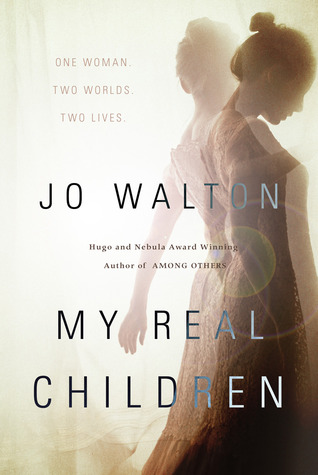
Jo Walton
Jo Walton's My Real Children is one of those books that I loved and completely devoured, but I cannot entirely pinpoint why.

The story is about Patricia Cowan.  Patricia is getting older, and she forgets many things, big and small, that have happened to her over the past few years.  But she also remembers things, big and small, that she could swear happened, but don't make sense in her current circumstances.  Patricia seems to be living two lives, in two separate worlds.  Her life was all on a steady path until one day, she made a decision, and based on that decision, her life (and the world she lived in) went in two very different directions.

I love almost any alternate reality or alternate universe story, so I was predisposed to enjoy this one.  I appreciated that it was, for the most part, set after WWII rather than before or during the war.  Yes, the second world war had stunning effects on the world and how it has turned out, but events and decisions made both before and after the war have had enormous impact as well.

I am now about a week removed from having read this book and I admit that I am not sure why I loved it so much.  I gave it an unreserved 5-star rating when I finished it.  I loved Patricia, I loved how she made the best of circumstances no matter what they were.  I felt so saddened by the way her children, in both lives, relegated her to the background as she got older.  I enjoyed the subtlety with which Walton introduced societal prejudices into her narrative.  For example, in one world, Trish and her partner, Bee, seem to have no issues whatsoever with their son being in a polyamorous relationship.  It just seems to be what he chooses and they are fine with it.  They are, however, quietly concerned when their daughter marries a Muslim.  Walton does not delve very deeply into this (though, admittedly, she doesn't delve deeply into very much, which I will get to in a bit).  But most people don't like to examine their prejudices, so in a way, it was quite realistic.

Jo Walton writes about the small, personal, everyday acts of our lives wonderfully.  In all her books.  You get such a vivid sense of a character's day-to-day activities, and I really enjoy how she gives such care and attention to things that all of us view as trivial, but are the events that fill our lives.  She does this so well in very slim volumes; her stories are compact and self-contained and somehow still deeply moving and I love that about them.

That said, in this one, I just feel like there was so much that was left out.  And I say that now, but please remember that I loved it.  It is only now, a week later as I write this review, that I am mulling a bit.  We hear about big world events in an off-hand manner, in both worlds that Patricia inhabits, but never quite enough to understand what the situation is.  We see only minor inconveniences, mainly to outlying characters.  Though we have the idea that there are stresses on Trish's family in one version of her life, we don't see anything very drastic happen.  Again, this is part of Walton's skill; most people don't have hugely dramatic events in their lives, they just make the most of what they have and try to soldier on and be happy.  I wanted a bit more context.

Also, the book takes place over several decades, and in two very different worlds.  Because of that, we hardly get to know any of the other characters at all.  They flit in and out but do not have a solid presence.  Good friends from college are rarely mentioned again, the children are all vaguely there but with hardly any impact on life, spouses are either horrible or perfect with no real personality or depth, and the world keeps turning but what happens on that world is not shared in any great depth.  Because of that, at the end, when Patricia is trying to make sense of whether she would rather have a happy life in a horrible world or a sad life in a much better world, it was hard to feel compelled in either direction; I did not know enough to compare the two worlds at all.

So, this book!  I loved it and read it so quickly and enjoyed it hugely.  But, looking back, I feel like it could have had more depth.  If you want to read about the impact that big events have on small lives, this is wonderful.  If you want something... bigger?  Then, maybe not this one.

Thursday, February 11, 2016

Even witches go through an awkward stage

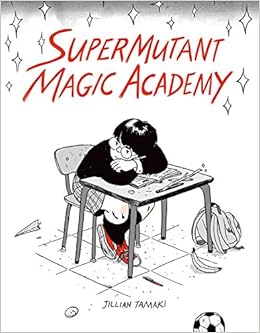
Jillian Tamaki is an author whose work I really enjoy, and her newest book, SuperMutant Magic Academy, is no exception.

I didn't know a lot about this book heading into it except that it was about mutant humans going through high school.  I was under the impression it would be one story with many characters involved in a big plot.  That's not at all how the book is set up, though.  SuperMutant Magic Academy started as a web comic, so it's written in vignettes that are usually only one page long, much like a comic strip.  Through these, Tamaki provides funny, sweet, and realistic snapshots of high school life.  The characters interact with each other in the classroom, at lunch, in their dorms, and elsewhere.  So many lovely moments in so little space.

What is great about this book is that you can enjoy it just as much by reading one or two pages at a time or by reading it in much bigger chunks.  I would love a copy for my bookshelf; I imagine myself strolling over, picking the book up, choosing a page at random, and then smiling at the humor, poignancy and all-around wonderfulness that comes through on that page.  And then I'd probably read the next page, and then the next, and continue standing there, smiling, until my legs began to complain.

This book is nothing like other fantasy books set in boarding schools.  In fact, it's nothing like fantasy books.  It's more like Calvin & Hobbes.  The characters happen to be magical, but the magic is in zero ways important to the stories that are told (except sometimes to add a dose of situational humor).  Instead, what's important is a group of teenagers nearing the end of their time at high school, making and keeping friendships, understanding truths about themselves and others, learning about what is important to them, and dealing with the normal trials and tribulations of being a high schooler.  The characters are usually very fun and kind to each other; I especially liked how very popular, beautiful, and good-at-everything Wendy always chastised her friends for being unkind to anyone else.  She is the sort of person we all want to be friends with.  And the casual acceptance the characters have for their gay classmates is quite heartening as well.  It's not a big deal.  It doesn't define them.

But even kind people make mistakes sometimes or can be cruel without meaning to, especially at an age when we are all so insecure and worried about our looks and what other people think of us.  That comes through a lot, too, particularly with the character of Frances, the artsy girl that no one quite "gets" (even though she is dating the biggest jock at school).

It's just a really lovely book.  I highly recommend it!


Thursday, March 12, 2015

A true fantasy winner from my bookshelf

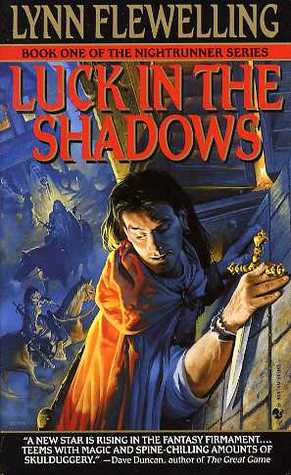
I am not sure how long I have owned Lynn Flewelling's Luck in the Shadows.  I entered it into my
Luck in the Shadows, by Lynn Flewelling
LibraryThing account on December 18, 2006, which is quite early in my LibraryThing account history, so I've owned it for at least 8 years, if not more.  In the many shelf purges that have occurred since then, I never got rid of Flewelling's books because she is rated so highly by fantasy fans.  And, for me, winter is the perfect time for a quality epic fantasy novel.  I love to become immersed in the worlds and the cultures and the struggle of good vs. evil.  So when I saw that Luck in the Shadows was available for download as an audiobook, I decided it was finally time for me to read it.

I was nervous that my tastes had changed too much for me to enjoy this one still, but that was not true at all.  While I don't read epic fantasy as much as I used to, I still love authors who thoughtfully develop strong, multi-dimensional characters who live in rich, developed worlds.  Lynn Flewelling does both those things, and she reminded me of why I love fantasy writing so much.  The customs and cultures and religions and folklore that she brought to life here all pulled me completely into the story and kept my attention the whole way through.

The story centers on two characters, Alec and Seregil.  They meet in prison, escape together, and then get along so well that Seregil makes Alec his apprentice (though Alec is vague on the details of what exactly Seregil does).  The two set off for adventures in distant lands, steal something that looks pretty small but ends up causing them a lot of trouble (a la The Hobbit), and then spend a lot of time trying to understand why that thing is so important and trying to solve a big political mystery.

Along the way, readers meet many other wonderful characters, such as Micum and Nysander, two of Seregil's closest friends and advisors.  We also get to explore a beautiful, multi-faceted world.

One of my absolute favorite things about this story was the way Flewelling weaves so many things that are important to me.  For instance, Seregil's country is led by women, and this seems completely natural to him.  Women fill many roles, from military adviser to queen to innkeeper to wizard to traitor, and they fill all of those roles well.  This is so rare in fantasy novels, and I appreciated it so much.  While none of the main characters is female in this book (bummer), the world is very much one in which both sexes have power and respect.

I think it's due to that fact that the romantic relationships are also more fluid in Flewelling's world.  Alec and Seregil are great friends but you can see how that friendship will develop deeper into romance in the future.  The red light district in town appeals to people of all tastes equally.  I loved that Flewelling made a point of stating that the houses catered to both men and women, and to people who preferred both men and women.

I loved so many, many things about this book.  It truly is exactly the sort of fantasy novel that I've always loved and will continue to seek out.

To give fair warning, Luck in the Shadows is the first book in a duology and it ends rather abruptly.  Luckily, the book was published in the 1990s, so you need not be frustrated for long.  Enjoy!

Monday, September 8, 2014

Sarah Waters proves her mastery over the post-WWI creepy relationship story

It's here, it's here!  Sarah Waters' eagerly anticipated new novel, The Paying Guests, hits shelves on the 16th and is sure to skyrocket to the best-seller list pretty much immediately.  I was absolutely thrilled to get an advance copy from LibraryThing.  It took me a while to get through this book because it is pretty long and, well, summer!  But I made it through to the end and I'm confident that if you enjoyed Waters' other novels, you will really enjoy this one.

The Paying Guests is set in post-WWI London.  The economy is not doing well, the class system is starting to break down, and there are many women living without the support of men.  Frances and her mother are two of those women - Frances' two brothers died in the war and her father passed away, too, leaving an old house and a lot of debts behind him.  To make ends meet, Frances and her mother decide to take in lodgers.  Enter Mr. and Mrs. Barber, a working-class couple who seem to embrace a more carefree, Bohemian lifestyle.  But sometimes, their marriage seems just a little bit less happy than they project to the world.  And as Frances spends more time with the couple and gets to know them better, she becomes intimately involved in their lives and can't quite get away.

I really like the cover shown on this one - not only is it in line with the rest of Waters' books, but I love the sinister look of it.  The woman standing in the light, and then a man to the side, watching her in the dark.  It really does evoke the feel of this book, the unease with which the characters approach each other.

If I could liken this book to another, I think the one that comes to mind is Donna Tartt's The Secret History.  I did not really enjoy The Secret History, and I admit that there were several times during The Paying Guests when I got a little tired as well.  It just started to feel so repetitive!  And I applaud Waters for being able to keep upping the ante and the tension for a good 300 pages or so, but GOSH, I got tired of it!  I would say more, except I am pretty sure that I would be accused of putting in spoilers.  But anyway - a lot of this book is about how relationships can evolve and change and backtrack and go in circles, particularly at times of stress.  It felt quite realistic to me, but also quite painful to read.  By the end, I wasn't really a big fan of any of the characters, though I started the book really liking all of them.

What is awesome about this book, though, is Waters' amazing turn of phrase.  Here are some of my favorites:

"Their friendship sometimes struck Frances as being like a piece of soap - like a piece of ancient kitchen soap that had got worn to the shape of her hand, but which had been dropped to the floor so many times it was never quite free of its bits of cinder."

"How well she filled her own skin! She might have been poured generously into it, like treacle."

"You don't think about all the colors when everything's going all right; you'd go mad if you did. But those colors are there, all the same. All the quarrels, and the bits of unkindness. And every so often something happens to put a chip right through; and then you can't NOT think of them."

"It was like a cure, being with Lilian. It made one feel like a piece of wax being cradled in a soft, warm palm."

Note:  I received an advance copy of this book in exchange for a review.  This review is based on an advance reader's copy.

Thursday, July 24, 2014

"We all fight our own private wars."

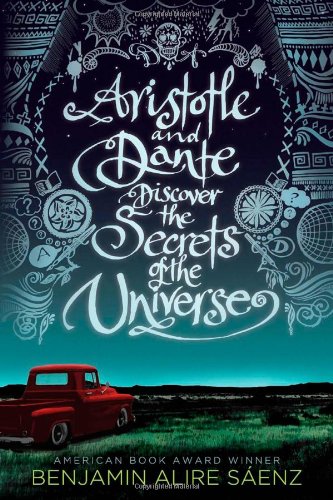
Aristotle and Dante Discover the Secrets of the Universe
Guys, this book.  It is so, so good.  Aristotle and Dante Discover the Secrets of the Universe, by Benjamin Alire Saenz, has such a glorious title and a beautiful cover, and it DELIVERS the fantastic story that both of these promise.

Aristotle (Ari) is a 15-year-old living in El Paso, TX in 1987.  He is angry a lot of the time.  His father is a Vietnam veteran and still has horrible memories of the war.  His mom is a sweetheart but never wants to talk about Ari's brother, who has been in prison for 11 years.
It's hot, it's summer, and he doesn't have any friends.  Ari goes to the pool but doesn't know how to swim.  Another guy there, Dante, offers to teach him.  Ari and Dante become best friends, though the two are polar opposites.  Dante wears his heart on his sleeve and seems happy and well-adjusted all the time.  Ari is an introvert; even readers, who spend the entirety of the book in his mind, get no access to his innermost feelings and what drives him to do the things he does.  As the story progresses, Dante's feelings for Ari develop into something deeper than friendship, and both Dante and Ari must come to terms with that.

I loved this book so much.  Saenz packed so many beautiful moments and relationships in here.  Ari and Dante both deal with being Mexican-American, though neither of them fit the stereotype of  Mexican-Americans.  They are both 15-year-olds coming of age, too, and deal with the whole "threshold to adulthood" thing that all of us have gone through and that people will continue to go through for ages and ages.  Ari has a lot of family stuff to deal with - an uncommunicative dad, a brother no one will talk about, an over-protective mother.  Ari also is so angry and lonely inside, and it's hard for anyone to understand why, including Ari himself.  And the way Ari and Dante play off each other and grow and stay such strong friends through so much, was so wonderful.  The dialogue between the two of them is so fun.  They enjoy each other's company, they are quick-witted, they talk about big things and small, and they drift away and back towards each other over the course of a few years in this book.

I loved the emphasis on family, and just how supportive family can be when you are going through a really rough patch.  There is one line from Ari's mom near the end that just set me over the edge because she is SO KIND and wonderful, and you can just see all of Ari's walls and defenses slowly beginning to crumble, and it's because his parents are just so loving and fantastic.  And Dante's parents are just the same.  This book is not just about Ari and Dante, it's about two families.  Every character gets so much care and attention, and the insights that come from all of them are just wonderful.

Saenz packed so much into this book and I've barely scratched the surface because I don't want to ruin the discovery for you.  So much is left unsaid (mostly because of Ari's repressed narrative style), but as you progress in the story, it just blooms into this majestic story, and then you feel ALL OF THE FEELINGS.

I think I've been fairly inarticulate here, but hopefully my gushing has made you want to go out and read this book.  Personally, I plan to read everything Saenz has written because the man can write.  A beautiful story on so many levels - highly recommended.

Monday, October 28, 2013

The frightening story of a Britain that might have been

Ha'Penny
I read Jo Walton's Farthing last year, but I didn't get around to reading its sequels until just recently.  Now I've read the whole trilogy (woohoo!  One series complete and off my list!), and I can say I'm quite glad it's done because this is one scary world that Walton created and one that hits pretty close to home in its commentary about our modern world.

I love alternate history, but maybe when it's written right now about a world that so nearly could exist and perhaps already does in some forms... it gets scary.  Like, really scary.

Ha'penny and Half a Crown are the second and third books, respectively, in Jo Walton's Small Change series about a world that might have been, if just a few small changes were made (seriously, if Jo Walton is so amazing in her symbolism even in her titles, you can only guess how awesome she is when she has real sentences to work with.  Answer - really, really awesome).  The basis of this series is that, instead of fighting a long war, the Allies negotiated a peace with the Axis.  America never entered the war and is still in the midst of a massive depression.  Japan rules Asia (and wants at least half of North America) and Hitler reigns supreme in Europe.  The British Prime Minister is a sadistic and manipulative man as well, who works more to secure his own power than help his people.
 
These books started a WWII era binge for me; I followed these two up with Code Name Verity and Rose Under Fire, and reading the four of these books basically all in a row made clear to me that, while the decade had its moments, the 1940s were a dismal time in the world.

But Jo Walton makes clear that it could have been so much worse.  And hey, have we really come that far from where we were before?  The problem with history is that we look at it with the "Whew, dodged a bullet there" mentality and not with the, "There but for the grace of God goes everyone" mentality.

Monday, October 14, 2013

Calliope --> Callie --> Cal, a gender journey

Middlesex
I finally read Jeffrey Eugenides' Middlesex!  I've had this book since 2007.  I'm quite proud of myself :-)  I didn't read the physical copy, though, but read the audiobook.  And the audiobook is fantastic!  I think that this is really an excellent method for me to get books that have been on my TBR list read more quickly, especially those that have been on it for years and years.  It's hard to find most of the old, more obscure ones on audiobook, but for books like Middlesex, which is quite popular, you're almost guaranteed to get a great narrator.

And that's exactly what happened here!  I really enjoyed this book.  It's just the sort of multi-generational saga that can be so grand and epic when done well.  I am so glad that I already own a copy of it so that I can hug it to my chest and sigh in satisfaction.

If there is an updated list of books with amazing opening lines, I would put Middlesex up there:

"I was born twice: first, as a baby girl, on a remarkably smogless Detroit day of January 1960; and then again, as a teenage boy, in an emergency room near Petoskey, Michigan, in August of 1974."

Thursday, June 13, 2013

Thoughts on Stuck Rubber Baby

Howard Cruse's Stuck Rubber Baby is one of those books with a title that felt vaguely familiar to me when I saw it, but didn't remember why it felt familiar.  I pulled it from the library shelves the other day, read the blurb, and thought to myself, "Now I remember why it feels familiar."  The blurb, for once, made clear that the book is right up my alley.

And then I remembered that Ana recommended the book to me back in February, and of course I had to snatch it up and read it.

I've been reading more graphic novels recently, mostly because I have been able to go to the library more often on the weekends.  I seem incapable of reading books without pictures these days, so I'm glad that the graphic novels are working out for me.

So, Stuck Rubber Baby.  What is it about the blurb that drew me in so completely?  Let me share it with you.
Art and story combine powerfully in this lyrical tale of a young man caught in the maelstrom of the civil rights movement and the entrenched homophoia of small-town America.  Toland Polk, the son of an uneducated white carpenter, has grown up in the Southern town of Clayfield.  It is the 1960s, a time of passionate beliefs and violent emotions, and Clayfield's citizens are divided in the fight over segregation.  As Toland fights on teh side of the civil rights activists, he slowly begins to realize that he also has a more personal battle -to accept that he is gay.
While I was initially drawn into the story, I admit that I was also wary.  I don't really like viewing the Civil Rights movement through the eyes of a white male.  This is the main reason I don't want to see the movie Glory.  Why does the story seem so much easier to take from a white guy who is kind of racist and then luckily changes his ways, rather than from the perspective of the people who have suffered through the pain for years and years and years?  I guess having the white male perspective gives the possibility of a happy ending.  Like, "Yay, I'm not racist any more, so there is hope for us all."

But that's not quite what happens in this book because Toland is so completely self-absorbed.  It's not like he starts interacting more with African-Americans and realizes that they're people, too.  It's more like the Civil Rights movement gives him the opportunity to think about other people.  For example, even while in the midst of a very tense sit-in to protest the shutdown of a local park, he thinks that everyone's actions and decisions are all driven by him.  It's a fantastically warped view of the world, and it's hard to make a complete about-face from that to becoming someone who is totally open with himself and other people.

There are many strengths to this book.  One was the illustrations.  They are gritty, done in black and white with pen.  And Cruse does them really, really well - your eyes are drawn immediately to the part of the page where there is the most tension (see the dog below).  The book is not populated by beautiful, busty women and tall, muscular men.  It stars average people living in tumultuous times and the pictures and the language and the action all reflect that:

Another thing I appreciated about this book was how complicated everything was.  Cruse did not set out to write a linear story about a man learning to accept himself while teaching tolerance to others.  He wrote a story about all the starts and stops, the steps forward and backward, that we all take on our personal journeys.  What was most powerful about this to me was that it made clear just how much work it takes to make progress.  Most people are inherently lazy about the status quo.  If things are going well for them, then they have very little incentive or motivation to change.  They are indifferent, and as Elie Wiesel said,
It is so much easier to look away from victims. It is so much easier to avoid such rude interruptions to our work, our dreams, our hopes. It is, after all, awkward, troublesome, to be involved in another person's pain and despair. Yet, for the person who is indifferent, his or her neighbor are of no consequence. And, therefore, their lives are meaningless. Their hidden or even visible anguish is of no interest. Indifference reduces the other to an abstraction.
The problem with hindsight is that everything seems inevitable.  Of course the civil rights movement happened.  Obviously, it was a success.  Clearly, it was a good idea.  But that ignores just how much EFFORT is needed to start a movement, to create a groundswell, to get people to act.  I think Toland exemplifies that.  He was not interested in the civil rights movement at all until he met A Girl.  (Sad, but true, and hey - whatever works, I guess).  And then he just wanted to hang out with her more, so he went to some civil rights meetings and, next thing you know, he's at a sit-in and fighting for civil rights like he really believes in them.

There are so many characters in this book, and Toland is not the only one whose life gets attention.  While the civil rights movement and Toland's personal struggles are central to the story, there are many other amazing characters, too.  The woman who gave up a promising career as a singer to marry the local pastor.  The old lady who refused to sit in the back of the bus long before Rosa Parks did.  The gay man who gets so angry at racists that he just can't hold it in any longer.  The woman who finally stands up to her husband, and a man who carries a heavy load of guilt for years and years.

It's many stories in one, told by imperfect people who will make so many more mistakes in their lives.  But it's so good to know that a big group of average people can make a huge difference in the world, too.

Tuesday, January 15, 2013

Musings: The Song of Achilles

The Song of Achilles
This book is SO GOOD.  Honestly, I was reading the first 250 to 300 pages or so and it was good but I was thinking, "I mean, this is a good book, but it's not AMAZING."  And then I spent the last 50 pages or so just bawling uncontrollably, and couldn't stop.  And I mean that in a GOOD way.  It is the kind of crying you do because you are just overwhelmed by the poetry and beauty and love of what you are reading.

The Song of Achilles, by Madeline Miller, is told from the point of view of Patroclus.  Born to a cruel father and a simple-minded mother, Patroclus' life really begins when he's exiled to Phthia.  There, he meets the golden boy Achilles, who will be the greatest warrior the world has ever known.  But Achilles is not war-obsessed.  He is kind and trusting and friendly and he plays the lyre beautifully.  Patroclus and Achilles become good friends, then they become inseparable, and then they become lovers.  And when Achilles goes to fight in the Trojan War and gain his fame, Patroclus goes, too.

The rest, as they say, is history.

Monday, January 7, 2013

Joint Musings: Farthing

Farthing Jo Walton
Farthing is the first book in Jo Walton's Small Change trilogy set in an alternate post-WWII Britain.  The United States never entered the war, and Britain came to terms with Hitler to end the war - so Hitler's campaign to cleanse the world continues in Europe, and Britain's powerful Farthing set continues to set post-war policy for the country.

One morning, a prominent politician is found dead at a house party.  The top suspect is a Jewish man married to Lucy, a pretty, naive young woman who just happens to be the daughter of one of Britain's political power coupons.  Detective Carmichael is assigned to the case, which becomes more and more murky.  Can he clear Lucy's husband of murder without exposing his own secrets?

This was an utterly brilliant novel, and I was so thrilled to discuss it afterward with Kelly and Ana.  Kelly unfortunately had to bow out of our discussion early, but Ana and I discussed the whole book.  Below is the first half of our group discussion, and you can find the second half on Ana's blog, things mean a lot.

Wednesday, January 18, 2012

Musings: Will Grayson, Will Grayson

Will Grayson, Will Grayson
I do not read a lot of contemporary young adult literature.  This is mostly because whenever I read it, I am utterly confuzzled by how completely different my high school experience was than everyone else's appears to have been, at least as interpreted by YA authors.  I did not drink.  I did not lie to my parents.  I did not have a fake ID.  I did not drive around Chicago going to bars in sketchy areas so that I could see an obscure band.  I did not take medication.  I did not text on my cell phone because I did not have a cell phone.  I never swore.  I loved many of my teachers.  I enjoyed most of my classes.  I did all of my homework.  I never ditched anything.

This was one of my first reactions to Will Grayson, Will Grayson, which takes place throughout my beloved Chicagoland (but was written by two authors who are not Chicagoans, unfortunately for them).  I remembered that I do not read contemporary young adult novels because they make me feel very old and stodgy.  Dusty.  This book was no exception.  This is not the high school that I experienced.

Thursday, June 10, 2010

Review: The Bucolic Plague

The Bucolic Plague:  How Two Manhattanites Became Gentlemen Farmers is a somewhat misleading title.  Yes, it's about a gay couple in New York that buys a rural mansion, but it's not so much about the farming as it is about relationships and the pursuit of perfection.

Josh Kilmer-Purcell is a former drug addicted drag queen (he brings this up multiple times in the narrative, though I am not sure how it was particularly relevant) turned ad executive.  His partner, Brent, is an MD/MBA who works for Martha Stewart.  On their way home from apple picking, they come across the beautiful Beekman mansion in Sharon Springs, NY and impulsively purchase it.  Then they hire a caretaker to raise his goats there.  They plant a large vegetable garden, have guests over and set about living the dream- city living during the week and relaxing on a farm on the weekends.  Perfect!  Josh soon wants to quit his job and live full-time on the farm, and they set about making this dream a reality.  Except, they soon come to find, making dreams reality takes a lot of work and can be exhausting, and as the economy collapses around them, Josh wonders if it's a worthwhile endeavor.

Saturday, May 22, 2010

Review: Skim

Skim
Skim, by Mariko Tamaki and illustrated by Jillian Tamaki, has won a plethora of awards for graphic novels, for young adult books, for illustrations, etc.  So when I had some time in Borders the other day, I grabbed it (and Burma Chronicles, which I only read half of but really enjoyed and is now coming to me via ILL).  And I finished it in one sitting!

Skim is a tenth grader at a Catholic high school in Canada.  She is a half-Asian who is dealing with divorced parents, trying to be a Wiccan, falling in love with her female English teacher, isolating herself from a best friend and recovering from a broken arm.  One day at school, she learns that a very popular girl's boyfriend committed suicide, and rumors fly that he did so because he was gay.  The school population reacts by forming a Girls Celebrating Life club, but that only makes Skim and others feel even more isolated.

Tuesday, March 9, 2010

Review: Cassandra at the Wedding

Cassandra at the Wedding
Cassandra at the Wedding, by Dorothy Baker, is about identical twin sisters Cassandra and Judith Edwards.  The two were inseparable growing up, insulated from the rest of the world without any other friends, and planned to move to Paris together after college, until Judith abruptly told Cassandra that before they moved together to Europe, Jude was going to spend a year on her own in New York.

Jude went to New York, met a man and fell in love.  Nine months later, Cassandra is on her way home to "the ranch" to serve as the sole bridesmaid at an intimate wedding that she does not want to see happen.  She, in fact, wants very much to stop it from happening.

Cassandra at the Wedding takes place over only one weekend, full of family drama, the pressures of being two very different people who look exactly alike, prescription drugs, marriage and much else.

Monday, December 14, 2009

Review: Fun Home

Fun Home
Title:  Fun Home - A Family Tragicomic

Author:  Alison Bechdel

Publisher:  Mariner Books, 2006

Plot Summary:
Alison Bechdel grew up in a small Pennsylvania town, where her father worked part-time at the family funeral home business.  Her parents had married in Germany, but by the time Alison is old enough to understand family dynamics, she realizes that her family members isolate themselves from each other, that they don't interact the way other families do.  Her parents fight a lot, when they actually talk to each other.  Her father loves gardening and decorating, and her mother acts in local productions and is working on a huge thesis statement.  When Alison goes to college and realizes she's a lesbian, she comes out to her parents and only after that does she realize that her father also is gay.  This graphic novel is Bechdel's attempt to reconcile her childhood memories with her new knowledge of her father and their relationship.

My first graphic novel experience was a prequel to George R. R. Martin's Song of Ice and Fire series.  I still have it on my shelf.  I didn't much like it, and I never tried to read another graphic novel.  The closest I ever got was The Invention of Hugo Cabret, which is a YA novel that has a lot of important pictures in it.  But Nymeth reviews graphic novels quite often on her blog, and they always look so pretty.  And it just seems like a really interesting and novel approach to telling a story.  So with a little nudging from Nymeth and some help from a co-worker, I decided to try another.  My co-worker lent me Fun Home last week, saying that if one wants to really give graphic novels a chance, it's better to start with the memoirs than the fantasy ones.  And, as I enjoyed Fun Home, I'd have to agree with her.

I don't really know how to review a graphic novel.  Focus on the words?  On the pictures?  I don't have much to say about the pictures.  They add to the story, yes, and I enjoyed looking at them, but I can't say much about how Bechdel's artistry compares to other graphic novelists.  When I first started reading, I'd look at the panels for some time before reading the associated text.  But as I got further into the story, I switched- read the text first and then looked at the pictures.  I'm not sure which way is better, or if there is a right or wrong way.  I did feel as though it required much more concentration on my part to read this graphic novel than if I were just reading a book with only text, because I kept feeling like I'd miss something in the pictures if I didn't look closely enough.  Hopefully I didn't!

Fun Home ExcerptWhat I liked most about this book was the author's way of referring to so many other books.  Bechdel obviously knows her classics, and I loved the way she set up parallels between her life and the works of Collette, James Joyce, Oscar Wilde and Odysseus.  It was done so well, and while this book put off my reading of Joyce's Ulysses indefinitely, I really enjoyed all the allusions to so many books.

I also thought that Alison's portrayal of her parents was done well.  Both of them develop into very strong characters in the novel, and it's obvious that their lives took a turn they didn't expect when they moved back to Pennsylvania and had a family.  I often wonder what my parents would have done with their lives if they didn't have children.  I think they would have spent a lot more time jet-setting around the world.  It's always a jarring moment, I think, when children realize that their parents could have led very different lives if their kids just hadn't shown up.

In contrast, I don't think Alison developed the characters of her brothers much at all.  I don't know if this was done on purpose, but I assume it was.  But I found it really sad, considering how close my relationship with my siblings is.

I think Fun House was a really good introduction to graphic novels for me.  I don't think I fell in love with the genre through it, but I'm definitely willing to try out some more.  I'm glad I tried this one, and if anyone else hasn't really tried graphic novels and wants to give them a try, I think this is a good first foray into them.
Wednesday, December 2, 2009

Joint Musings: Fingersmith

Fingersmith
Title:  Fingersmith

Author:  Sarah Waters

# of Pages:  582

Publisher:  Riverhead

Plot Summary:
Susan is a petty thief in London, living what she thinks is an ideal life.  Until Gentleman comes to her and her adopted family with a proposition- to entice a naive country lady into marriage with Gentleman, throw her into a mental institution, and abscond with her fortune.
Maud is that country lady, but she is not naive.  She is tired of her life in the country, locked up in her uncle's home with no power or authority.  In Gentleman, she sees a way to escape.
But things, for both ladies, don't turn out quite as they expect, and this novel is full of twists and turns that will make your head whirl.
A short plot summary, but it's hard to summarize when there are so many potential spoilers!

The below review is done jointly between Kailana and I.  See the first half of our discussion on her blog here, and then come back here for the conclusion.  My thoughts are in green and hers are in black:

I was expecting a lesbian relationship because that is one of the common themes in Waters' books. I was surprised that it wasn't more of a major theme than it was, though. I thought it was tastefully done, though, and if it played more of a theme than I probably wouldn't have liked the book as well. I am not big on romance novels. I am looking forward to read more from Waters next year, actually. The two books by her that I don't own are all ready on my 'buy with Christmas money' list. I think I am reading one of them with Ana from things mean a lot, but I can't remember what at the moment! Anyways, I agree on it being natural and built on trust.

As to my favourite character, I am like you. I can't really say who I enjoyed. I thought that Maud and Susan both had redeeming characteristics, so I actually liked both of them. Maud and her reading appealed to me at first. Then, though, there was everything that happened afterwards that made me not so fond of the reading anymore. I don't really want to say a lot because it is a potential big spoiler. Really, I could gush on and on about the characters and their stories and everything that came to pass, but if others want to read this book without knowing everything that happens I guess I cannot say nearly anything that I would love to say!

Yes, I know exactly what you mean!  It's hard with a book that has so many twists and turns to review it without spoilers.  I agree with you on the romance aspect- I expected it to be a more prominent plot piece, but I think the book succeeded really well with it being pushed pretty far away from mainstage because we got to see the characters on their own, and get to know them individually, rather than as two halves of a whole couple.

I thought that Waters did well with the settings, too.  The old, decrepit country house that was so dark and gloomy, where Maud spent so much time trying to keep her mother's grave clean.  The way the Thames by the house was so thin and weak, whereas in London it was so wide and busy.  Seeing London as a frightening and dirty place that was kind of the end of the road for a lot of people.  And the idea now that someone living only about 40 miles from such a huge city but never having been there is so hard to fathom, but just again goes to show the level of isolation women felt.  And then the scenes in the institution were written so well, too, and just make a reader ache to read.  Just great writing style all around!  Do you agree?

Oh, yes, I felt like I was there! I think she is fantastic all around writer. Not only did I feel like I really got to know the characters, but I felt like I was there. Even now that it has been a couple days since I finished the book I can close my eyes and picture the story through her description. I have never seen anything that she mentioned myself, but I feel like I almost have now. She is the sort of author that does not waste a word, but at the same time she is not long-winded either. She has just the right balance. Plus, she throws in the twists and turns, so just when you are starting to feel 'safe' you have another moment to consider what just happened! Talking about the book gets me very excited. I have read a lot of really good books this year, but I was feeling like I was lacking in the 'wow' books. The type of books that you are very sad to see end and that you want to reread again because you miss it all ready. That was this book for me! Reading this book was an experience and I cannot wait to have another one! I am not going to let it be two years this time!

That's great!  I love "wow" factor books, too.  I will have to think back over everything I read for my year-end wrap-up post.  I think Waters will be on the list of "newly discovered but long-on-my-shelf" authors.  A great book- I can't really add to your description above, so I'll just say "hear, hear!"  Thanks for reviewing it with me- it's definitely the sort of book that is fun to discuss with someone else, so I'm glad we did this!

Well, she won't be alone on my 'wow' list. There have been a couple others, but judging the total read compared to how many there are it is not really a very large amount! This was fun! And, it is about time we read a book together. Now, we need another one...