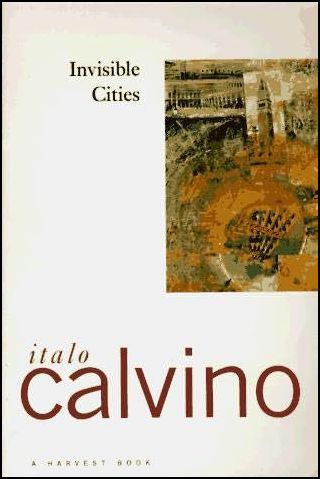
I purchased the book
Invisible Cities, by Italo Calvino, after hearing one of the author's short stories on an
episode of Radiolab. I was completely mesmerized by the story and wanted immediately to read more by the author. I chose
Invisible Cities because the premise just seemed so fascinating. It's based on imagined conversations between famed explorer Marco Polo and the emperor Kublai Khan. Each section begins and ends with bits of conversation between the two men and each short chapter is Marco Polo's description of a different, fantastical city that he has visited within Kublai Khan's realm.
I should say right from the start that there is no plot in this book. This was a surprise to me and I was on uneven footing through the first few chapters, unsure of whether I was reading the book correctly or if I had missed something major, or
what happened. It also isn't a book with great characters. While Marco Polo and Kublai Khan to us are larger than life and would be expected to dominate the narrative, they do not. You learn about them in subtle ways, through their conversations and their descriptions of cities, but you do not know them any better than they
want you to know them and they are not the stars of this collection.
This short book, more than anything else, is about the power that words have to evoke a setting, utterly and completely. The cities that Marco Polo describes do not exist, but
gosh, you wish they did. This is where Calvino's genius for description, for using just the right word to get across exactly what he wants the reader to take away, really comes through. I wish I could read Italian because I can't help feeling that
something must have been lost in translation. This is not because I read a bad translation - I didn't, the language was beautiful - but because I feel like each word was chosen with such care that I would like to read the book in Calvino's chosen language. In a way, I felt like each chapter was a poem. They were all so short - between two and three pages long - and they evoked such a sense of nostalgia for places that do not even exist, and with such a succinct use of words - that they felt very poem-like to me.
I read this book while traveling, which I think was ideal. As you walk around unfamiliar places, I think you notice things that the locals ignore or don't think about any more, and you are very aware of how the city
feels and what its personality is. Calvino takes that feeling to an extreme by making his cities as magical as possible so that you have a sense not just of the physical attributes of the city, but the more nebulous aspects, too - the atmosphere and vibe that are so hard to describe to other people.
And each chapter is such a delight. I don't want to ruin the experience of reading something so different for you, but I
do want you to get a sense of what is waiting for you. There's one city that exists on a spiderweb. One that is built in men's dreams of chasing a woman. One that has only the plumbing but none of the buildings. One that is built entirely on massive stilts. So many inventive and creative places to visit!
I admit this book wasn't what I was expecting. I really wanted to read a novel by Calvino and this is certainly not a novel. I was disappointed at the lack of characters and plot and context. But I can still get a novel by Calvino and enjoy that. This was a different, completely new, kind of treat, and I think if you go into the book knowing that it really is just a series of vignettes that describe cities you wish truly were in our world, then you would really enjoy it. The language is beautiful, and the cities - I wish there were accompanying illustrations for each chapter!