Showing posts with label adventure. Show all posts

Thursday, March 12, 2015

A true fantasy winner from my bookshelf

I am not sure how long I have owned Lynn Flewelling's Luck in the Shadows.  I entered it into my
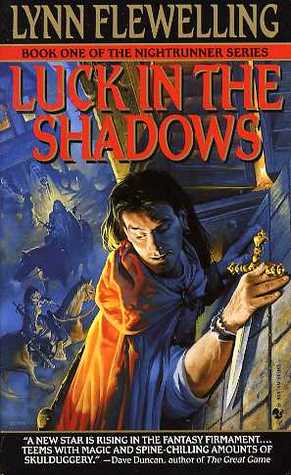
Luck in the Shadows, by Lynn Flewelling
LibraryThing account on December 18, 2006, which is quite early in my LibraryThing account history, so I've owned it for at least 8 years, if not more.  In the many shelf purges that have occurred since then, I never got rid of Flewelling's books because she is rated so highly by fantasy fans.  And, for me, winter is the perfect time for a quality epic fantasy novel.  I love to become immersed in the worlds and the cultures and the struggle of good vs. evil.  So when I saw that Luck in the Shadows was available for download as an audiobook, I decided it was finally time for me to read it.

I was nervous that my tastes had changed too much for me to enjoy this one still, but that was not true at all.  While I don't read epic fantasy as much as I used to, I still love authors who thoughtfully develop strong, multi-dimensional characters who live in rich, developed worlds.  Lynn Flewelling does both those things, and she reminded me of why I love fantasy writing so much.  The customs and cultures and religions and folklore that she brought to life here all pulled me completely into the story and kept my attention the whole way through.

The story centers on two characters, Alec and Seregil.  They meet in prison, escape together, and then get along so well that Seregil makes Alec his apprentice (though Alec is vague on the details of what exactly Seregil does).  The two set off for adventures in distant lands, steal something that looks pretty small but ends up causing them a lot of trouble (a la The Hobbit), and then spend a lot of time trying to understand why that thing is so important and trying to solve a big political mystery.

Along the way, readers meet many other wonderful characters, such as Micum and Nysander, two of Seregil's closest friends and advisors.  We also get to explore a beautiful, multi-faceted world.

One of my absolute favorite things about this story was the way Flewelling weaves so many things that are important to me.  For instance, Seregil's country is led by women, and this seems completely natural to him.  Women fill many roles, from military adviser to queen to innkeeper to wizard to traitor, and they fill all of those roles well.  This is so rare in fantasy novels, and I appreciated it so much.  While none of the main characters is female in this book (bummer), the world is very much one in which both sexes have power and respect.

I think it's due to that fact that the romantic relationships are also more fluid in Flewelling's world.  Alec and Seregil are great friends but you can see how that friendship will develop deeper into romance in the future.  The red light district in town appeals to people of all tastes equally.  I loved that Flewelling made a point of stating that the houses catered to both men and women, and to people who preferred both men and women.

I loved so many, many things about this book.  It truly is exactly the sort of fantasy novel that I've always loved and will continue to seek out.

To give fair warning, Luck in the Shadows is the first book in a duology and it ends rather abruptly.  Luckily, the book was published in the 1990s, so you need not be frustrated for long.  Enjoy!

Thursday, December 12, 2013

Rabbits on the run

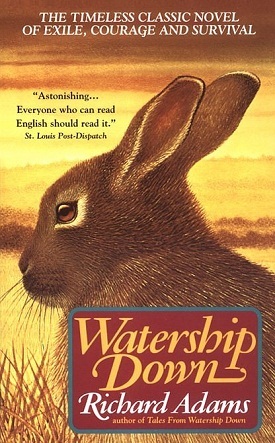
Watership down
I did not know Watership Down was only published in the 1970s.  For some reason, I always assume books of this nature were written very early in the 20th century.  I also didn't know that Watership Down had political commentary in it about the way governments are run, but it does.  What is with me recently and reading all these books about political activism?  Animal Farm, The Jungle, etc.  It is a lot of heavy reading to close out the year.

In case you don't know the story, Watership Down is about a group of rabbits who leave their warren and try to establish a home of their own.  They encounter all sorts of dangers and mishaps along the way, and set out to save other rabbits as well, mostly those who have lost their wildness due to poor ruling.

Many people have recommended Watership Down to me as one of their favorite books of childhood.  They also really love the movie.  I was pretty excited to read the book even though I generally don't love books that are written from the point of view of animals.  But I decided that if SO MANY people love this book, then I should read it and know what all the gush is about.

I wonder if this is the sort of book you read as a child and then love for the rest of your life because of how immersed you become in the story and the lives of its characters.  Much as I felt about Anne of Green Gables,  as I begged my parents to take me to Prince Edward Island for vacation.  (Alas, they did not do so as no one else wanted to go there.)  But I don't think I'd fall in love with Anne Shirley if I were only to be introduced to her now.  I think I'm past the age when her life seems idyllic and wonderful enough to me that I would want to fully immerse myself in it as a character in the series.

And I think that's what happened with me for Watership Down.  Honestly, the only thing I kept thinking while reading it was, "Seriously, this story isn't over yet?"  I kept thinking that FINALLY the rabbits had made it past a crisis, and then I'd look at my audiobook progress and I was only about 50% of the way done with the story!  It just wouldn't end.

Maybe I didn't love the book because I did it in audiobook format.  There was nothing wrong with the narrator, really - he did a lot of different voices and accents and such.  But a lot of the book was fighting scenes and such, and those never appeal to me and I would have liked to flip past those pages (of which there were several) and get onto the next part.

Also, in his forward, Richard Adams talked about how he wanted to make his rabbits as realistic as possible.  This basically meant that for much of the book, females weren't mentioned and when they were, they were spoken of as objects for reproductive purposes only.  Maybe this is how rabbits really DO act in the wild, but Adams was perfectly fine with having them chat with each other and set up dictatorships and become friends with birds and escape in boats, so I think he could have had a bit more leeway on the female front.

Anyway, this one wasn't a great success for me, but I'm glad I read it.  I do feel like this book has a lot of cultural relevance, so I'm glad I've read it and now understand that it is about a group of animals (and not, er, a battleship/submarine battle, which is what I grew up thinking it was about).

Sunday, December 8, 2013

Allons! Vive le republic!

Scaramouche
I heard about Rafael Sabatini's Scaramouche from Heidenkind when she read it and reviewed it on the Project Gutenberg Project blog.  It sounded like such a swashbuckling and fantastic story!  Plus, it takes place during the French Revolution, which is one of my favorite historical periods to read about (not one that I would ever choose to live through, however).

Scaramouche is the stage name of Andre-Louis Moreau.  Andre-Louis does not know who his parents are but was raised by a man in the French gentility.  After his best friend is killed in a duel by a marquis, Andre-Louis vows revenge and joins the revolution, giving stirring speeches that really get the people going and rioting and mobbing.  Then he becomes an actor and OWNS the stage.  And then he becomes a fencing master and is AMAZING at that.

Basically, Andre-Louis is good at everything he does.  While this generally annoys me in a character, in this situation it did not because, hey, he's a swashbuckling hero who saves France from the aristos, and he does it in style.

This is the sort of story that works best if you devote a weekend to reading it.  I, unfortunately, did not do this, but instead read it in fits and bursts over the course of several weeks.  This often caused me to forget people's names and their relationships to one another and that was to my detriment.  Finally, I powered through half the book in one evening, and then I got completely absorbed and wrapped up in the story.  It was fantastic.

In many ways, Scaramouche is the stereotypical adventure story of a man who rises through society by his wits and his skill and his ability to keep a cool head in a crisis.  But just because a story's arc is fairly predictable, that doesn't mean that it can't also be REALLY fun, and this book is just a LOT of fun.  There are dastardly villains, beautiful heroines, greedy friends, and a tale of pure vengeance.

It's a great read for this time of year, and I highly recommend it if you want a fun and exciting story that will take you back to days of powdered wigs and swords.

Also, there's a movie version.  I must find it!

Thursday, January 31, 2013

Vikings Raid, Find God, and Search for Treasure

The Long Ships
Gosh, this book is fun.  I mean, I knew it was going to be fun but I didn't expect it to be nearly as much as it was.  As usual, the New York Review Books team did a fantastic job of finding a truly fitting cover image as well - I could see Red Orm, the main character, standing on the prow (is that the front of a ship?  I don't know my terminology) and leading his team forth to battle or pillaging or finding treasure in a manner very like the man on the front of this book.

What's this book?  It's The Long Ships by Frans Bengtsson, written in the 1940s about life in the 10th century.  I've had it on my radar for a while and then Eva reviewed it at the end of 2011 and reminded me about it and confirmed its awesomeness.  And then recently Amazon had it on Kindle Daily Deal, so I snatched it up (figuratively, not literally, of course, as it is an e-book) and then I started reading it in India and on my flight back from India.

While I enjoy reading, and often read on planes, I do think that a book needs to be fast-paced for me to enjoy reading it on a plane.  I am not sure why this is so - perhaps because if I am hurtling through the air at 700 miles per hour, I feel that the book I am reading should also be moving super-fast?  The Long Ships does move really fast, for the entirety of its nearly 500 pages.  And it's great fun the whole way through.

Thursday, December 6, 2012

Musings: The Foundling

The Foundling Georgette Heyer
After my great success with re-reading Sylvester by Georgette Heyer, I decided to re-read another book by her, The Foundling.  I chose this one because I rated it very highly on LibraryThing, but I didn't remember many of the details about it except that it was about a very quiet Duke who wanted an adventure away from his overly involved relatives and retainers.

And that is what this book is about!  I would say that this book is not really a romance novel in the way that many of Heyer's Regency novels are.  Yes, there's a man and yes, he falls in love with a woman, but that is in zero ways the main point of this novel.

 The Foundling is a coming-of-age tale.  It has some hints of Understood Betsy in that it's about a very coddled person who has no real idea about how the world works finally going out and realizing that he can fend for himself without anyone's help.  The main character is Gilly, Duke of Sale.  His parents are both dead and he has been brought up by well-meaning but suffocating relatives and servants his whole life.  He is a very kind person who avoids confrontation at all costs and he's small for his age due to being sickly as a child.  But now, as he nears 25 years of age, he's sick of being told what he can and can't do and sets off on his own adventure to help his young cousin out of a dilemma.

What follows is typical of a Heyer novel - the Duke must interact with many middle-class and lower-class people, all of whom are well-written and sparkle with humor.  And in the course of solving any number of small matters and a few very big ones, he comes into his own - he gains confidence, takes charge of situations and very firmly realizes that he does not have to answer to anyone.  And what's so wonderful about Gilly is that he does all this without ever becoming unkind or arrogant - he stays just the way he always was, but just asserts himself more.

On this read-through, I didn't love The Foundling as much as I did when I was younger.  And maybe that's because when I was younger, I could understand Gilly wanting to go out and experience the world for himself and learn more about his own limits.  This time, I was more aware of the stereotypical beautiful blonde bimbo and the high-handed ways in which aristocrats dealt with lower-class women.  But Gilly himself was nothing but kind and loveable, and perhaps this book suffered a bit for me after the high I experienced re-reading Sylvester and falling even more in love with it than I had the first time.  Regardless, these two books have made me realize that I have many, many Georgette Heyer novels - and Terry Pratchett novels, and Jane Austen novels, and so many others! - that I can re-read and immerse myself in once more, and that in itself is a great treat!

Thursday, October 11, 2012

Musings: The Lost City of Z

The Lost City of Z
David Grann's The Lost City of Z has been on my radar for a while, but came to the fore recently after I read 1493.  I wanted to learn more about the ancient Americas and the civilizations that thrived there, and Grann's book seemed like a good introduction to the topic.

I listened to The Lost City of Z on audiobook, a format I've found can either be really good or really bad for me.  I have the propensity to let my mind wander while driving to work or working out at the gym.  This is generally not a good idea with non-fiction titles as I lose track of chronology and the cast of characters and then struggle to get back into the groove of the book.  That happened to me with this book, too.  While I found the parts I did pay attention to absolutely absorbing, I must admit that there are some characters who seemed to show up out of nowhere to me and others that disappeared without a trace, and I'm sure that is due to my lapses in attention.

Thursday, August 16, 2012

Musings: The Warrior's Apprentice

The Warrior's Apprentice
I first heard about Lois McMaster Bujold's on a Yahoo! Group dedicated to Dorothy Dunnett's Lymond Chronicles and House of Niccolo novels. Miles Vorkosigan is often compared to Francis Crawford of Lymond, and after reading The Warrior's Apprentice, I can completely understand the comparison.  Both Miles and Francis have a lot of gumption for aristocratic teenagers.

I finally got my hands on the first book in the (Miles portion of the) Vorkosigan series via audiobook download!  I have no idea when I will read the next book in the series because the library sadly doesn't have all the books available in audiobook.  But now I've started the series, and I have plans to finish it, whenever that may be.

So what's the book about?  Miles Vorkosigan is a stunted and crippled 17-year-old who fails the physical exam to join the Imperial Army, so sets off on a trip to see his grandmother on a distant planet instead.  When he arrives on Beta colony, he somehow gains control and ownership of an outdated airship, a deserter from the Barrayaran army, and a commission to deliver weapons to a region in the midst of a horrible, long-running war.